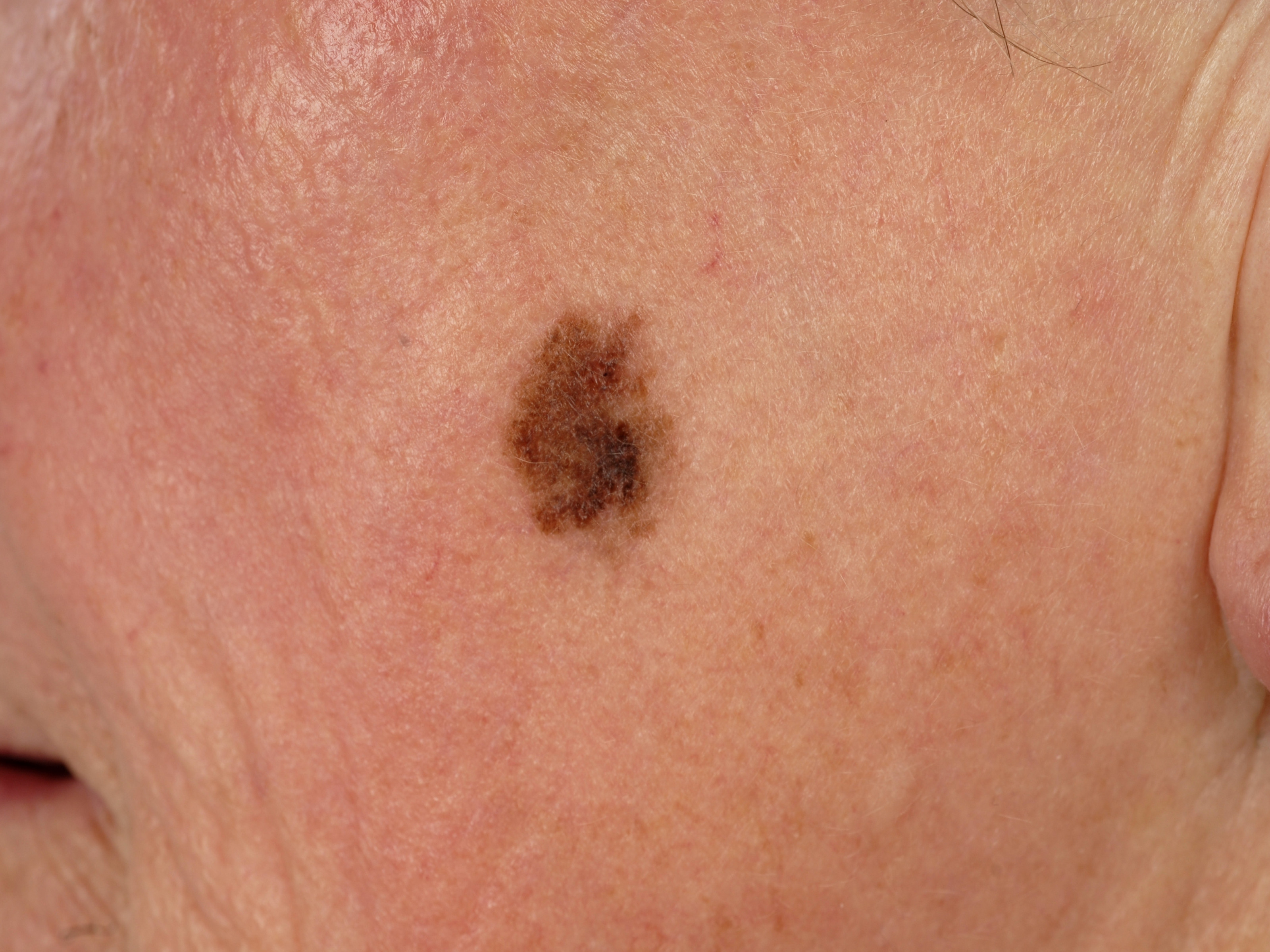
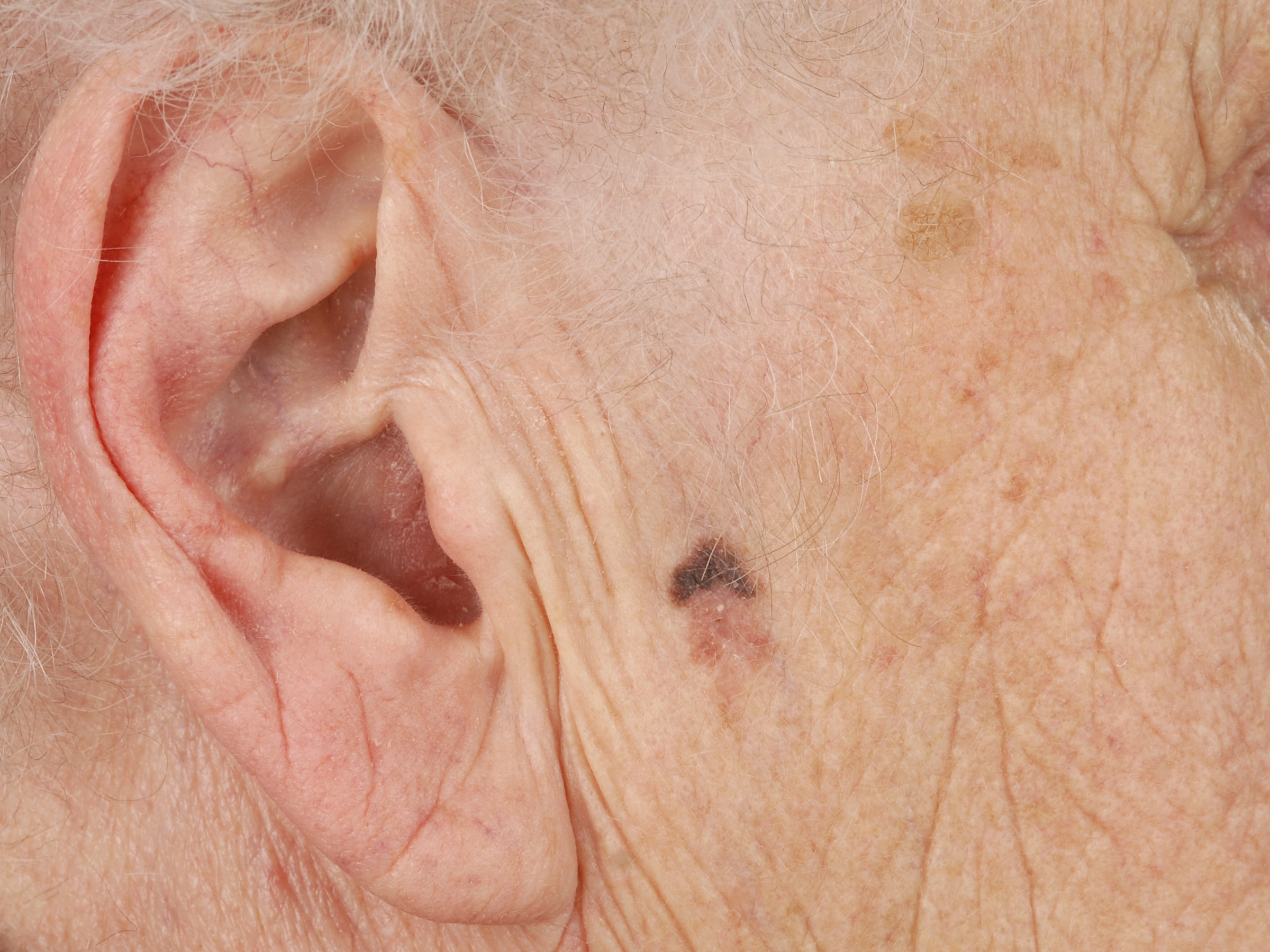
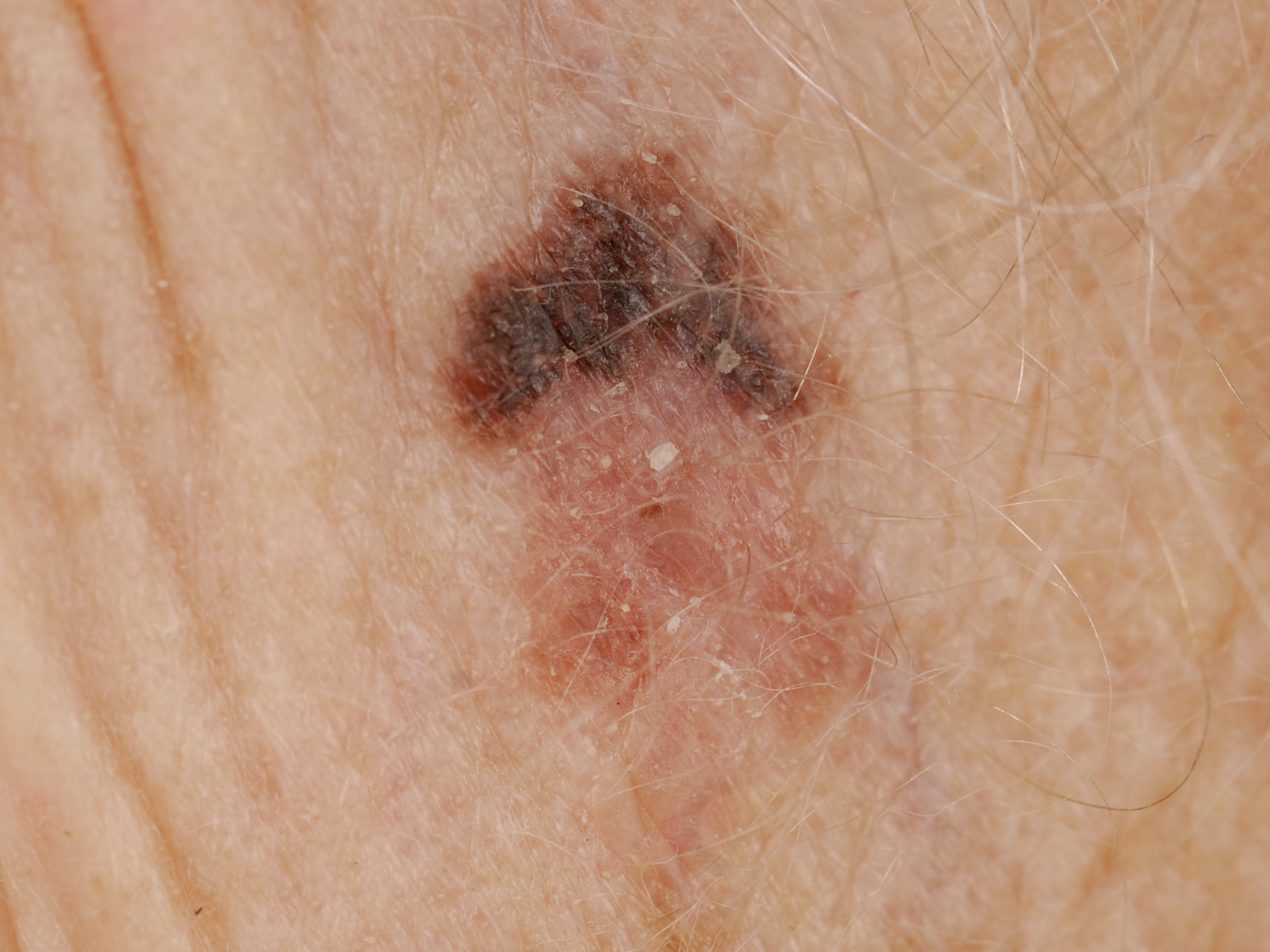
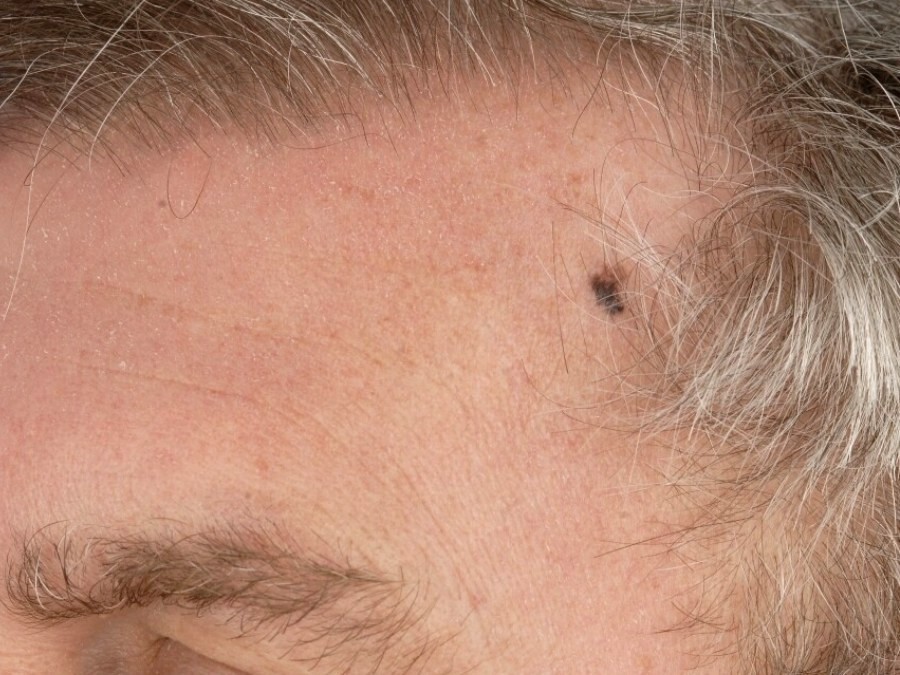
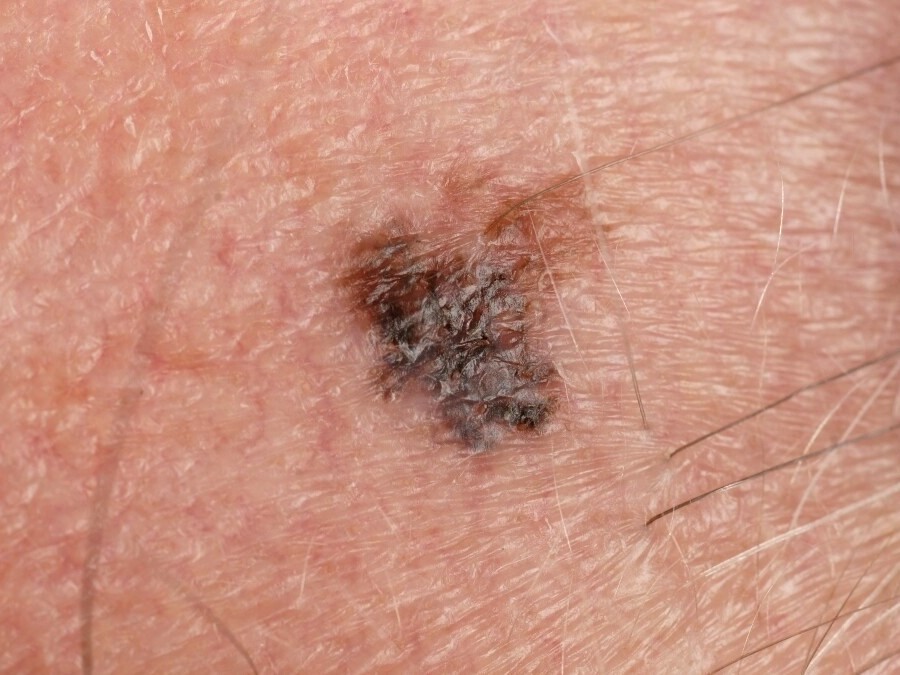
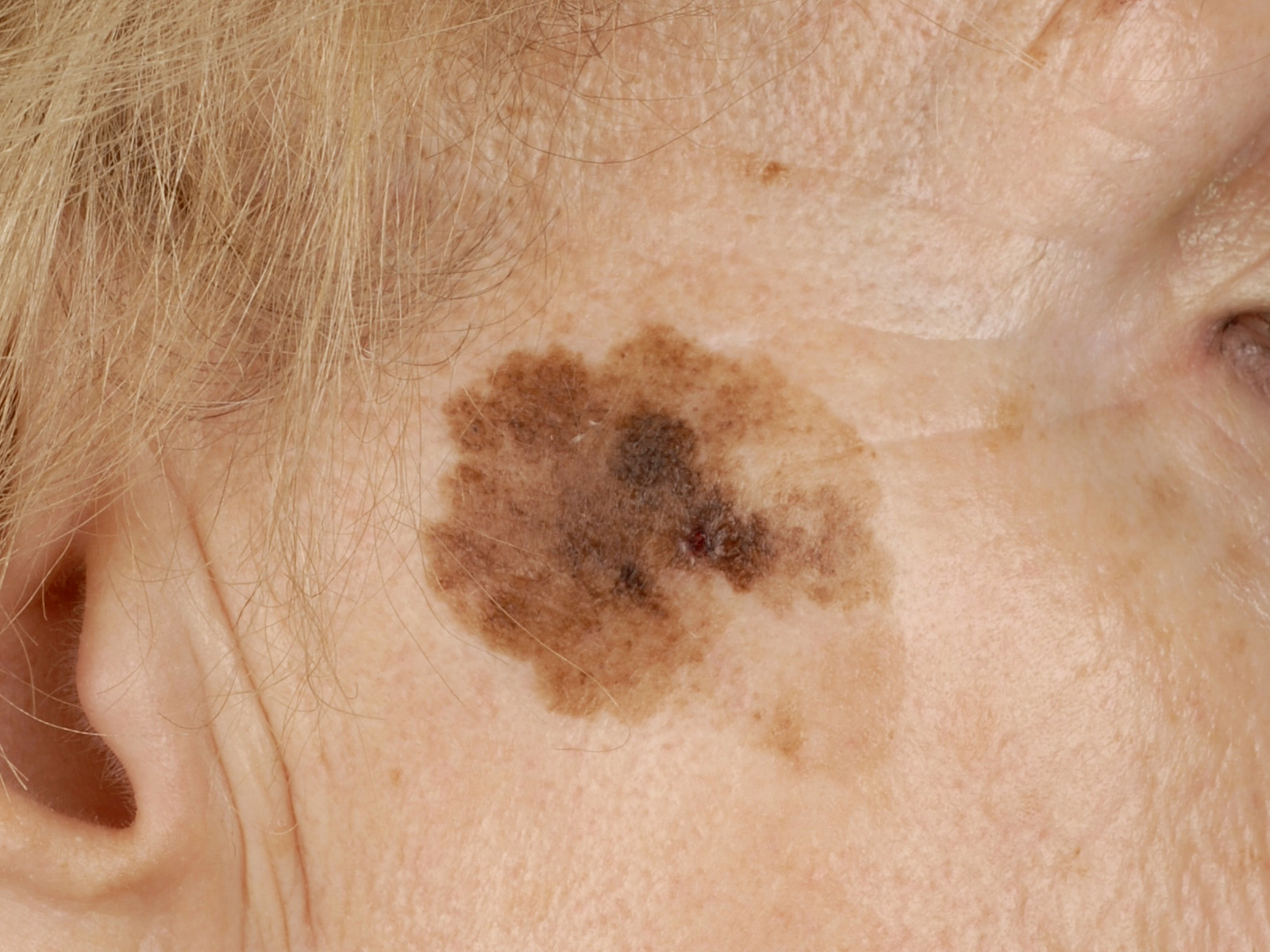
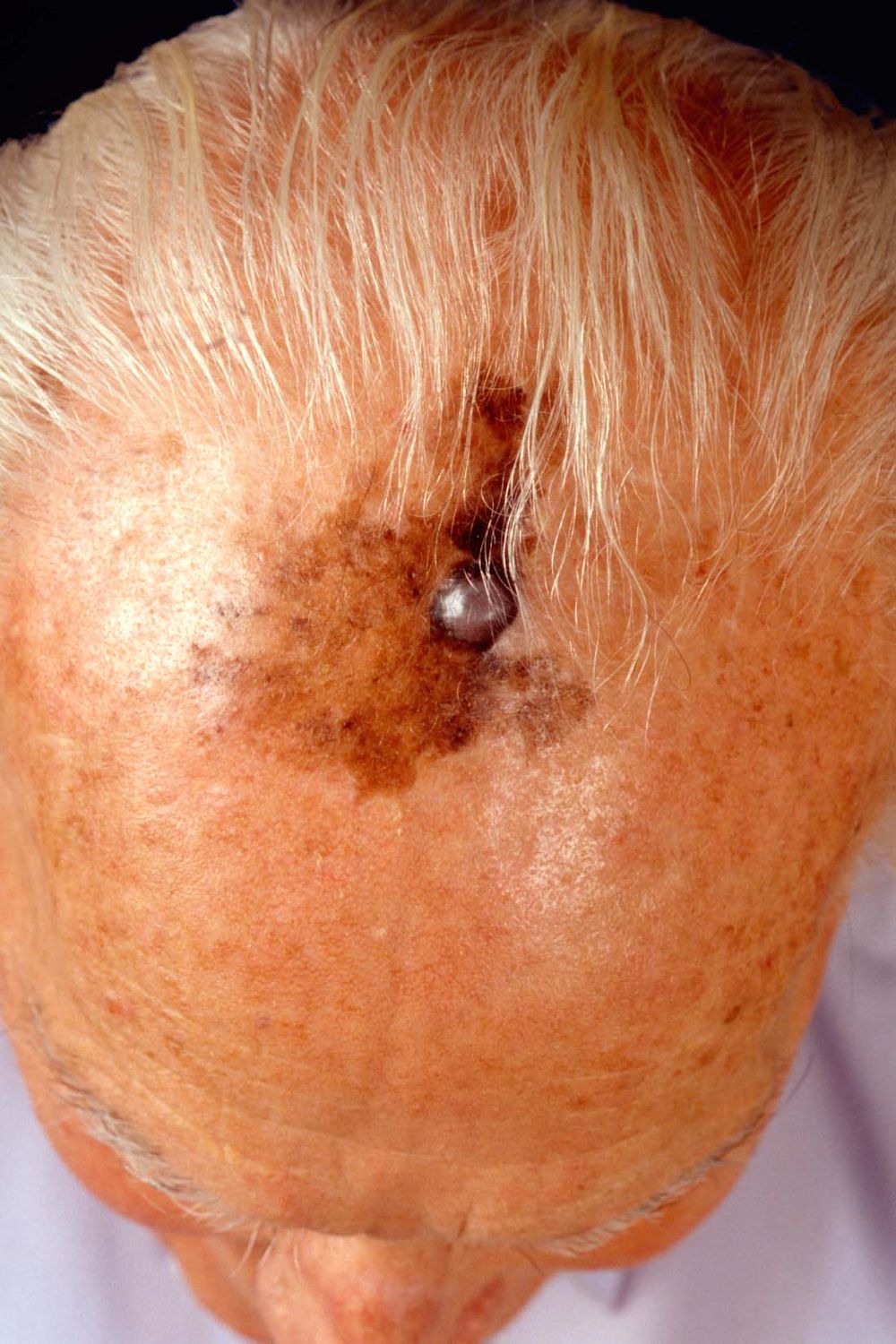
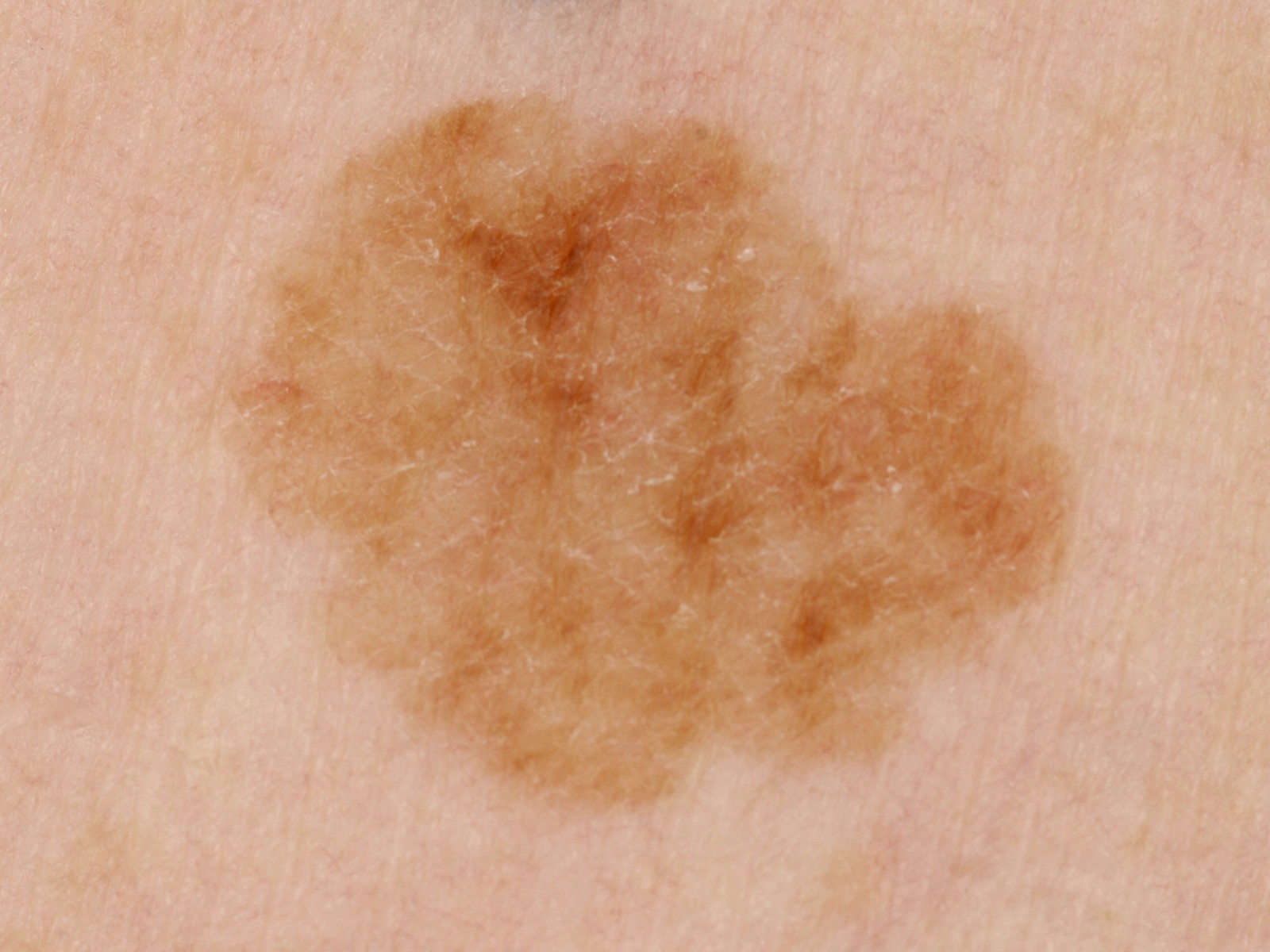
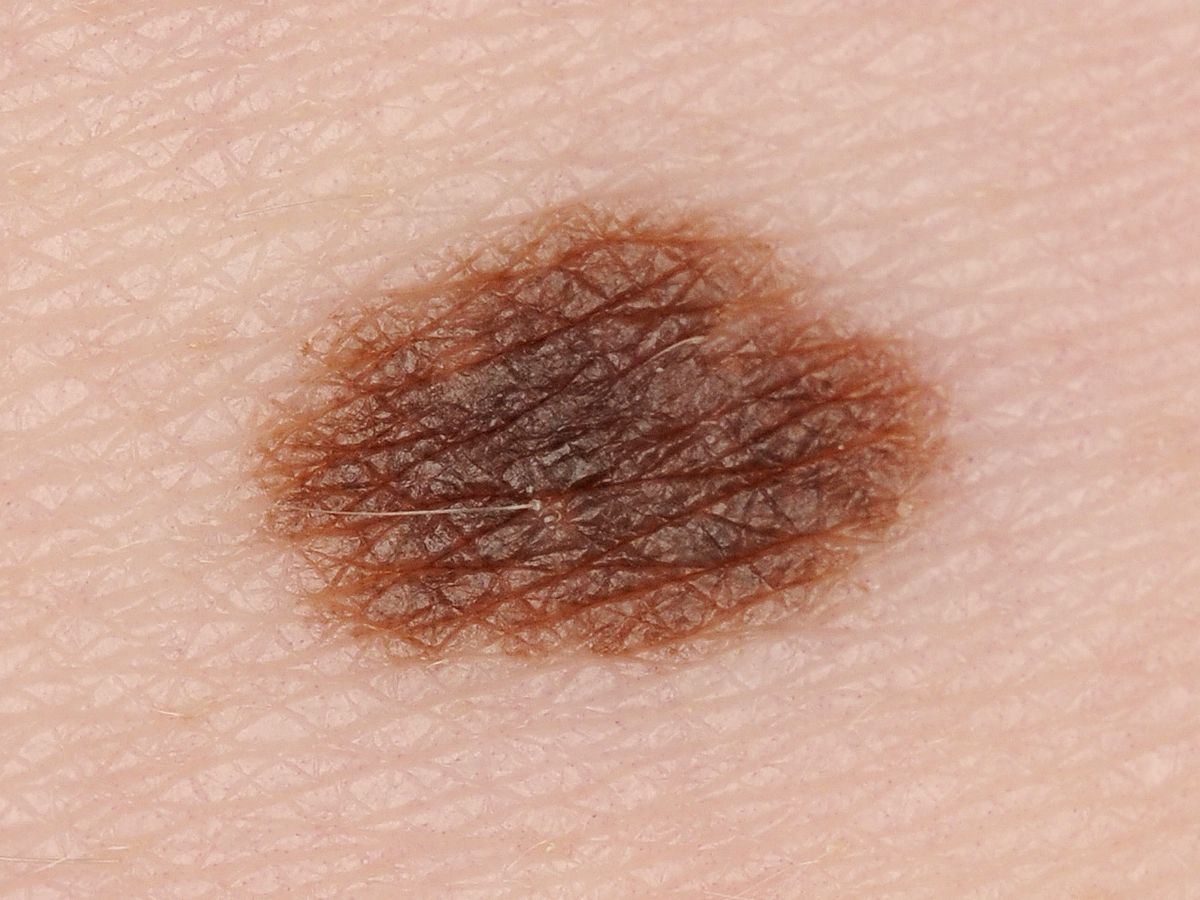
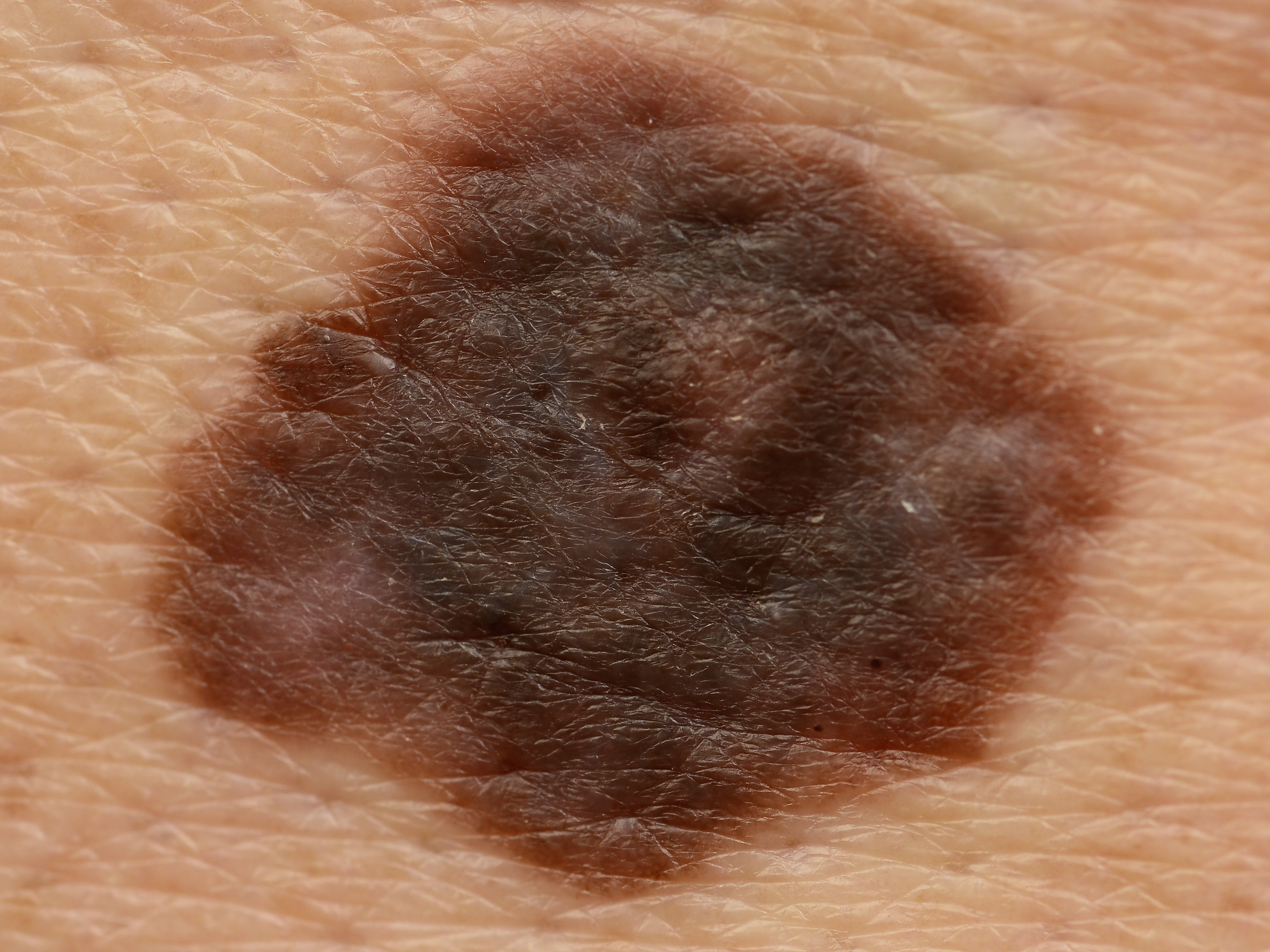
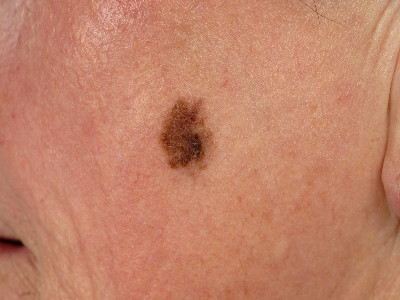
WHAT IS A LENTIGO MALIGNA?Lentigo maligna is a superficial form of skin cancer, originating from pigment cells. Pigment cells (melanocytes) are found throughout the skin. These cells give the skin its color and also protect it from sunlight. These pigment cells can suffer DNA damage, usually due to prolonged exposure to sunlight, particularly UVB radiation, and then start to grow unchecked. In lentigo maligna, the tumor cells are only in the superficial part of the skin, the epidermis. Sometimes, the tumor cells also penetrate into the deeper part, the dermis. This is not easy, because between the epidermis and the dermis lies a strong connective tissue layer called the basement membrane. If the tumor cells are found deeper than this basement membrane, it is called a lentigo maligna melanoma : a melanoma that originates from a lentigo maligna. The chance of a melanoma developing from a lentigo maligna is approximately 2-3%.WHO IS AT RISK OF GETTING LENTIGO MALIGNA?Lentigo maligna occurs primarily in older adults, over 60, and particularly in people who have spent a lot of time in the sun. It is most common in areas that have been frequently exposed to the sun, such as the face. People with fair skin are at a higher risk of developing lentigo maligna or lentigo maligna melanoma. It is rare in people with darker skin, as they are better protected from sunburn. Approximately 4 out of every 100,000 people develop lentigo maligna each year.WHAT DOES A LENTIGO MALIGNA LOOK LIKE?Typically, a brown, black, or gray spot develops on the face, with an irregular shape. Sometimes a spot contains multiple colors, light brown and dark brown or black. Lentigo maligna can also develop on other parts of the body, especially in sun-exposed areas. The spots gradually enlarge over the years but cause few symptoms. There is no pain or itching.
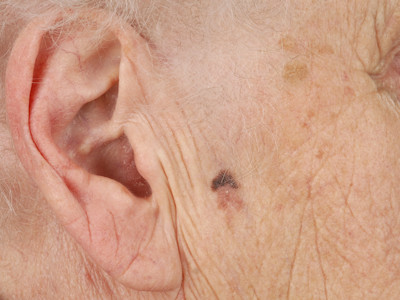
If a melanoma develops in the spot, a thicker section is usually visible, either protruding or growing deeper, which can cause pain.
 |
 |
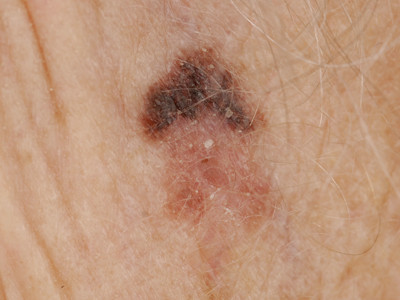 |
| lentigo maligna |
lentigo maligna |
lentigo maligna |
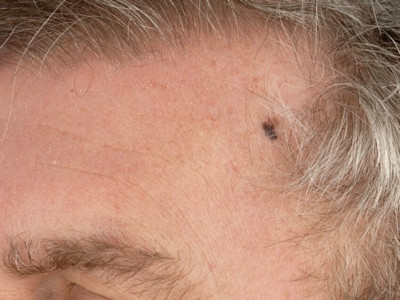 |
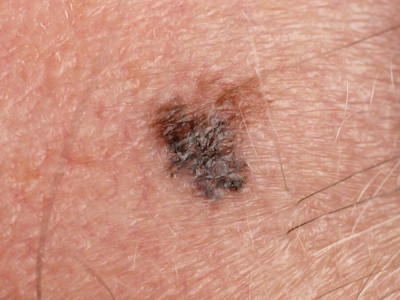 |
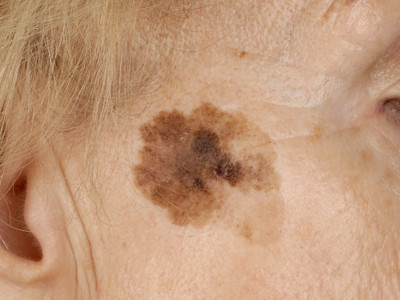 |
| lentigo maligna |
lentigo maligna |
lentigo maligna |
IS LENTIGO MALIGNA DANGEROUS?A lentigo maligna itself isn't dangerous, but it can develop into a melanoma, a dangerous form of skin cancer. A melanoma can grow deeply and spread to lymph nodes and other organs, and it can be fatal. Therefore, it's usually recommended to remove a lentigo maligna as a precaution, if possible. The chance of a melanoma developing in a lentigo maligna is approximately 2-3%. For someone over 65, the chance is approximately 2.2%; for someone who developed a lentigo maligna at a younger age (from 45), the chance is slightly higher, at approximately 4.7%.
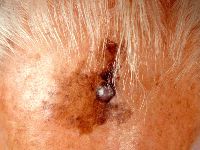 |
melanoma, arising in a
lentigo maligna |
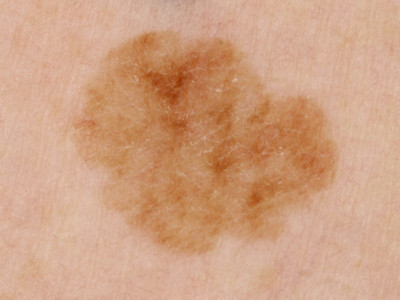
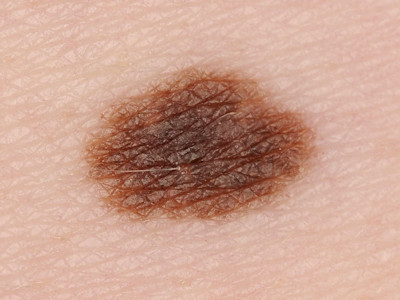
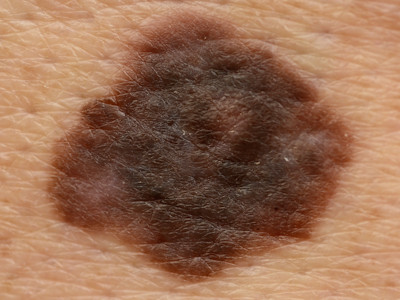
HOW IS LENTIGO MALIGNA DIAGNOSED?Based on the location and appearance of the spot, its shape, and color, your doctor may suspect lentigo maligna. Using a dermatoscope (a special magnifying glass with good lighting) can reveal this even more clearly and distinguish between lentigo maligna and other skin conditions that can strongly resemble lentigo maligna, such as a solar lentigo, a naevus naevocellularis, a melanoma ( melanoma malignum), or a seborrheic verruca (verruca seborrheica). An age spot (solar lentigo, senile lentigo) is a benign pigmented spot in older adults that does not develop into melanoma. Age spots are usually a uniform light brown and not as irregularly shaped.
 |
 |
 |
| age spot |
birthmark |
melanoma |
If lentigo maligna or melanoma is suspected, tissue samples must be taken for examination in the pathology laboratory. If possible, the entire lesion is removed, leaving a small rim of healthy skin around it. This allows the pathologist to assess the lesion as a whole. Sometimes a lentigo maligna is very large, and it's not possible to remove the entire lesion for examination. In that case, a skin biopsy (sample) is taken from the area that appears most disturbed.HOW IS LENTIGO MALIGNA TREATED?The most effective treatment is to excise the entire lesion, leaving a small margin (5 mm) of healthy skin around it as a safety margin. The entire area is locally anesthetized with anesthetic injections around and under the lesion, and then excised. The wound is then sutured. If the lesion is very large, skin from another area may need to be used to close the hole. The excised skin is sent to a pathologist, who examines it under a microscope to ensure it has been completely removed. If any tissue remains in the margin, this area can still be removed. Lentigo maligna can recur after surgery in a small number of patients.
The pathologist examines the entire lesion to ensure no lentigo maligna melanoma has developed. Melanoma is treated differently; it is excised with a wider margin of 1 cm, and additional examination of nearby lymph nodes is often necessary. Additional treatments are sometimes also required. See the brochure on melanoma for more information .
Sometimes a lentigo maligna is very large or located in difficult areas of the face, making surgical removal difficult. In that case, alternative treatments are available, such as radiation therapy (radiotherapy), treatment with a cream (Aldara cream, imiquimod), or freezing with liquid nitrogen (cryotherapy). The latter two methods are less effective than surgery or radiation therapy.
Radiation Therapy (Radiotherapy)
Radiation therapy is an effective treatment if the area cannot be excised because it is very large or located in difficult-to-operate areas, such as near the eyes or on the nose. Radiation therapy is not administered all at once, as that would cause too much damage. It is divided into several smaller doses, so you will need to visit the hospital several times.
Aldara (imiquimod) cream
Imiquimod cream stimulates the body's own immune system. The immune system cells then eliminate the malignant cells. This is effective for various superficial forms of skin cancer, including lentigo maligna. However, it must be applied to the affected area continuously, every day for three months. Studies show approximately 77% effectiveness with 6-7 applications per week, for a total of at least 60 applications. Redness, swelling, and peeling of the skin occur at the application site, and sometimes the skin breaks out. These inflammatory symptoms are part of the treatment, but they can sometimes make it difficult to maintain the treatment for 3 months.
Nitrogen freezing (cryotherapy)
Cryotherapy involves freezing the area thoroughly twice. If necessary, the skin is first locally anesthetized. After freezing, a blister, redness, and swelling may develop, and sometimes a frostbite or ulcer. The effectiveness of freezing is less effective than other methods and depends primarily on the depth of the freezing.
It's also possible not to treat a lentigo maligna, for example, in old age or if there are other reasons for not treating it. It's always a good idea to discuss whether treatment is truly necessary, especially since the risk of developing melanoma is less than 5%. Waiting and monitoring the area is also an option.IS A POST-INSPECTION NECESSARY?Regular follow-up is officially not necessary if a lentigo maligna has been completely removed. Thin melanomas also do not require follow-up, and a lentigo maligna is much less dangerous than a thin melanoma. Keep a close eye on the area and surrounding area and schedule an appointment if any changes or new dark spots are visible.WHAT IS THE PROGNOSIS?The prognosis is good; the risk of melanoma developing in a lentigo maligna is small, and the risk of metastasis is even smaller. However, recurrence is common, often at the edge of the excised area.WHAT CAN YOU STILL DO YOURSELF?Check your skin regularly and see a doctor if you have any concerns. Early detection makes treatment easier because the area is still small. |