Malignant fibrous histiocytoma, new name:
undifferentiated pleomorphic sarcoma, is a soft tissue tumor,
a sarcoma, that occurs in adulthood (ages 10-90, peaking at 50-70). It is the
most common sarcoma in adults, accounting for 5-10% of all sarcomas. It usually
occurs in the legs, especially the thigh, but can also arise in numerous other
organs and even retroperitoneally. The tumor originates from primitive mesenchymal
cells that do not differentiate in any specific direction and is often located
in fascia or muscle. It occurs primarily in Caucasians; the male-to-female ratio
is approximately 2:1. Clinically, it presents as a painless, slowly growing
swelling of 5-10 cm, usually in the thigh. It is a dangerous tumor that can
metastasize, especially to the lungs. The 5-year survival rate for tumors <
5 cm is around 80%, between 5 and 10 cm it is 65%, and for tumors > 10 cm it
is around 45%.
There are two variants:
superficial and
deep. Superficial tumors are confined to the dermis
and subcutaneous tissue, have a better prognosis, and metastasize less frequently.
They may be provoked by damage of the skin (scars, ulcers, radiotherapy). These
rare superficial variants are primarily seen in dermatology. Deep tumors are
much more common (90%), are usually located in striated muscle tissue of the
extremities, and have a poor prognosis. They can metastasize to the lungs, lymph
nodes, bones, liver, and other organs.
Currently, most pathologists prefer
the term
pleiomorphic sarcoma to
malignant
fibrous histiocytoma because immunohistochemical analysis shows
that these lesions can be several different pleiomorphic sarcomas, such as pleiomorphic
liposarcoma, pleiomorphic leiomyosarcoma, and pleiomorphic rhabdomyosarcoma.
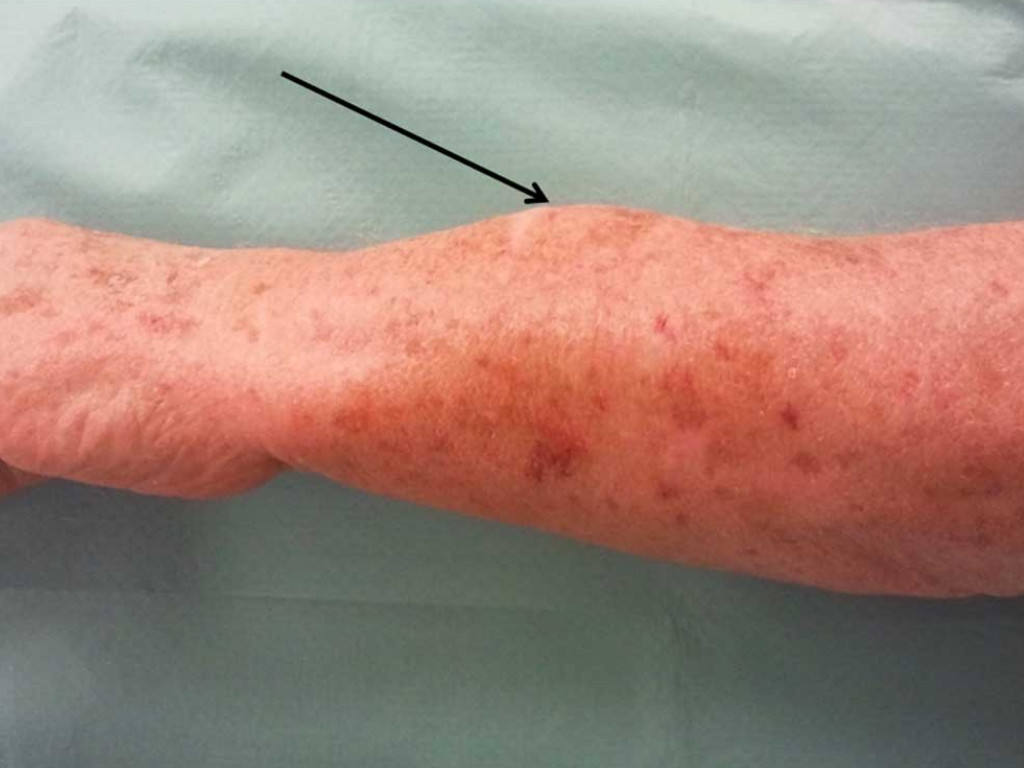
 |
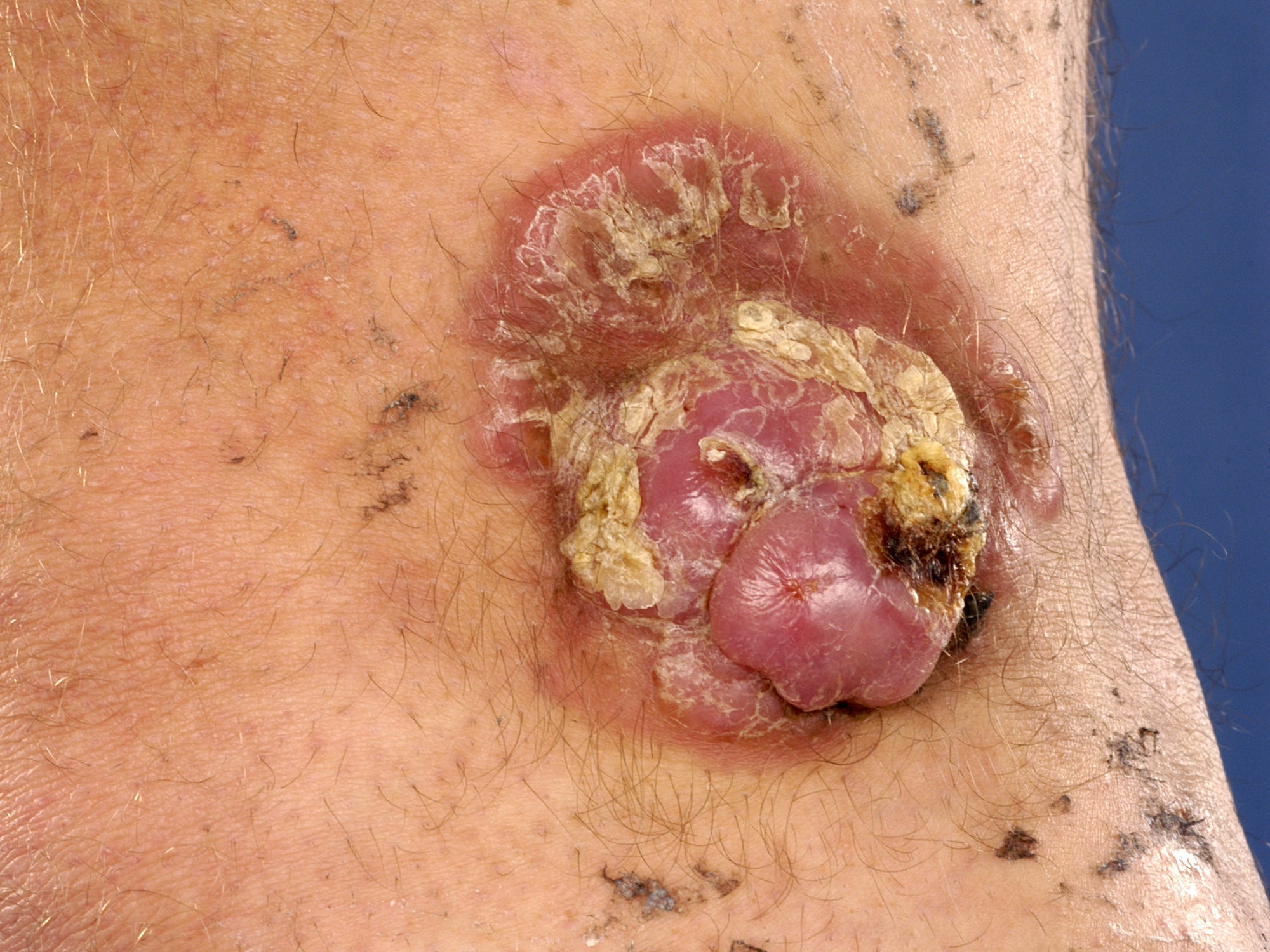
 |
| malignant
fibrous histiocytoma |
malignant
fibrous histiocytoma |
Photo left: D'Orazi V - Mol clin oncol 2015;31251-1254 - Public Access
Journal - Creative Commons License
4.0
DD:Other soft tissue sarcomas,
pleomorphic dermal sarcoma
(primary cutaneous localization of an undifferentiated pleomorphic sarcoma),
atypical fibroxanthoma,
dermatofibrosarcoma protuberans,
leiomyosarcoma,
angiosarcoma,
fibrosarcoma, liposarcoma, myxofibrosarcoma,
osteosarcoma, malignant peripheral nerve sheath tumor, metastases,
desmoplastisch melanoma,
spindle-cell squamous cell carcinoma.
Therapy:

Wide surgical
excision. Radiotherapy and chemotherapy may contribute to survival. Caution
is advised when performing the excision; there is a case report in which the
tumor was transferred to the surgeon through an incision during surgery.
Additional radiotherapy may be administered before or after surgical excision.
Various chemotherapeutic agents are used, such as doxorubicin alone or in combination
with ifosfamide, gemcitabine, docetaxel, and others. The effect is disappointing.
Newer studies are underway combining chemotherapy with pembrolizumab or nivolumab.
Patients are best referred to an oncology center with expertise in soft tissue
tumors.
| AJCC Staging System for Soft Tissue Sarcoma of the Extremity
or Trunk |
| TNM |
| T1 |
|
Tumor ≤ 5 cm in greatest dimension |
| T2 |
|
Tumor > 5 cm and ≤ 10 cm in greatest dimension |
| T3 |
|
Tumor > 10 cm and ≤ 15 cm in greatest dimension |
| T4 |
|
Tumor > 15 cm in greatest dimension |
| N0 |
|
No regional lymph node metastasis or unknown lymph node
status |
| N1 |
|
Regional lymph node metastasis |
| M0 |
|
No distant metastasis |
| M1 |
|
Distant metastasis |
| |
|
|
| Histologic criteria |
| G1 |
|
Low-grade (grade 1) |
| G2 |
|
Intermediate-grade (grade 2) |
| G3 |
|
high-grade (grade 3) |
| |
|
|
| Stage groups |
| IA |
|
T1; N0; M0; G1 |
| IB |
|
T2, T3, T4; N0; M0; G1 |
| II |
|
T1; N0; M0; G2/3 |
| IIIA |
|
T2; N0; M0; G2/3 |
| IIIB |
|
T3, T4; N0; M0; G2/3 |
| IV |
|
Any T; N1; M0; any G Any T; any N; M1; any G |
|
Nomenclature: Malignant fibrous histiocytoma, undifferentiated
pleomorphic sarcoma, pleomorphic dermal sarcoma, or atypical fibroxanthoma?
An
atypical fibroxanthoma is a tumor that often
develops on the face of the elderly in sun-exposed areas. There are variants
that are clinically and histologically difficult to distinguish from a superficial
form of
malignant fibrous histiocytoma /
pleiomorphic sarcoma. There is debate about whether an atypical
fibroxanthoma is a single entity or a superficial variant of a malignant fibrous
histiocytoma / pleiomorphic sarcoma. Clinically, there are major differences,
because atypical fibroxanthoma is a red, spherical, erosive tumor and the prognosis
is good (recurrence after excision approximately 7%, low mortality) compared
to MFH / pleiomorphic sarcoma (43% recurrence). Histologically, the distinction
is difficult to make, even with immunohistochemical staining (perhaps CD74,
which is strongly positive in MFH / pleomorphic sarcoma and weakly in atypical
fibroxanthoma).
In newer classifications, the term
superficial
variant of malignant fibrous histiocytoma is no longer used; the
new preferred term is
undifferentiated pleomorphic sarcoma,
or
pleomorphic dermal sarcoma. The WHO (World Health
Organization) also recommends deprecating the term malignant fibrous histiocytoma,
because cytogenetic and molecular research has shown that it is not a single
entity but rather a kind of catch-all group. In the past, various tumors, particularly
different types of sarcomas, were classified as malignant fibrous histiocytoma,
but these would now be called differently.
The WHO now distinguishes
five different
undifferentiated/unclassified sarcomas:
| 1. |
|
Undifferentiated spindle cell sarcoma |
| 2. |
|
Undifferentiated pleomorphic sarcoma (previously classified
as malignant fibrous histiocytoma) |
| 3. |
|
Undifferentiated round cell sarcoma |
| 4. |
|
Undifferentiated epithelioid sarcoma |
| 5. |
|
Undifferentiated sarcoma not otherwise specified |
Dermatologists usually do not see the deep presentations of undifferentiated
pleomorphic sarcoma, formerly known as malignant fibrous histiocytoma, in muscles,
retroperitoneally, in bones, or in other organs. They see only the rare
primary cutaneous presentations,
pleomorphic
dermal sarcoma, and its benign variant,
atypical fibroxanthoma.
Atypical fibroxanthoma is confined
to the dermis and does not invade the depths or vessels.
Pleomorphic dermal sarcoma
does grow deeply into the subcutaneous tissue and can metastasize. Both occur
in old age and are often found on the face.
Some authors (Cohen PR, 2020)
argue that for these unusual cutaneous locations the terms
pleomorphic
dermal sarcoma and
atypical fibroxanthoma
should be retained and that the umbrella term
undifferentiated pleomorphic
sarcoma should not be used.
References
| 1. |
Gärtner HV, Seidl C, Luckenbach C, Schumm
G, Seifried E, Ritter H, Bültmann B. Genetic analysis of a sarcoma
accidentally transplanted from a patient to a surgeon. N Engl J
Med1996;335(20):1494-1496. |
| 2. |
Bose AC, Kate V, Ananthakrishnan N, Srinivasan
S. Primary cutaneous malignant fibrous histiocytoma: a case report.
Med Sci Monit 2006;12(7):CS61-63. |
| 3. |
Cohen PR. Cutaneous undifferentiated pleomorphic
sarcoma is a pleomorphic dermal sarcoma. Dermatol Online J 2020;26(5):13030/qt1tx8b3hr. |
| 4. |
Graves L, Jeck WR, Grilley-Olson JE. A League
of Its Own? Established and Emerging Therapies in Undifferentiated
Pleomorphic Sarcoma. Curr Treat Options Oncol 2023;24(3):212-228. |
| 5. |
Saleh JS, Whittington CP, Bresler SC, Patel
RM. Pleomorphic Dermal Sarcoma. Surg Pathol Clin 2024;17(1):153-158. |
| 6. |
Menon G, Solis-Ledesma G. Undifferentiated
Pleomorphic Sarcoma. 2025 Jun 23. In: StatPearls [Internet]. Treasure
Island (FL): StatPearls Publishing; 2025 Jan–. PMID: 34033374. |
| 7. |
Miwa S, Yamamoto N, Hayashi K, Taniguchi
Y, Yonezawa H, Morinaga S, Demura S. Current and emerging systemic
treatment options for malignant fibrous histiocytoma/undifferentiated
pleomorphic sarcoma. Int J Clin Oncol 2025;30(9):1734-1742. |
Author(s):

dr. Jan R. Mekkes. Dermatologist, Amsterdam
UMC.
 ICD10: C49.9