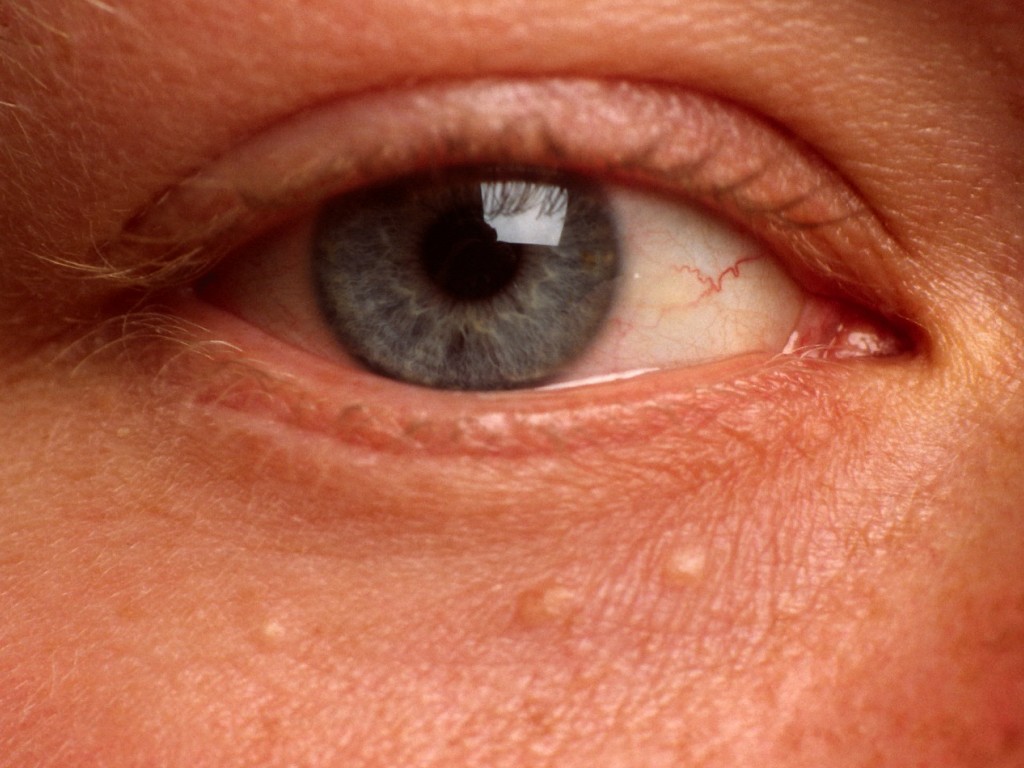
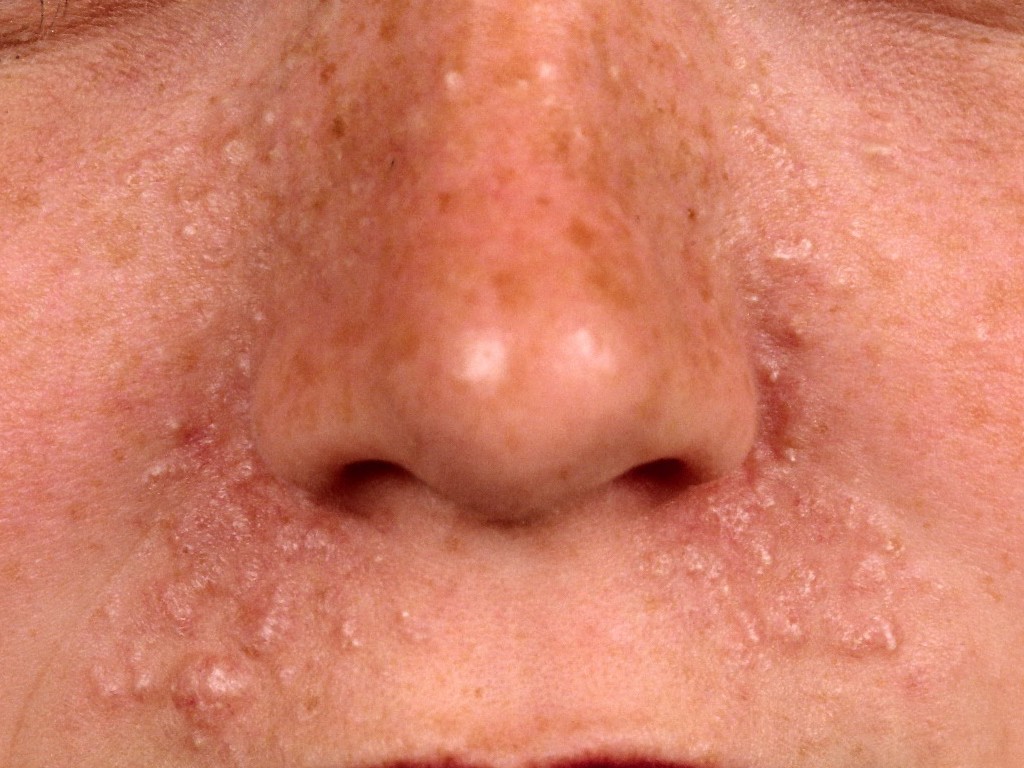
WHAT IS A TRICHO-EPITHELIOMA?A trichoepithelioma is a rare , benign bump on the face that originates from a hair follicle. It can be one or more. They are skin-colored or yellowish bumps . Trichoepitheliomas can already be present in childhood and slowly increase in number and size. From puberty onwards, they usually remain stable. The form in which multiple bumps develop, sometimes very numerous, can run in families. There is also a rare familial syndrome called Brooke-Spiegler syndrome , in which multiple trichoepitheliomas occur along with other bumps on the face.
 |
 |
| trichoepithelioma |
trichoepitheliomas |
WHAT DOES A TRICHOEPITHELIOMA LOOK LIKE?Typically, there are multiple skin-colored or yellowish bumps on the face, several millimeters in size. These bumps are primarily found around the nose, eyes, and cheeks. However, they can also occur all over the face. The trichoepitheliomas are either isolated or clustered. They usually appear in childhood and then gradually enlarge, increasing in number. Alternatively, they may already be present but gradually enlarge and become more visible. From puberty onward, the condition usually remains stable.HOW IS THE DIAGNOSIS MADE?Diagnosis is made by taking a skin biopsy and examining the tissue under a microscope. There are many different types of benign skin-colored bumps on the face, but only under a microscope can it be determined whether a bump is a trichoepithelioma. A trichoepithelioma can closely resemble a basal cell carcinoma , a skin tumor that also commonly occurs on the face. If this is the case, it must be removed entirely.HOW IS A TRICHOEPITHELOMA TREATED?Treatment consists of removal. If there is only one or a few, this can be done through a biopsy, possibly with sutures. But if there are a large number, it becomes a problem. Sometimes it's possible to treat them with a laser (CO2 laser) or electrocoagulation (electrical burning). Because the trichoepitheliomas are not superficial, any treatment will leave some damage and scarring. There is also a risk of recurrence or the development of new trichoepitheliomas.WHAT IS THE PROGNOSIS?The prognosis is good; these are benign abnormalities. The form in which many develop, which can also run in families, is also not dangerous, but it is cosmetically very disturbing and difficult to treat. |