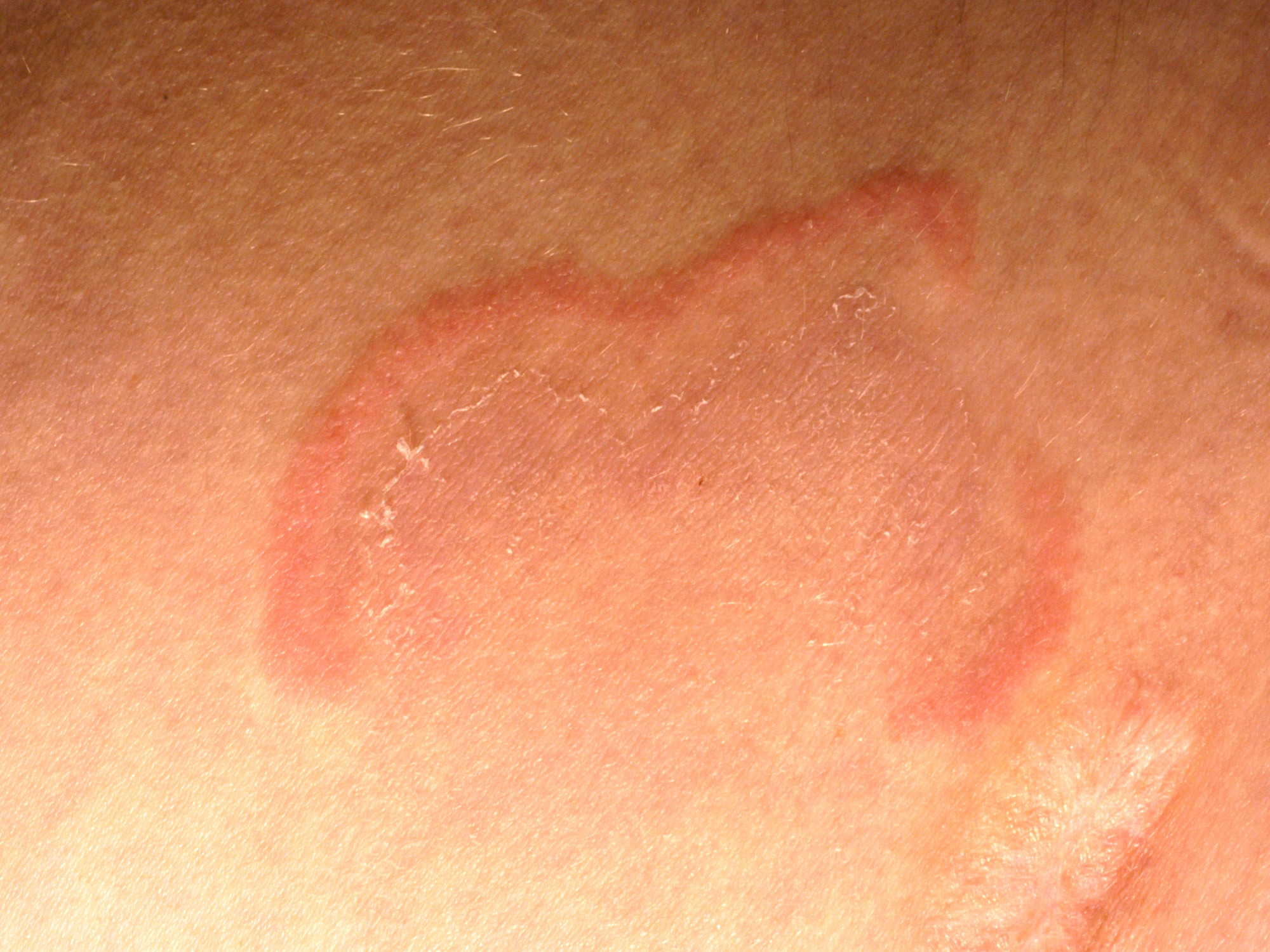
WHAT IS ERYTHEMA ANNULAR CENTRIFUGUM?Erythema annulare centrifugum are red rings that appear spontaneously on the skin and gradually grow larger. They begin as a red bump or spot, which then spreads in all directions, forming a red ring. The ring can grow 2-3 mm larger each day. The outer edge of the ring is sometimes slightly raised, and the inner edge usually has a scaly edge. As the ring grows, this edge shifts along with it. At the same time, the center begins to heal, although a dark discoloration of the skin may remain.
 |
 |
| erythema annulare |
flake edge |
The rings cause few symptoms, only some itching. There is also a deep form of erythema annulare that does not itch and where no scaly edge is visible. Erythema annulare centrifugum can occur all over the body, even on the face, but it is most commonly found on the thighs.
The name erythema annulare centrifugum is descriptive: erythema means red, annular means ring-shaped, and centrifugum means spreading in all directions.WHAT IS THE CAUSE OF ERYTHEMA ANNULARE CENTRIFUGUM?The exact cause is unknown. It is thought to be an allergic reaction to foreign substances that do not belong in the body, such as substances found on fungi or bacteria. Fungi, in particular, are often cited as the culprit. These can include fungi growing on the skin (fungal infections) or fungal spores ingested with food. Besides fungal infections, there is a long list of other conditions in which erythema annulare centrifugum can occur:Conditions in which erythema annulare centrifugum may occur:- fungal infections
- infections with bacteria, viruses, parasites, worm infections
- appendicitis
- urinary tract infection
- thyroid diseases (hyperthyroidism, Hashimoto's disease)
- autoimmune diseases (rheumatism, lupus erythematosus, Sjögren's syndrome)
In addition, the development of erythema annulare centrifugum has been reported with the use of medications (amitriptyline, cimetidine, cotrimoxazole, finasteride, gold salts, hydrochlorothiazide, hydroxychloroquine, ibuprofen, estrogens, penicillin, piroxicam, salicylates, spironolactone).
Cases of erythema annulare centrifugum have also occurred with blood diseases (leukemia, lymphoma, Hodgkin's disease, etc.) and malignant diseases (lung cancer, prostate cancer, colon cancer, etc.). However, this is very rare, so rare that it is not necessary to investigate. In most cases, no cause is found for erythema annulare centrifugum and it goes away on its own.HOW IS THE DIAGNOSIS MADE?The diagnosis can be made based on the clinical picture (how it looks). However, because other skin conditions can also take the shape of a ring (e.g., a tick bite ), it's common to take a skin biopsy . Sometimes, some skin flakes are also examined under a microscope to see if they contain fungal threads. A fungal infection can also be ring-shaped; this is called ringworm .
Sometimes, additional testing, such as blood tests, is necessary. This is done if it could be something other than erythema annulare, such as a tick bite. If you have symptoms that point to an underlying disease or infection, that will also be investigated.HOW IS ERYTHEMA ANNULARE CENTRIFUGUM TREATED?If an underlying condition has caused the skin lesion, it must be treated. Afterward, the lesions will disappear. If no cause can be found (which is unfortunately often the case), the only option is to wait until the lesions disappear on their own. If itching occurs, the lesions can be treated with an anti-inflammatory cream (corticosteroid cream). This will alleviate the symptoms. For very severe cases, corticosteroid tablets (prednisone) are sometimes prescribed.WHAT ARE THE OUTLOOK?The course of the condition varies. Typically, the spots remain visible for a few weeks and then disappear on their own. However, it can also take months or even years. On average, it takes about 11 months for the spots to disappear completely. |