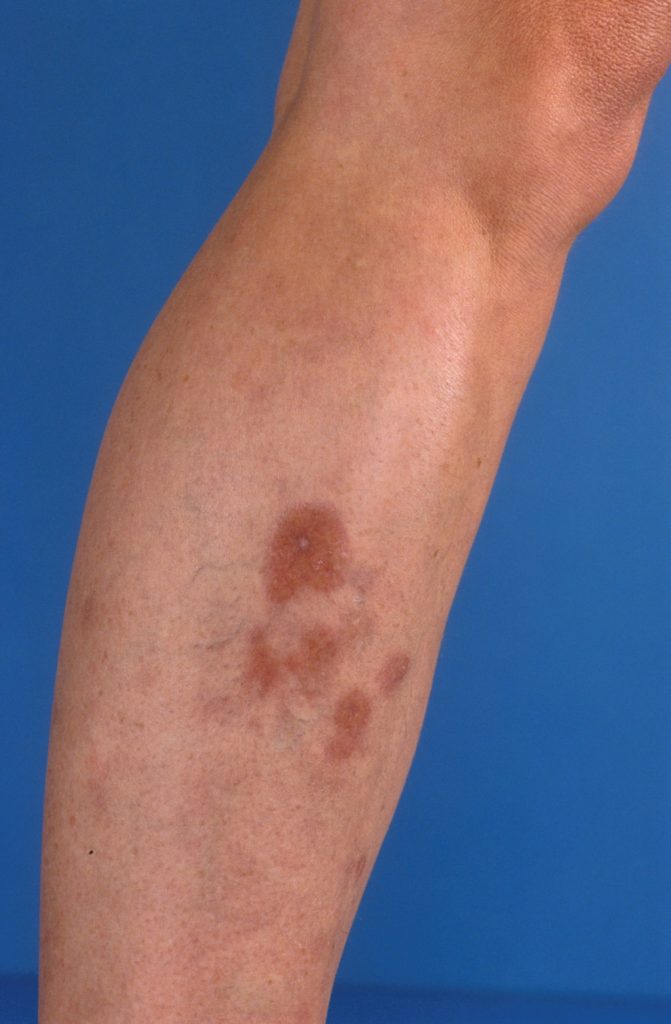
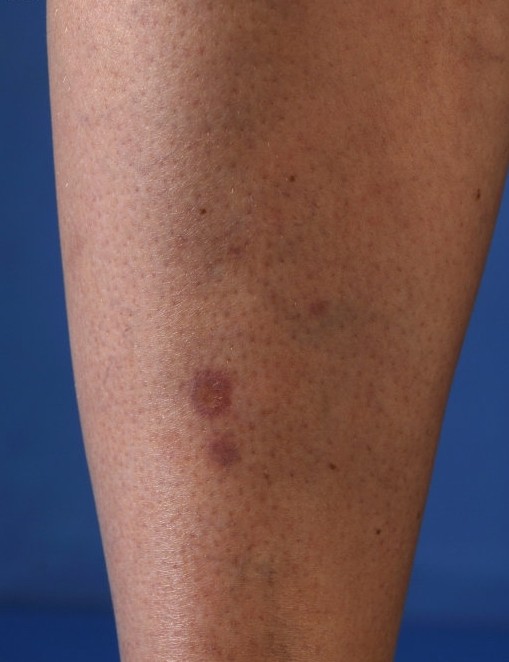
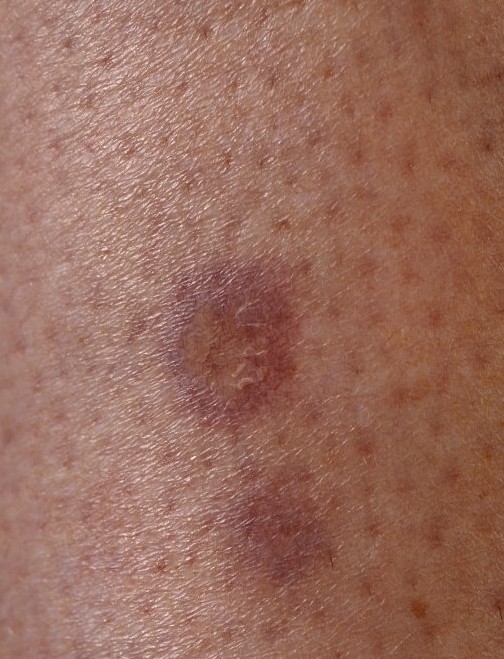
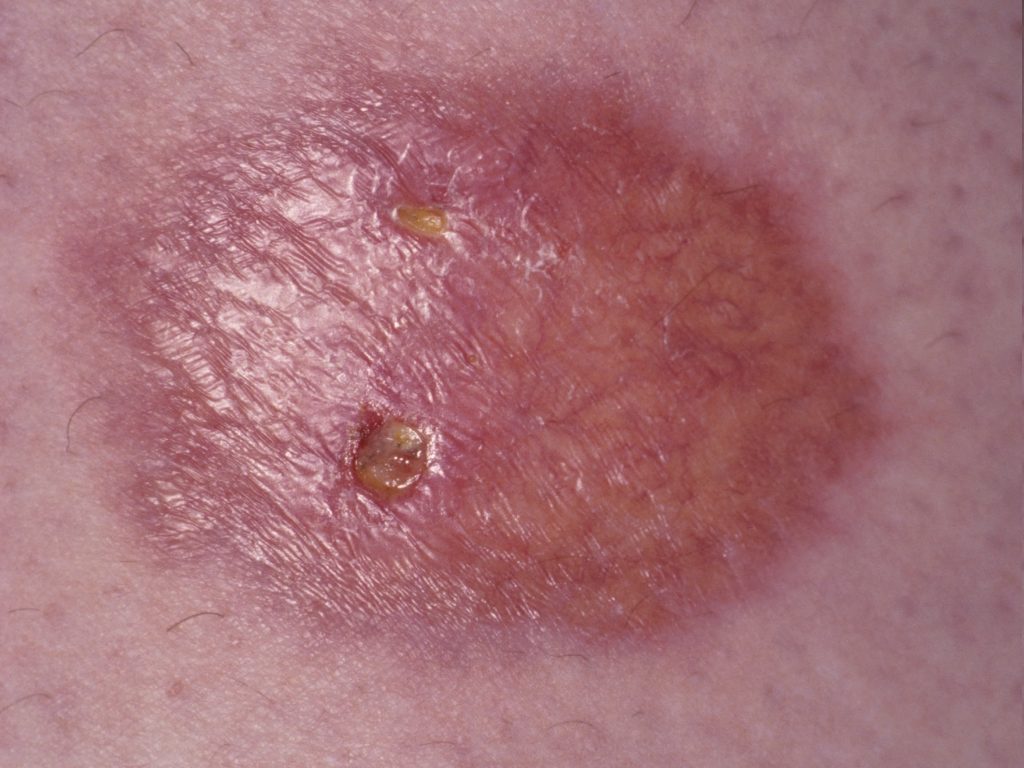
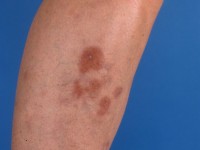
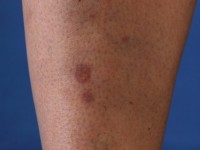
WHAT IS NECROBIOSIS LIPOIDICA?Necrobiosis lipoidica is a harmless skin condition that usually develops spontaneously on the lower legs, particularly at the front of the shin. It's a light brown or yellowish-brown spot, sometimes called applesauce-colored. The skin is also somewhat thin at the site, and a few dilated blood vessels are usually visible. It begins as a small spot, 1 to 2 cm in diameter, and can gradually enlarge. In most people, it doesn't grow larger than about 5 cm in diameter. It's primarily a cosmetic issue. Sometimes the skin around the spot is less sensitive or even numb.
 |
 |
 |
| necrobiosis lipoidica |
necrobiosis lipoidica |
necrobiosis lipoidica |
HOW DOES IT COME ABOUT?The cause of necrobiosis lipoidica is unknown. It is not an infection, it is not contagious, and it is not malignant. A mild, chronic inflammation occurs beneath the skin. Under a microscope, it can be seen that the connective tissue fibers (collagen fibers) of the skin are being attacked and broken down by cells belonging to the skin's normal immune system (white blood cells). Specialized cells (macrophages) clear away the remains of these connective tissue fibers. This inflammatory reaction is also called granulomatous inflammation. The term "necrobiosis" indicates tissue death (necrobiosis = death), while the term "lipoidica" (lipo = fat) refers to the appearance seen under a microscope: foam cells resembling fat cells. Necrobiosis lipoidica is sometimes seen in patients with diabetes. This, too, is unclear. Because of its most common location—the shinbone—it is suspected that it may be caused by a blow to the leg. It can also occur in other places where the skin is damaged, for example in a surgical scar.WHO GETS IT?Necrobiosis lipoidica can develop at any age, from young to old. The average age is 30. It is three times more common in women than in men and is more common in Caucasians. Patients with diabetes have an increased risk of developing necrobiosis lipoidica. Smoking is also cited as a risk factor.SHOULD I BE CHECKED FOR DIABETES IF I HAVE LIPOIDIC NECROBIOSIS?Yes. There is a clear relationship with diabetes. Previously, it was thought that about half of all patients had necrobiosis lipoidica, which is why it was also called necrobiosis lipoidica diabeticorum. Recent studies show that this is not the case for half, but significantly less. Approximately 11% of patients diagnosed with necrobiosis lipoidica appear to have diabetes. Another 11% appear to have a predisposition to diabetes (have an impaired glucose tolerance test) or develop diabetes later in life (in the 15 years after the onset of necrobiosis lipoidica). Conversely, 0.3% of patients with diabetes appear to have necrobiosis lipoidica. That's 3 per 1,000 diabetics, which is much higher than in the general population, where necrobiosis lipoidica is a rare condition. It is even more common in young patients with type 1 diabetes (2.3%).
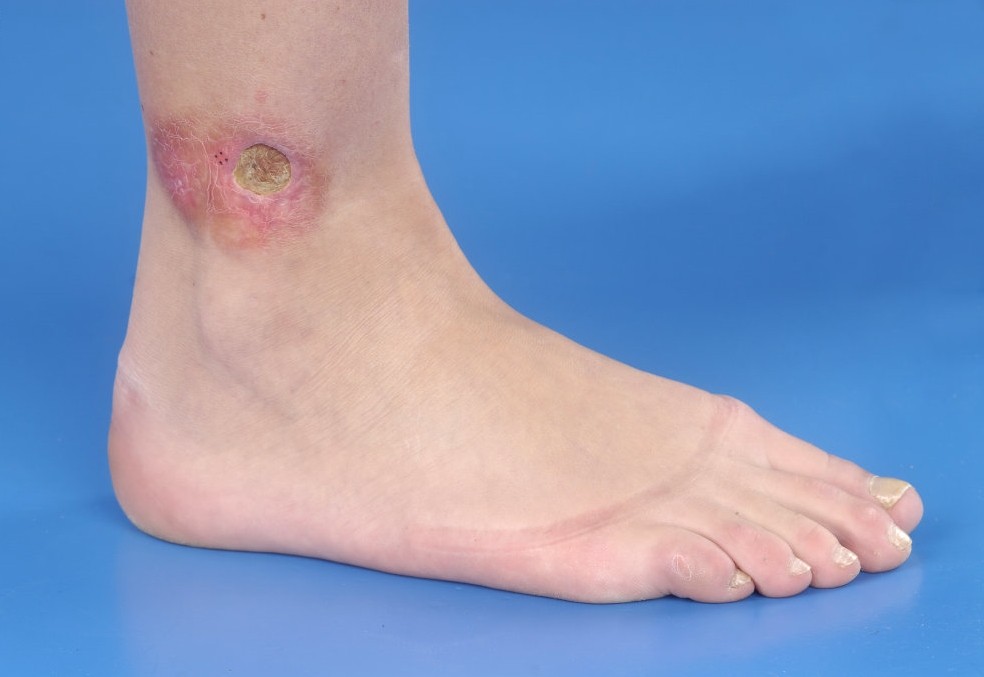
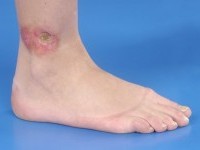
Therefore, blood glucose levels should always be measured. The most reliable way to do this is to go to the lab early in the morning, before breakfast (fasting glucose test). To be on the safe side, it's wise to have this checked again after one and two years (this can be done through your GP).HOW IS THE DIAGNOSIS MADE?The diagnosis is usually made visually. Based on the appearance of the lesion, the dermatologist can determine with high certainty that it is necrobiosis lipoidica. Sometimes there is doubt, as other skin conditions can resemble it. In that case, a skin biopsy can confirm the diagnosis. A small piece of skin is taken under local anesthesia and sent to the pathology laboratory. There, the typical inflammation with damage to the connective tissue fibers can be seen under a microscope. A skin condition that strongly resembles necrobiosis lipoidica is granuloma annulare, which also occurs on the lower legs but is more ring-shaped.CAN NECROBIOSIS LIPOIDICA CAUSE PROBLEMS?Usually not, aside from the cosmetic issue. Itching and pain can occur during the growth phase of the lesion. Sometimes the lesions become large, several dozen centimeters in diameter. In a small percentage of patients (approximately 10%), a wound, an ulcer, can spontaneously develop in a necrobiosis lipoidica lesion. This is because the inflammation associated with necrobiosis lipoidica affects the connective tissue fibers. These ulcers can be difficult to heal and leave a scar. Another rare problem, which only occurs in long-standing lesions (years old), is the development of a certain form of skin cancer ( squamous cell carcinoma ) in a necrobiosis lipoidica ulcer. These problems are mentioned here for completeness, but it is important to realize that this is very rare. In most patients, the problem remains limited to a small, brownish-yellow spot that causes no symptoms.
 |
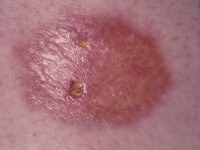 |
| ulcer in necrobiosis spot |
ulcer in necrobiosis spot |
TREATMENTNecrobiosis lipoidica is difficult to treat. Most treatments aim to suppress the inflammation occurring beneath the skin. Therefore, anti-inflammatory treatments are administered, such as topical corticosteroid creams or ointments. These must be strong corticosteroids, otherwise they won't work. The effectiveness can be enhanced by applying the cream under a special occlusive patch. Corticosteroids can also be injected as a solution. This penetrates deeper into the skin, where the inflammation is located. The disadvantage is that this is painful. Another problem with corticosteroids is that they can thin the skin with prolonged use. And the skin with necrobiosis lipoidica is already thin due to the disease itself. Nevertheless, they are often necessary; they are the first choice.
Corticosteroids can also be administered in tablet form (prednisone). This will only be considered for extensive forms of necrobiosis lipoidica, or when wounds develop. However, prednisone is generally not recommended, especially for patients with diabetes or those predisposed to diabetes, as it can increase blood sugar levels.
In addition to corticosteroid treatment, additional anti-inflammatory treatments are also used, such as light therapy, hormone-free anti-inflammatory ointments such as Protopic (tacrolimus), or anti-inflammatory tablets. Often, several products will need to be tried to find one that works and has few or no side effects. Because necrobiosis lipoidica is a rare condition, few studies have been conducted on the effects of these medications.
If a wound develops, it is important to optimize all conditions that can promote wound healing. Necrobiosis lipoidica ulcers are difficult to heal; for this, you should be referred to a dermatologist with experience in treating chronic wounds. A variety of measures may be necessary, ranging from modern wound dressings, antibiotics, elastic stockings, to hospitalization for skin grafting. |