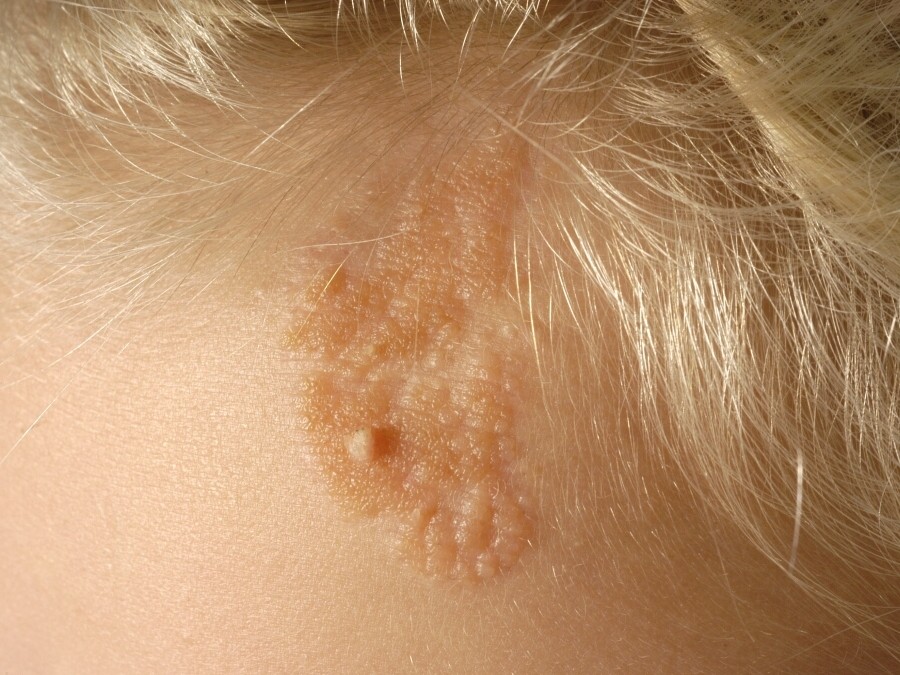
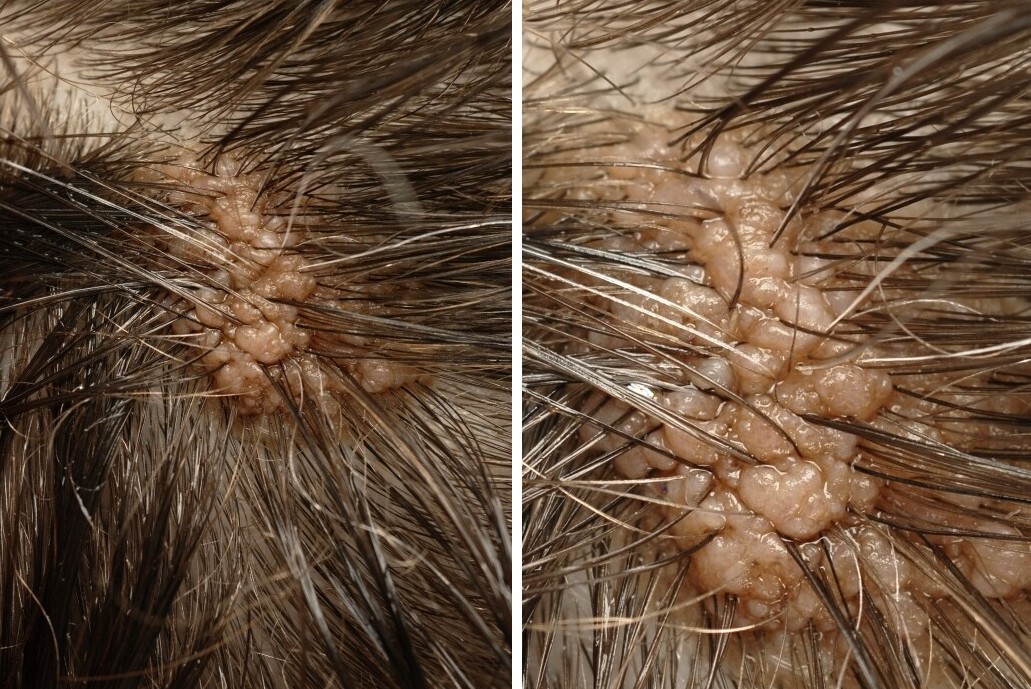
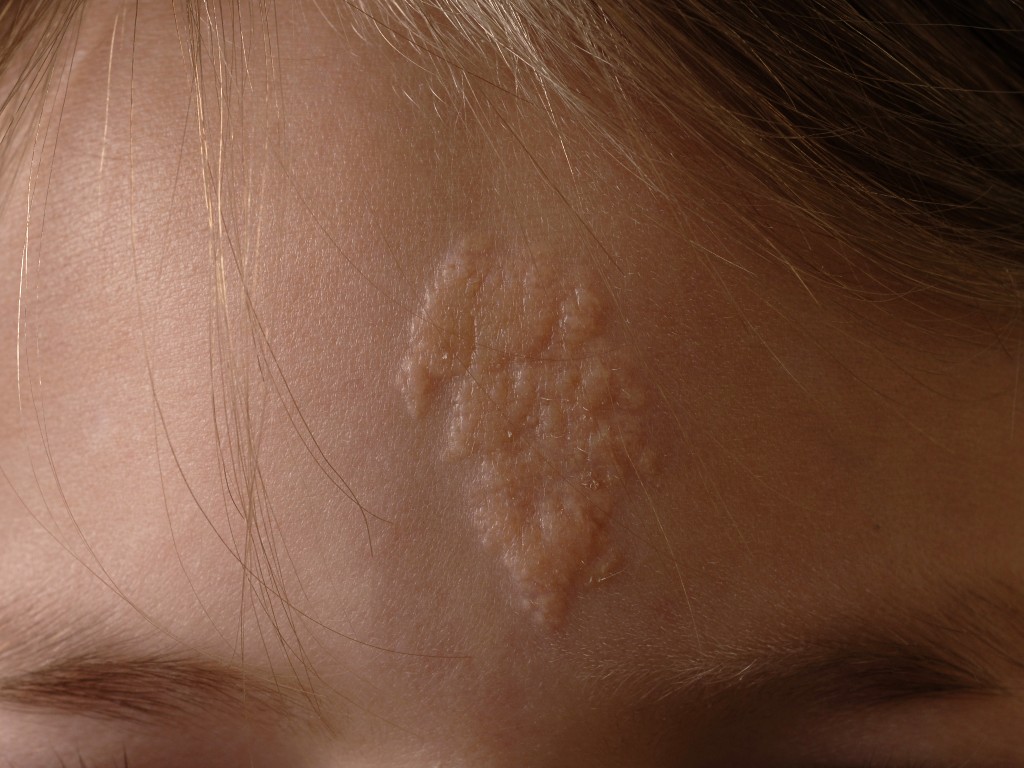
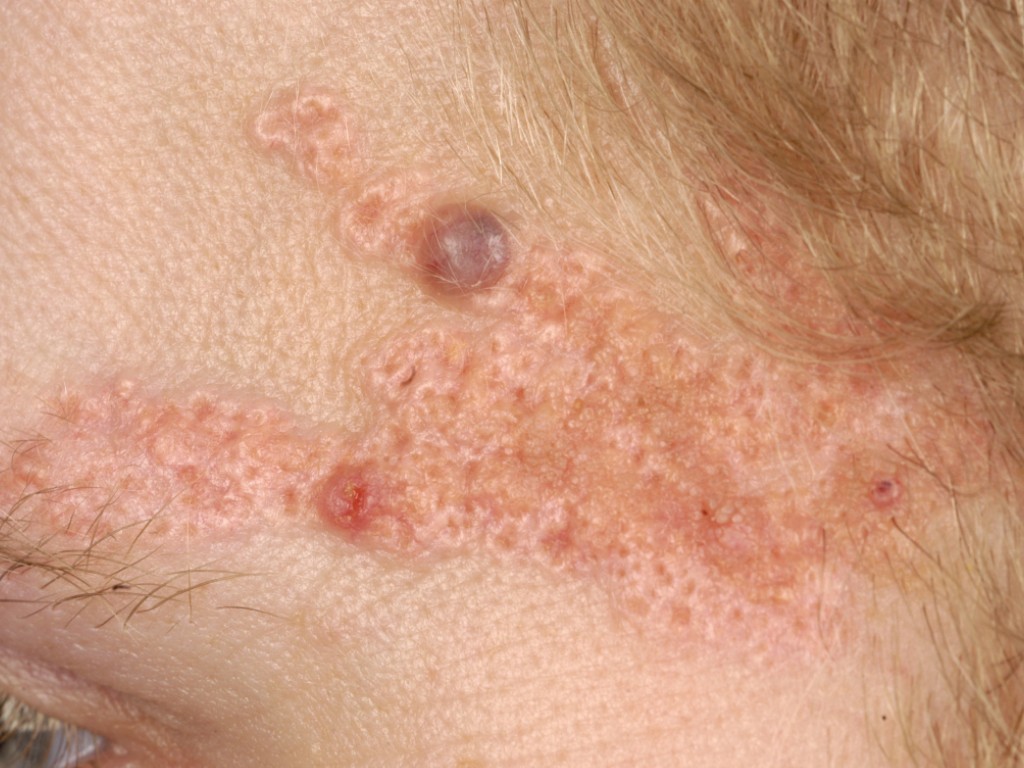
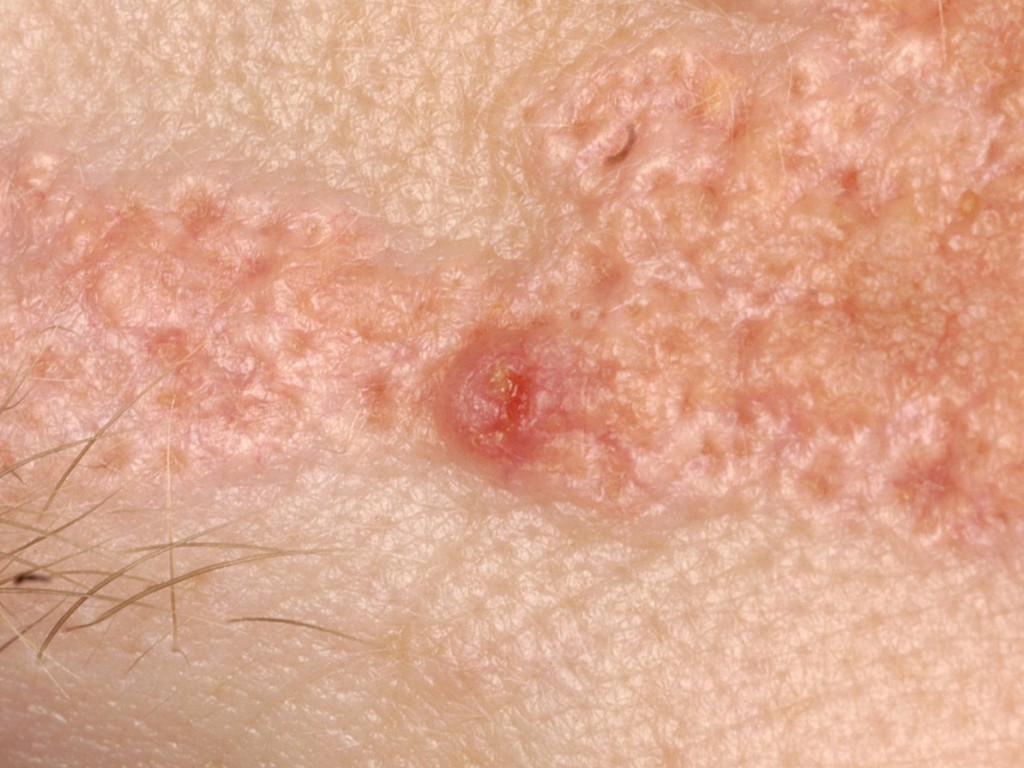
WHAT IS A NAEVUS SEBACEUS?A nevus sebaceus is a wart-like, bumpy birthmark on the scalp, present from birth. The name derives from sebum (oil) because the mark consists primarily of enlarged sebaceous glands. It is a congenital malformation of the sebaceous glands. Sometimes, abnormal hair follicles or sweat glands are also present. A nevus sebaceus occurs in 0.3% of newborns, with equal frequency in both boys and girls. It is a benign condition.WHAT DOES A NAEVUS SEBACEUS LOOK LIKE?A nevus sebaceus is usually found on the scalp (60%), sometimes on the face (30%), in front of the ear (4%), or on the neck (3%). They are usually oval or elongated plaques, yellow-brown or orange, or skin-colored. The surface is bumpy and wart-like. They usually have little or no hair growing on them. There may be just one or several. Their size varies from a few millimeters to several centimeters. They do not increase in size after birth, but they do grow with the child. During puberty, they may become somewhat raised, likely due to hormonal influences.
 |
 |
| nevus sebaceus |
nevus sebaceus |
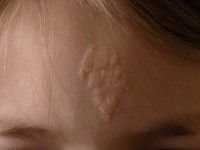 |
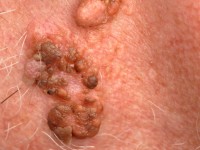 |
| nevus sebaceus |
nevus sebaceus |
HOW IS THE DIAGNOSIS MADE?The diagnosis is based on the clinical picture, i.e., its appearance. Sometimes a skin biopsy is necessary .IS A NAEVUS SEBACEUS DANGEROUS?A nevus sebaceus is not dangerous; it is a benign condition. There are two notable features:
1. Nevus sebaceus as part of a syndrome.
In very rare cases, a nevus sebaceus occurs in conjunction with abnormalities of the central nervous system or eyes. Symptoms that may occur include epileptic seizures (convulsions) or eye abnormalities such as an irregularly shaped pupil. This is called Schimmelpenning-Feuerstein-Mims syndrome . Because this is extremely rare, it is not necessary to routinely examine all children with a nevus sebaceus for brain or eye abnormalities. If symptoms are present, they can be referred to a pediatric neurologist and ophthalmologist.
2. The development of a skin tumor in a nevus sebaceus .
Skin tumors can develop in a nevus sebaceus. These are usually benign skin tumors , originating from the structures found in a nevus sebaceus, such as sebaceous glands, hair follicles, and sweat glands. Benign skin tumors develop in a nevus sebaceous cell carcinoma in approximately 13% of patients, but primarily in older adults. In individuals under 16, the risk of developing such a benign skin tumor is only 1.7%. These tumors can be easily removed under local anesthesia if they cause discomfort. Malignant skin tumors
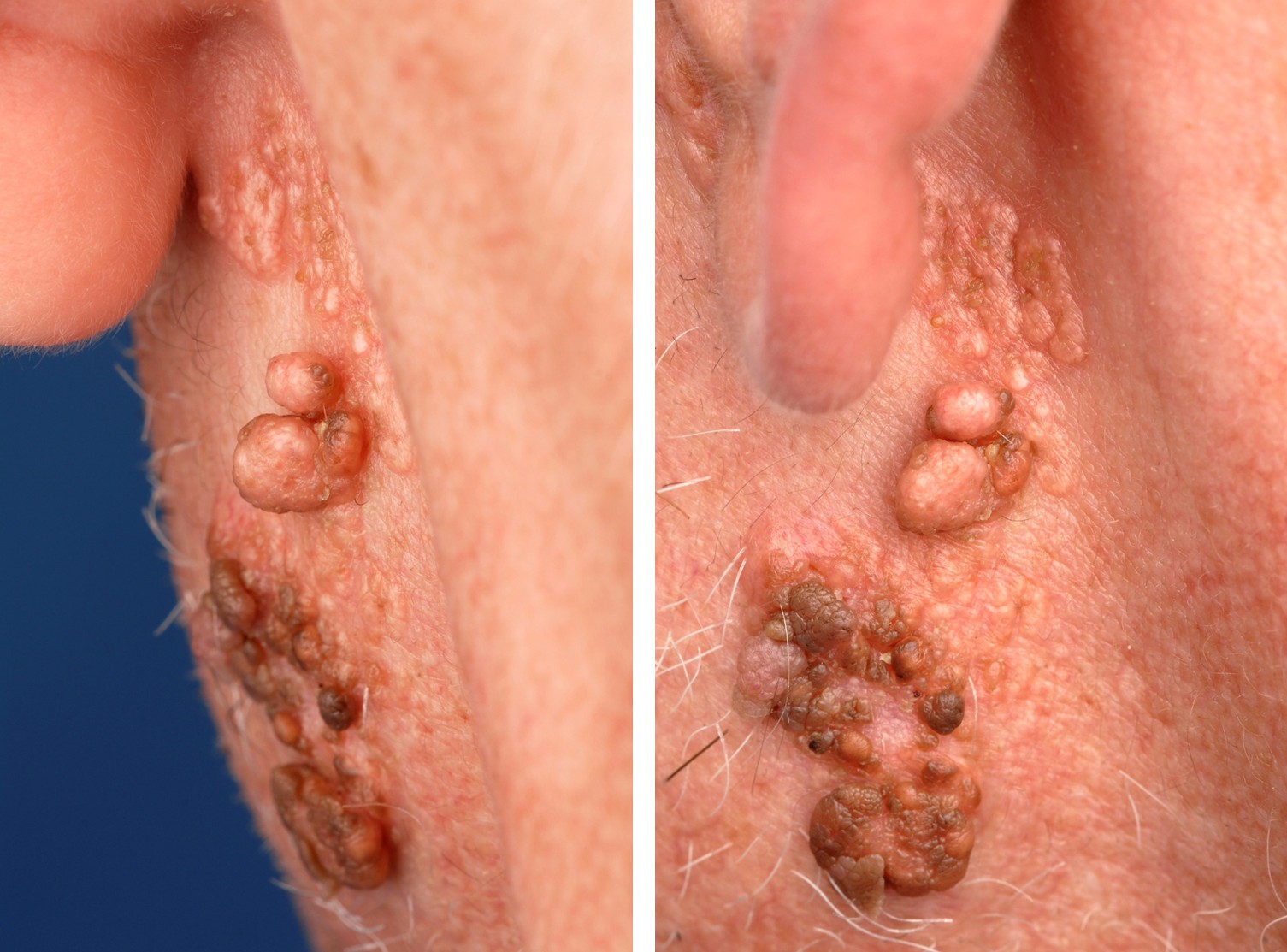
can also develop in a nevus sebaceous cell carcinoma . This is most common in patients aged 40 and older. In most cases, it is a skin tumor called basal cell carcinoma . In very rare cases, it is a sebaceous gland carcinoma or a sweat gland carcinoma. Malignant skin tumors from a nevus sebaceous cell carcinoma almost never occur in children.
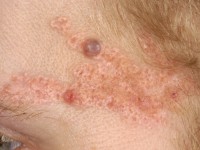 |
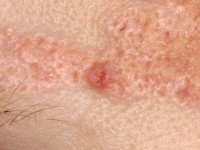 |
| basal cell carcinoma in a nevus sebaceus |
It was previously thought that basal cell carcinomas very often arise from a nevus sebaceus, even in 5-10% of patients. Preventative removal of these lesions was also recommended at the time. Recent, improved studies show that the risk of developing basal cell carcinoma is much lower, less than 1%, and that it does not develop in childhood. Information needs to be updated to reflect this new information; old brochures still state that preventative removal is desirable and that annual checkups are recommended. None of this appears to be necessary.HOW IS A NAEVUS SEBACEUS TREATED?A nevus sebaceus can be surgically removed if it's a very bothersome lesion, or for cosmetic reasons. Because it's a benign condition, it's not strictly necessary. Preventative removal of the lesions in childhood isn't necessary, as was once thought.
Surgical procedures will always leave a scar. The appearance of the scar depends on the size and location of the lesion. If the lesion is in the hair follicle, it will be barely visible after the procedure. The entire lesion must be removed, down to the subcutaneous fat. Cutting off just the top is pointless, as it will recur.SHOULD A NAEVUS SEBACEUS BE CHECKED?There's no need to schedule checkups. The chance of a skin tumor developing is so small that it's unnecessary to check for it. And if a tumor does develop, it's usually benign, and at most a basal cell carcinoma, which aren't very dangerous. It's enough to know and remember that it can happen. If a lump or thickening develops in a nevus sebaceus, see your doctor, who will arrange for it to be removed.WHAT ARE THE PROSPECTS FOR A NAEVUS SEBAEUS?These are good. A nevus sebaceus is present at birth, grows with the child, and sometimes gradually enlarges, especially during puberty. Later in life, small tumors can develop from the skin, sebaceous glands, hair follicles, or sweat glands, but these are harmless and easy to remove. And sometimes, depending on the size and location, a nevus sebaceus can be removed entirely. |