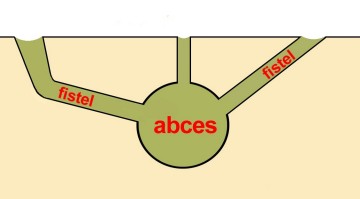
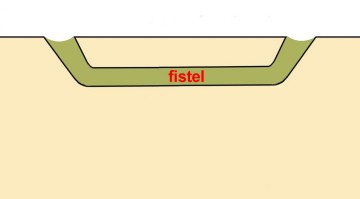
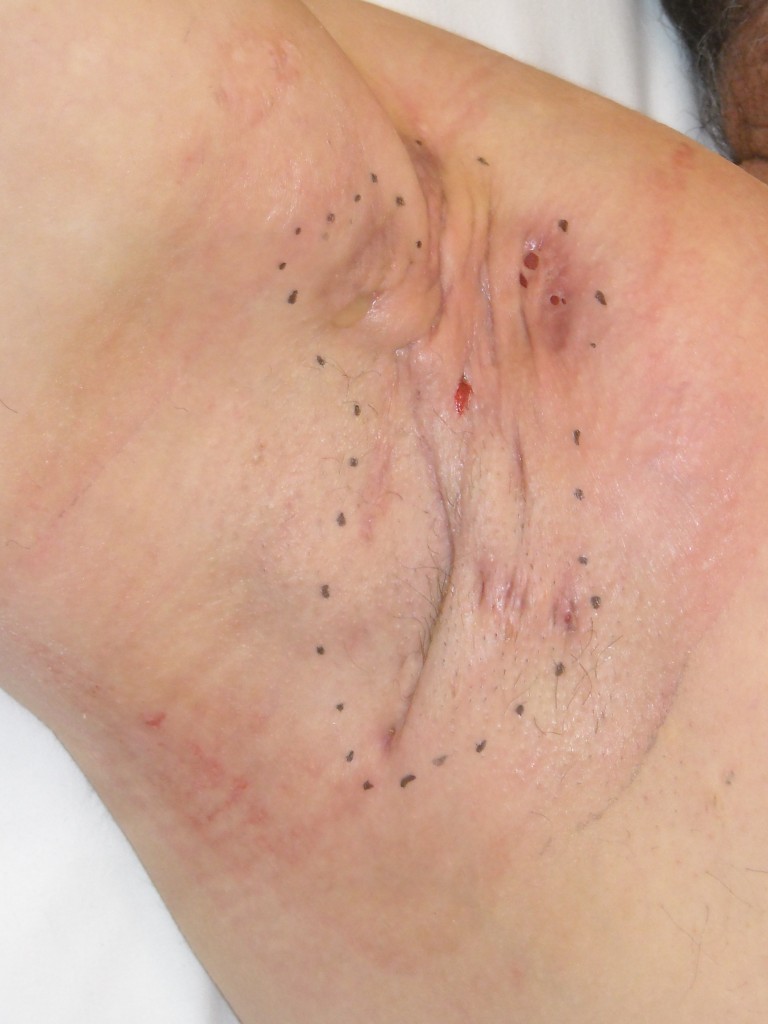
Hidradenitis suppurativa is a serious inflammation that originates in the hair follicles. The inflammation usually occurs in the armpits, groin, around the anus, or on the buttocks. Abscesses and fistulas are characteristic of this condition . For more information, see the brochure on hidradenitis suppurativa .WHAT IS A FISTULA?A fistula is a passage or tunnel under the skin. It is a tube-shaped structure. A fistula can develop after an infection, such as a boil . A boil is caused by an infection of a hair follicle. A pus-filled cavity forms under the skin. This is called an abscess . Such an abscess usually breaks through into the skin, creating a tunnel-like connection to the outside. Skin cells can grow into the tunnel, creating a tube completely lined with skin cells. If this happens, the connection usually remains, and such a permanent connection is called a fistula .
DO FISTULAS GO AWAY ON THEIR OWN?No, rarely or never. Once such a fistula forms, it doesn't go away on its own. It's a firm tunnel, lined with skin cells. Inside the tube, a buildup of skin flakes and sebum quickly develops, and more and more bacteria join in, and every so often, all that debris escapes through the fistula.WHAT DOES A FISTULA LOOK LIKE?A fistula is recognizable by a small hole in the skin that repeatedly leaks sebum or pus. Sometimes a red or skin-colored bump appears around the opening. A probe (metal probe) can be inserted into the opening to see where the tunnel leads. Sometimes these fistulas are centimeters long, the probe emerges through the skin centimeters further on, or the fistula extends deeper. Hidradenitis suppurativa can have many of these types of fistulas. Sometimes a whole network of tunnels can be found under the skin, similar to subway stations and tubes, or mole tunnels and molehills. For more information about fistulas, see the brochure " Fistulas under the skin ."
 |
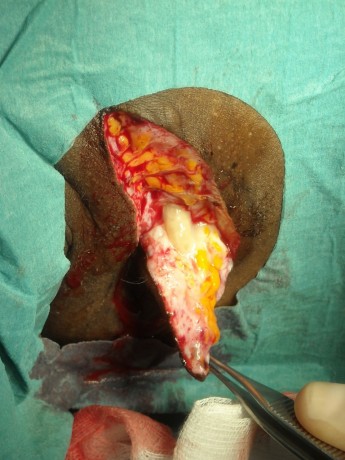 |
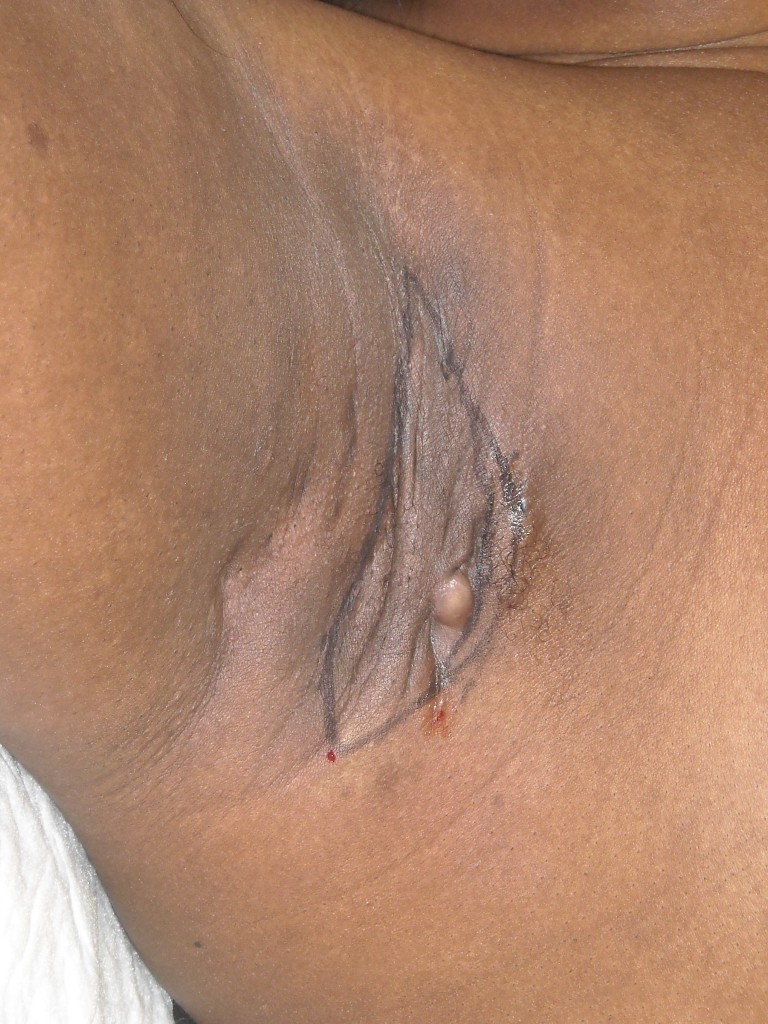
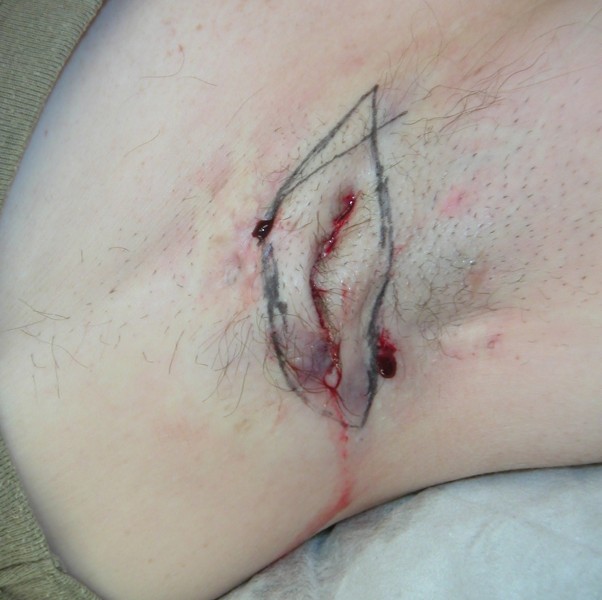
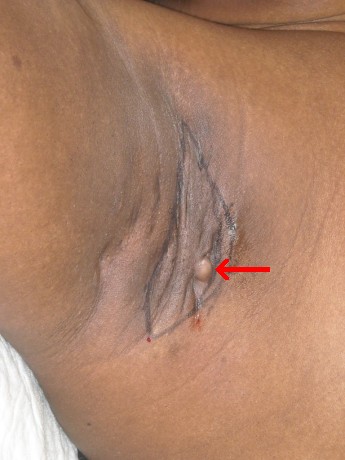
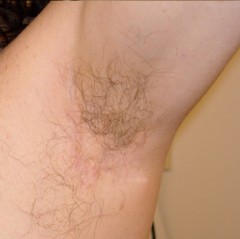
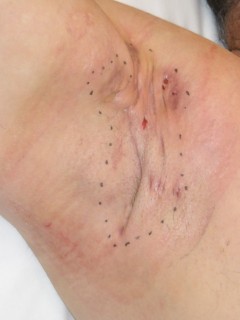
| There's been a fistula in this armpit for a long time. The small lump is the opening. Every so often, it becomes infected, and pus builds up deep inside, which then leaks out. The black line is the planned procedure; this area will be removed. |
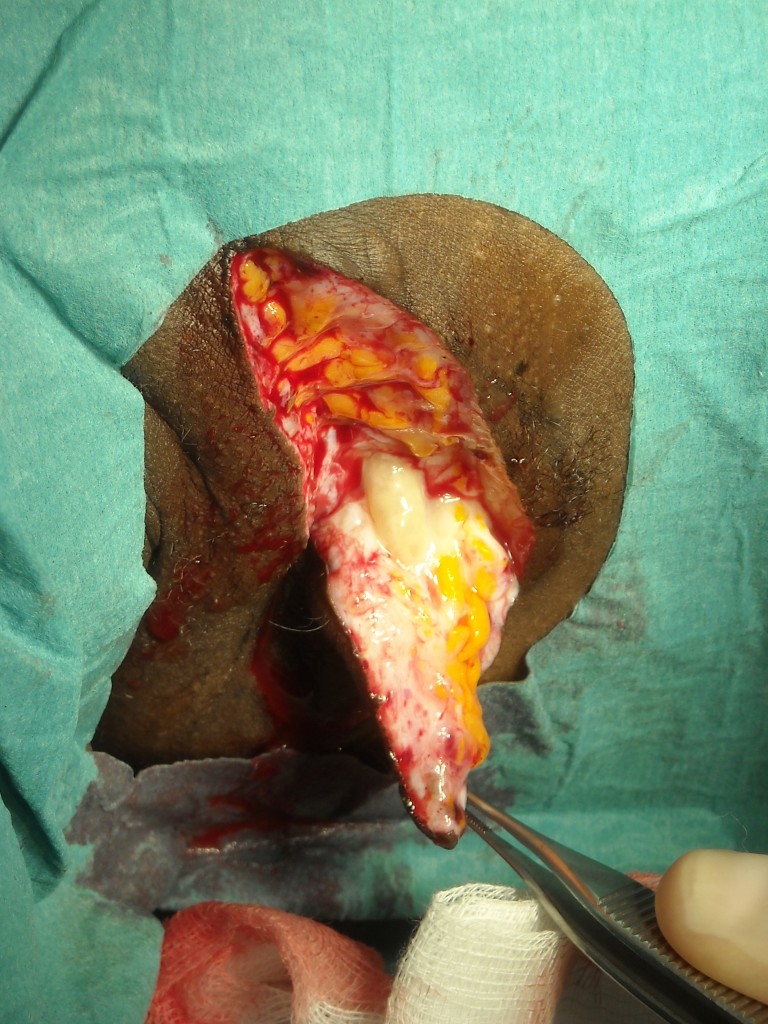
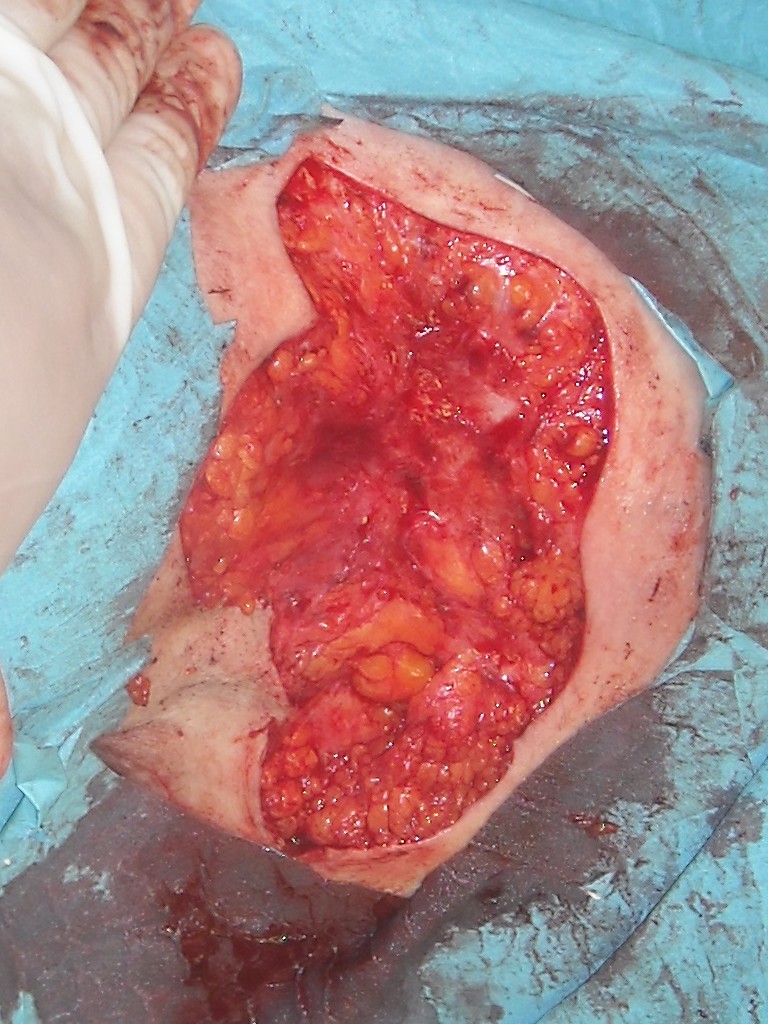
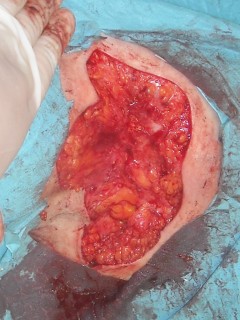
Only during the procedure will the depth of the fistula become apparent. The inflamed area is cut out in an oval shape, down to healthy tissue. Pus is still found deep down, at least 1.5 cm beneath the skin. |
WHEN SHOULD SURGERY BE DONE?If there's an infection (a pus-oozing opening or a lump that occasionally erupts) that keeps recurring in the same spot , surgery is necessary. If problems persist in the same spot, there's a cavity or tunnel under the skin. Surgery is the only effective solution. Making an incision when it's about to burst temporarily relieves the pain, but it's not a permanent solution.WILL THE FISTULA NEVER RETURN AFTER SURGERY?The success rate isn't 100%. It depends on the location and size, and ranges from 70% to 100%. This means that a single area sometimes requires multiple surgeries. If the fistula is completely removed, it won't return. Of course, a new area can develop right next to an operated area, because hair follicles are everywhere. The only certainty is that if you don't operate on a fistula, it will only get much worse. The fistulas grow in all directions and deeper, and it becomes increasingly difficult to operate. So, not operating isn't really an option.HOW DOES THE OPERATION WORK?The surgery is performed on an outpatient basis under local anesthesia. Depending on the extent of the procedure, the procedure takes approximately half an hour to an hour. For very large surgeries, it may take longer. The procedure is performed in a treatment room at the outpatient clinic. Please report to the reception desk in the Dermatology Department at the appointed time. Sometimes you may have to wait a while if the surgery schedule runs over. Please understand: it is difficult to estimate how long this type of surgery will take. Please use the restroom shortly before the procedure, as the surgery can sometimes take a long time. Before the procedure, you will lie down on the treatment table; find a comfortable position that you can maintain for a long time. For surgeries in the groin folds or around the anus, you may need to rest your legs in gynecological leg supports for easy access. Although you can walk, travel, and drive after the procedure, it is advisable to ask someone to drive you home, if possible. If this is difficult and you are going to drive yourself, take some time to recover before getting in the car.Pre-procedure checklistRead the information carefully and ask questions if anything is unclear.
You must agree to the procedure.
The doctor will want to know a few things:
- Is everything clear and do you agree to the procedure?
- Are you taking blood thinners, and if so, which ones?
- Do you have a pacemaker?
- Do you have any allergies to antibiotics, anesthetics, or painkillers?
- Are you taking medications that affect your immune system, or do you often suffer from infections?To drawThe first step is to draw a line around the area to be removed. It's important to carefully look for the holes, but also to feel for any strings or swelling under the skin. A shape is drawn around the inflamed area that can be closed with sutures. This is usually an oval, but it can also be star-shaped or an oval with extensions.To anesthetizeThen, the area is numbed by injecting an anesthetic (lidocaine) around the area. This is, of course, painful. The pain can be reduced by injecting the anesthetic in one spot first, then slowly working your way from the already numbed area. The anesthetic takes a moment to take effect; after that, you won't feel anything.To operateThe inflamed area is then excised down to healthy tissue. The base and edges are carefully examined. If a piece of the floor of a cavity or fistula remains, it is excised. If a fistula is still hidden in one of the edges, it is also followed up and removed. Sometimes, additional anesthesia is necessary during the procedure if the tunnel system is larger than anticipated.AttachOnce everything has been removed and feels soft, stitches can be applied. The stitches usually remain in place for two weeks. You will receive an appointment for stitch removal in two weeks. Sometimes your GP can also remove the stitches.Leave openSometimes it's better not to suture the wound but to simply leave it open. This is also called deroofing. The wound will then heal naturally from the edges within a few weeks. Suturing is only suitable for small areas and only if it's certain that all tunnels have been removed; if a growth is overlooked, a new infection can develop under the scar. Leaving the wound open eliminates this problem; any pus accumulation from the surrounding area can simply drain. There's less risk of infection or recurrence. There are no sutures that can constrict, loosen, or grow inward. The pain is bearable. The disadvantage is that the wound needs to be bandaged daily and that it takes longer, several weeks (3-8 weeks depending on the size).After painThe anesthetic lasts for several hours, after which it will start to hurt. Make sure you have enough painkillers at home. There is a standard package of painkillers for after the procedure. This starts with 500 mg paracetamol . If you are in pain, take two 500 mg paracetamol tablets four times a day according to a fixed schedule. If that is not enough, add an NSAID painkiller such as diclofenac 25 mg (maximum 6 tablets of 25 mg per day) or Brufen (ibuprofen) 200 mg (maximum 8 tablets of 200 mg per day). For patients who cannot take NSAID painkillers, an alternative is Tramal (tramadol) 50 mg (maximum 8 tablets of 50 mg per day). For very severe pain, morphine may be prescribed: Oxynorm (oxycodone) 5 mg (maximum 6 tablets of 5 mg per day).Post-bleedingLarge blood vessels are sutured during the procedure, while smaller ones are sometimes cauterized. Nevertheless, a wound can bleed after a while. The standard treatment is to lie down or sit quietly and apply a pressure bandage. Usually, applying pressure to the wound for a prolonged period (15 minutes) with a pressure bandage or by holding a stack of washcloths or a rolled-up towel against it is sufficient. Occasionally, the bleeding doesn't stop, and you need to see your doctor, go to the emergency room, or return to the hospital for treatment. For wounds that are left open, it may be necessary to cauterize blood vessels. The bleeding area is then numbed first. For wounds that have been sutured, sometimes part of the wound needs to be reopened to suture the vessels. Sometimes, only an additional suture is placed on the outside, a pressure bandage is applied, or simply the dressing is changed. A bruise with swelling and bruising may occur; this will subside on its own.After the operationPlease be aware that you will not be able to perform your normal activities after such a procedure. Take it easy. Do not plan any busy work. Of course, this depends greatly on the location of the surgery and the size of the wound.StitchesIf the wound has been stitched, the stitches usually need to remain in place for two weeks. You will receive an appointment for stitch removal in two weeks. Sometimes your GP can also remove the stitches. Showering is allowed, but not on the first day. Water may run over the wound, but the shower head should not be aimed directly at it; it should remain as dry as possible. Bathing, swimming, and saunas are also not permitted.Wounds left open (deroofing)If the wound remains open, things will be different. You should rinse the wound daily in the shower and then re-dress it with one or two layers of Betadine iodine ointment gauze, covered with dry absorbent gauze, secured with a plaster. These dressings can be picked up at the pharmacy or delivered to your home, and it's often possible to get a supply for the first day. When changing the dressing, thoroughly wet the gauze and let it soak in for a few moments before removing it from the wound. Removing dried-out gauze can be painful and may cause the wound to bleed. The wound will heal naturally from the edges within a few weeks (3-8 weeks depending on the size).Infections and antibiotics after the procedureThere is a risk of wound infection, because all these wounds are actually infected. Deep down, cavities containing bacteria are cut. Therefore, the wound is not sterile after the procedure. Cleaning is done as thoroughly as possible, but bacteria will certainly remain in the wound. Therefore, antibiotics are sometimes prescribed as a precaution after the procedure, especially if the wound is sutured. This usually involves Augmentin 625 mg (amoxicillin/clavulanic acid) three times a day for two weeks. If you are already taking antibiotics, such as clindamycin, you can continue taking them. If you are taking other antibiotics such as doxycycline or minocycline, these will be temporarily stopped and replaced with Augmentin. If the wounds are left open, it is usually not necessary to prescribe or change antibiotics.WHAT COMPLICATIONS CAN OCCUR AFTER A PROCEDURE?Complications are generally minor. Pain after the procedure and postoperative bleeding are the main complications. These are part of the procedure and can be resolved with the measures mentioned above. Most patients find the pain insignificant compared to the pain of an infected abscess. The wound can partially or completely burst open. Stitches can come loose or tear. This may seem serious, but it isn't. Often, the decision is made to leave the wound completely open from the start. It will eventually heal from the edges anyway. After a procedure, the skin around the surgical site may be numb because nerves have been severed. This always occurs with major surgeries and is unavoidable. For example, after major armpit surgery, the skin on the inside of the upper arm may be numb. This can resolve after months to years, but sometimes it is permanent. A wound infection can occur, for which antibiotics are prescribed. Furthermore, scars may remain that are cosmetically unappealing. This happens with every procedure. This must be weighed against the pain caused by the fistulas and abscesses.Contact us for acute problems and aftercare following a procedureFor patients who have undergone surgery at the Dermatology Department of the Amsterdam UMC: In case of acute problems, please contact the AMC Dermatology outpatient clinic (extension 5662530). Outside office hours, for emergencies, you can contact your own GP/the GP post, or the AMC Emergency Department (extension 020-5662222), or ask for the dermatologist on duty via the AMC switchboard (extension 5669111).
For more information about hidradenitis suppurativa, see the hidradenitis suppurativa patient brochure or visit www.hidradenitis.eu.
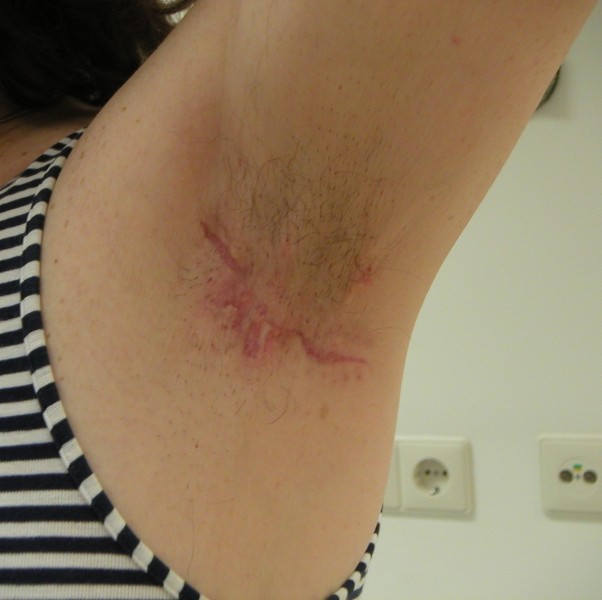
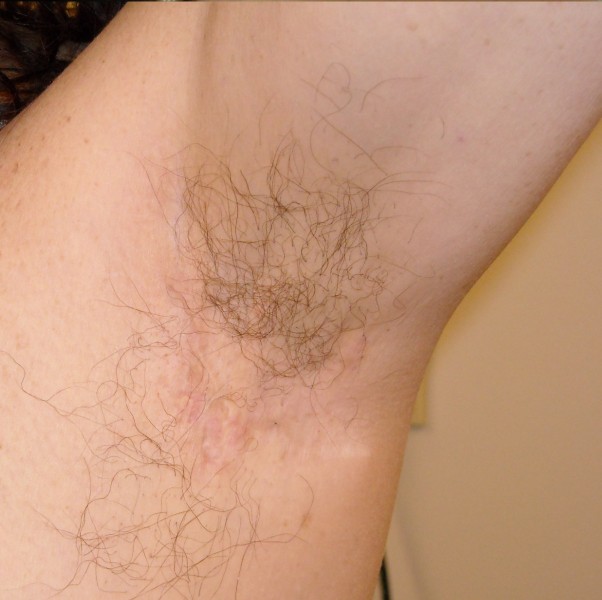
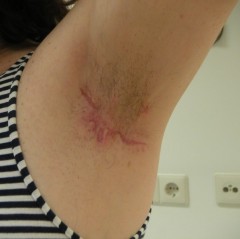
For more information about fistulas, see the brochure "Fistulas under the skin ."WHAT DO THE SCARS LOOK LIKE?Initially, it usually doesn't look good, especially if there's a lot of tension or if the wound is infected. Sometimes parts of the wound recede. The final result should only be assessed after a year. The body's ability to heal is enormous, and even scars that initially look bumpy will naturally smooth out and become less visible.
 |
 |
 |
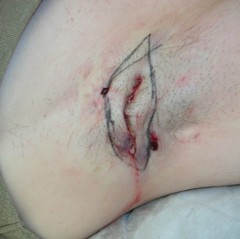
| Before the operation |
The scar after 1 month |
The scar after 1 year |
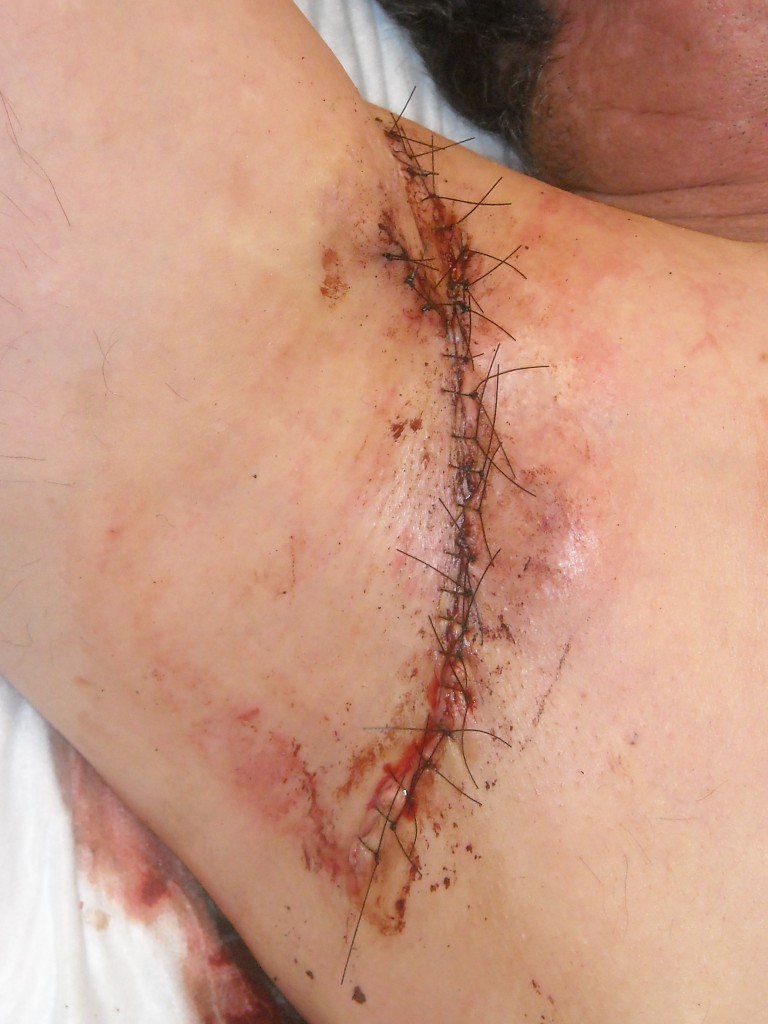
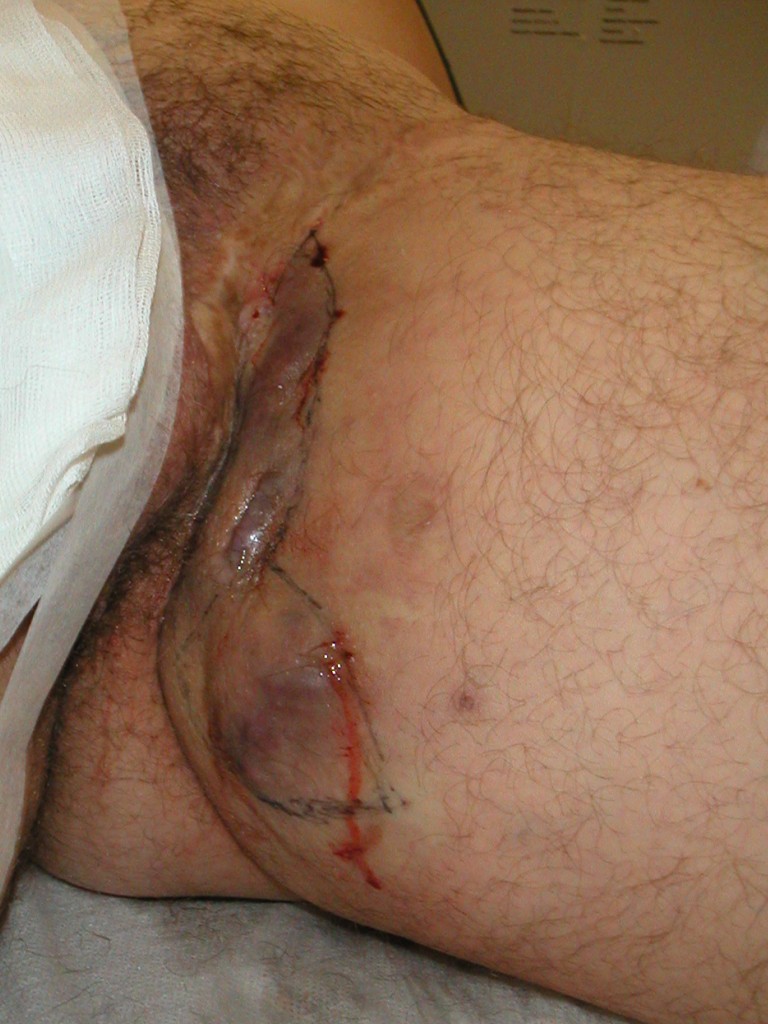
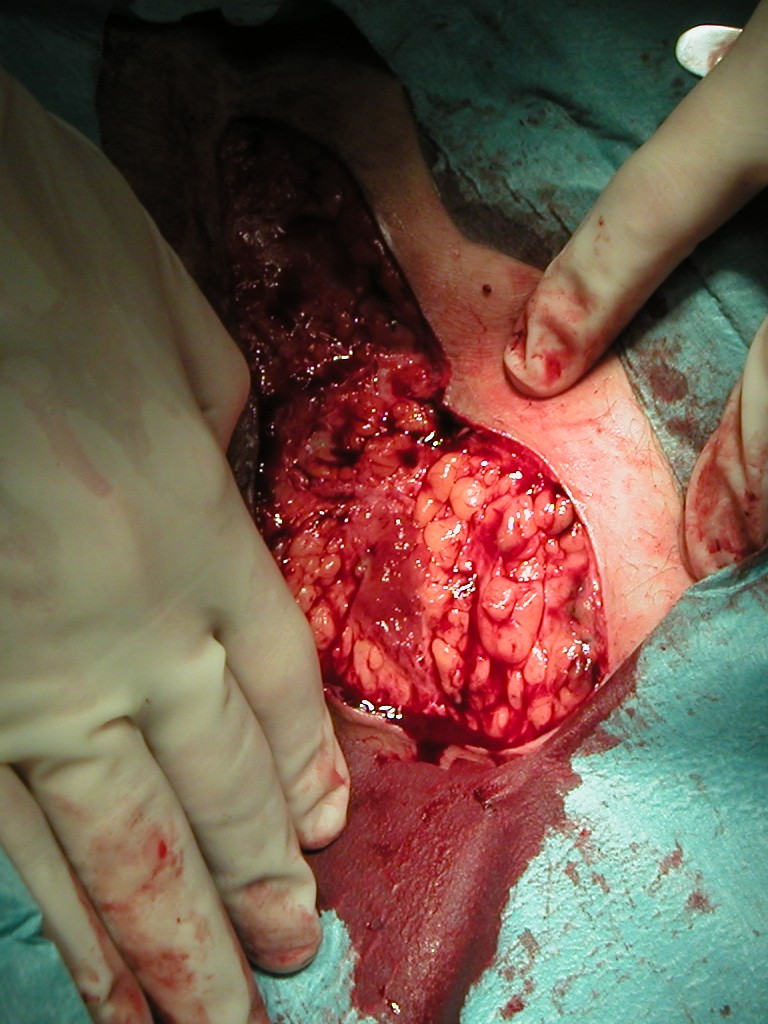
IS THERE A MAXIMUM SIZE FOR SURGERY?Large areas can be operated on (see photos below), but there is a limit to the amount of local anesthetic that can be injected at a time. The area to be operated on cannot be larger than approximately the size of a hand. If the area is much larger or very deep, the procedure cannot be performed under local anesthesia. In that case, you will be referred to a plastic surgeon, who has the option of performing the procedure under general anesthesia in the operating room. Sometimes it is possible to perform the procedure under local anesthesia, but in stages: one section at a time. The advantage of this is that you will not have to deal with very large wounds that require a long healing time.
 |
 |
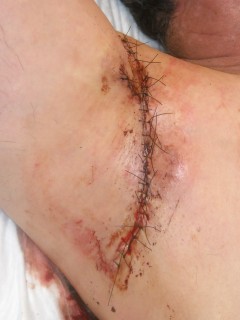 |
| Example of a major intervention |
Wound during the procedure |
Wound sutured |
 |
 |
 |
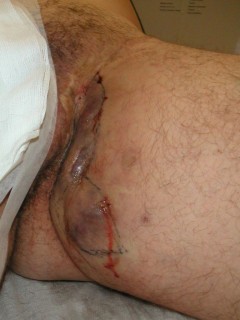
| Example of a major procedure: a severe hidradenitis of the inguinal fold that has existed for years, with numerous fistula openings. |
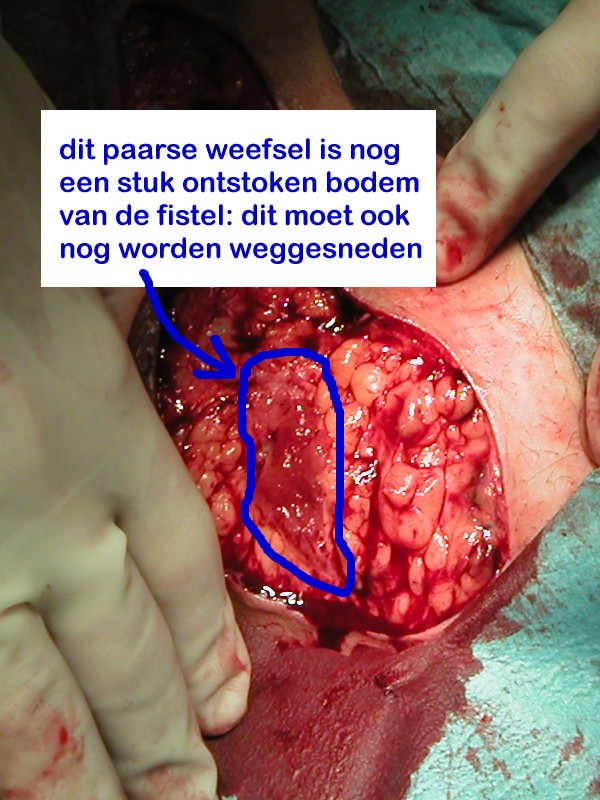
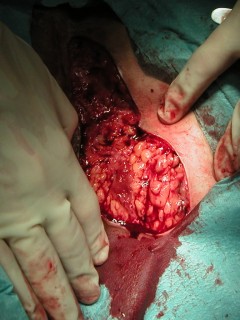
Wound during the procedure: all inflamed tissue is completely removed, down to the fat. Nothing should be left behind. |
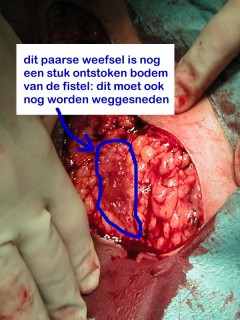
The circled area is the inflamed base of the fistula. This purple, inflamed tissue will also be removed. |
 |
 |
 |
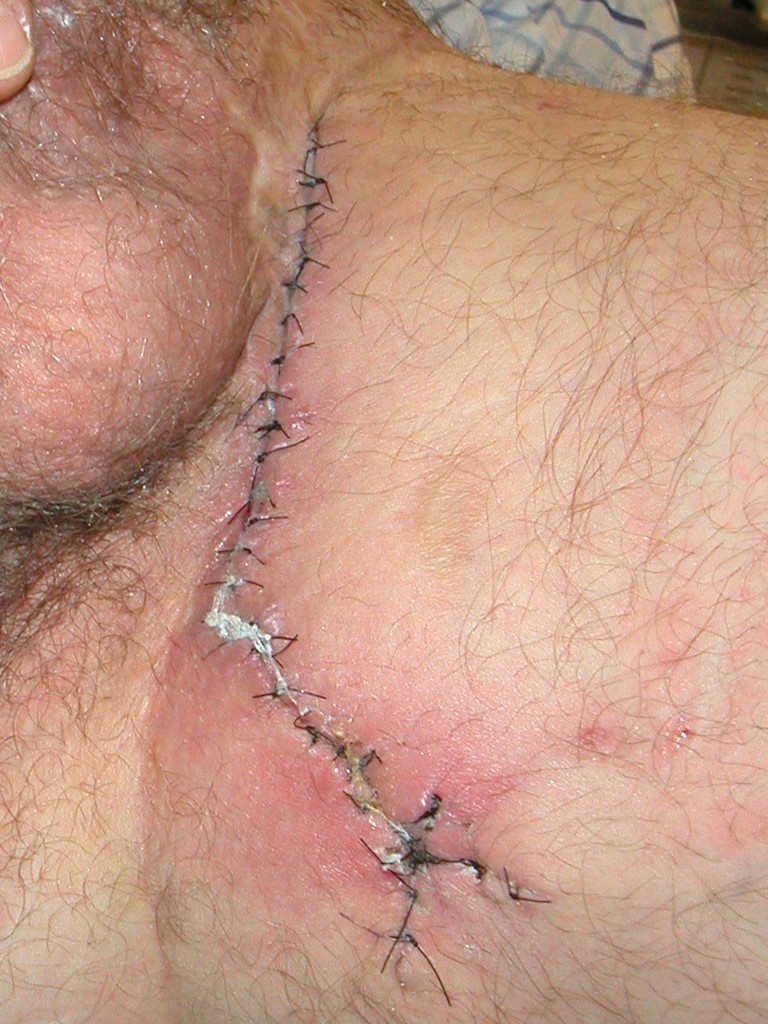
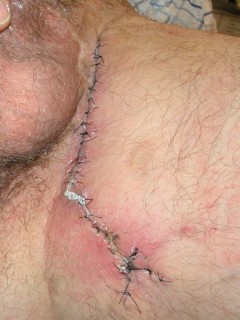
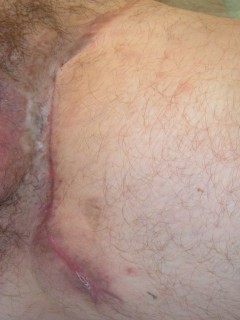
| The wound two weeks after surgery. The stitches are now being removed. Initially, these kinds of wounds don't look pretty; they're not typical surgeries: inflamed tissue (abscesses and fistulas) is incised, teeming with bacteria. |
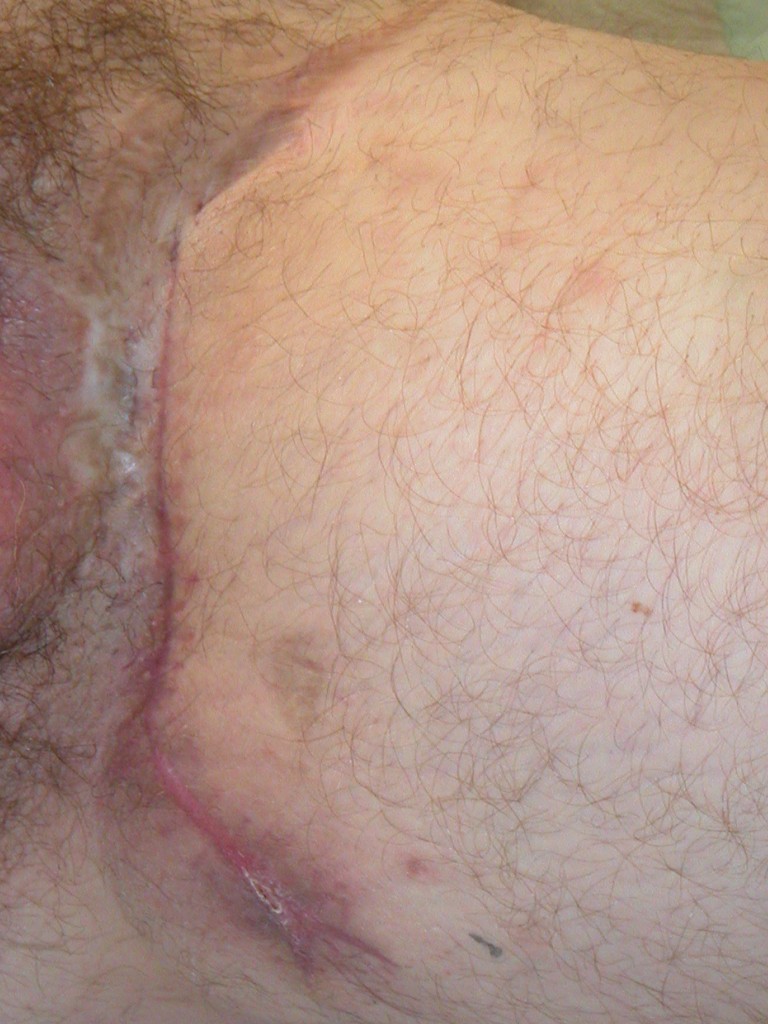
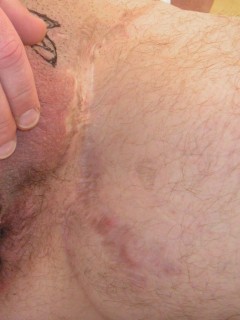
Scar after 6 weeks. Still not pretty, but take a look at what used to be there. The patient is already satisfied: for years, he had pustules in his groin that he had to constantly dress with gauze. And now that's over. |
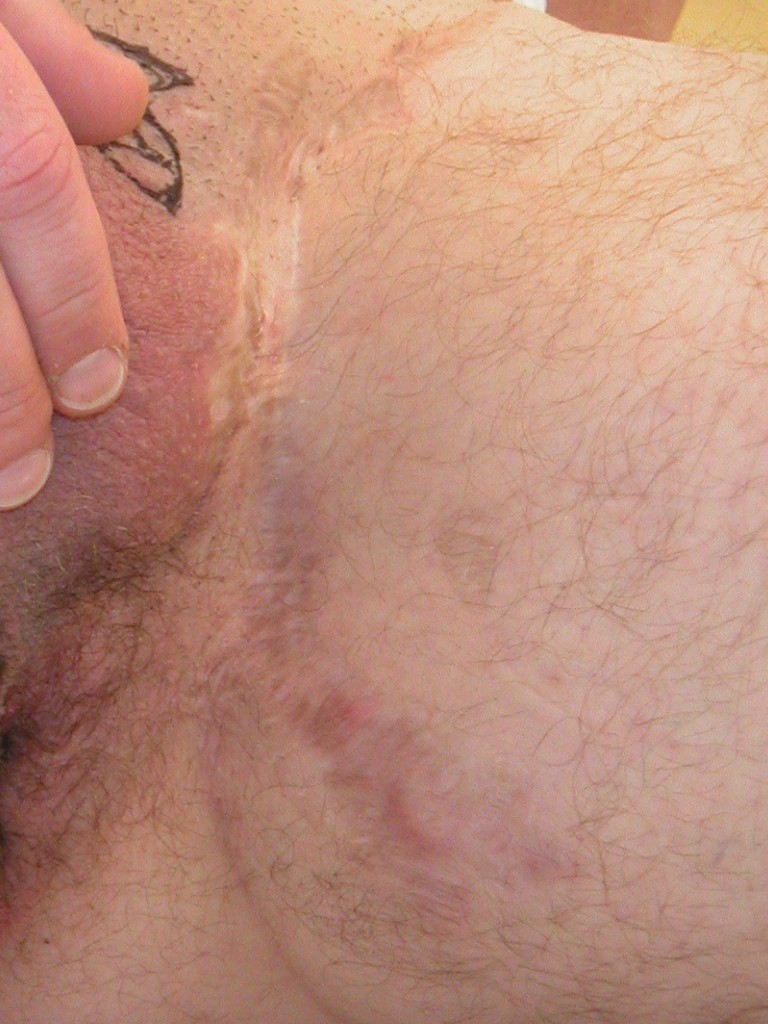
The scar after a year: much more beautiful and completely smooth. This clearly demonstrates how well the body can heal. Importantly, the inflammation hasn't returned. The patient also has the other areas removed. |
|