1. WHAT IS ADALIMUMAB AND HOW DOES IT WORK?Adalimumab(anti-TNF-α, brand names Humira, Amgevita, Hulia, Hyrimoz, Idacio, Imraldi, and Uflyma ) is a man-made antibody that binds to the substance TNF-alpha found in the body . TNF-alpha is a protein that plays a role in various inflammatory processes. Adalimumab (anti-TNF-α) inhibits these inflammatory processes by binding to TNF-alpha. TNF-alpha is produced in the body by cells that are part of our immune system. It is released where something is wrong, for example, a bacterial infection, an inflammation, or an injury. The release of TNF-alpha strengthens the inflammatory response: white blood cells (leukocytes) are attracted and activated, causing even more inflammation. This causes local redness, warmth, swelling, and pain. This inflammatory response is a normal mechanism in the body, intended to clear away bacteria, for example. However, there are diseases in which the inflammatory response gets out of control and causes damage to the surrounding tissues. This is the case with, among others, Crohn's disease (inflammation of the bowel), rheumatoid arthritis (inflammation of the joints), and psoriasis (inflammation of the skin). In all these conditions, the inflammation can be inhibited with adalimumab (anti-TNF-α).
2. WHAT IS ADALIMUMAB USED FOR? Adalimumab is currently registered in the Netherlands for the following conditions:
- joint complaints: rheumatoid arthritis, polyarticular juvenile idiopathic arthritis, enthesitis-related arthritis, ankylosing spondylitis and psoriatic arthritis
- skin diseases: psoriasis and hidradenitis suppurativa
- bowel diseases: Crohn's disease and ulcerative colitis
- eye diseases: uveitis , anterior uveitis
The effectiveness of TNF-alpha inhibitors in hidradenitis suppurativa was discovered by chance. Over the past 25 years, thousands of patients with Crohn's disease (inflammatory bowel disease) have been treated with TNF-alpha inhibitors such as infliximab and adalimumab. Some of these patients also had hidradenitis suppurativa. This is no coincidence; these conditions occur together. During treatment of the bowel disease with TNF-alpha inhibitors, it was noted that the hidradenitis suppurativa also improved. Subsequently, from around 2003, patients with only hidradenitis suppurativa (without Crohn's disease) were also treated with TNF-alpha inhibitors. Favorable results were also observed in this case. The first studies were conducted with infliximab infusions. Subsequent studies were also conducted with adalimumab injections for hidradenitis suppurativa. These studies showed that 40 mg of adalimumab per week is also effective for hidradenitis suppurativa.
3. WHAT IS HIDRADENITIS SUPPURATIVA? Hidradenitis suppurativa , also called acne inversa or acne ectopica, is a chronic inflammation of the hair follicles and sebaceous glands, primarily in the groin and/or armpits. Hidradenitis suppurativa means purulent sweat gland inflammation, acne inversa means acne of the folds, and acne ectopica means acne in places other than regular acne. The name "sweat gland inflammation" is actually incorrect, because it is now known that hidradenitis does not originate in the sweat glands, but in the hair follicles.
Unlike regular acne (acne vulgaris), hidradenitis suppurativa causes extensive and deep inflammation in and around the hair follicles, resulting in painful swelling. Sometimes dilated ducts and pustules are visible externally. Large and painful pus-filled abscesses can develop, which eventually rupture. Large cavities ( cysts ) can develop deep within the skin. Sometimes the pus seeks an escape through routes other than the original duct, creating tunnels and ducts ( fistulas ) under the skin, which sometimes resurface several centimeters away. See also the brochure on fistulas under the skin . Abscess cavities can be connected by ducts. Abscesses can recur repeatedly in the same place. In the most severe cases, hidradenitis suppurativa is a very debilitating condition due to the pain and the continuous discharge of sebum, fluid, and pus from the inflamed areas.
Besides the well-known predilections of the groin and armpits, hidradenitis suppurativa can also occur in other areas, such as the buttocks, around the anus, under the breasts, in the neck, or elsewhere on the torso.
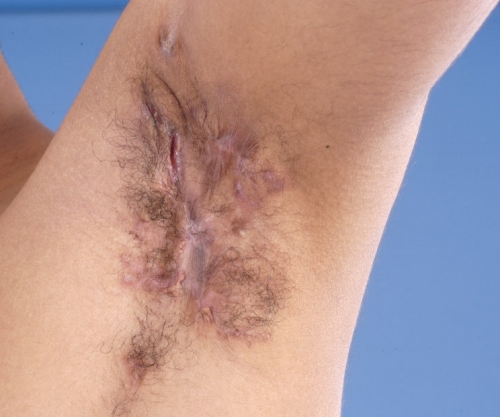
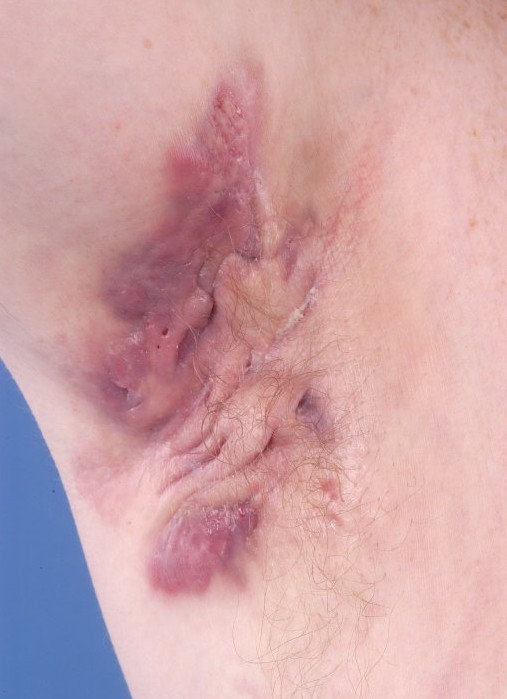
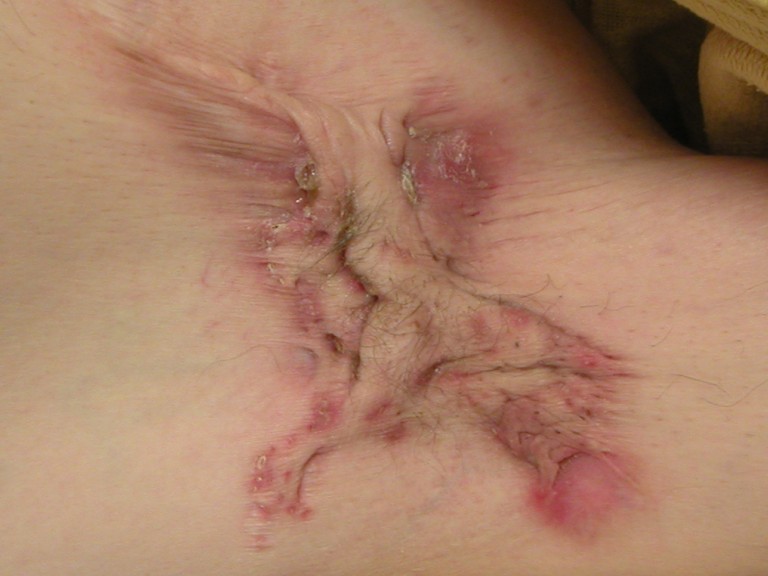
Hidradenitis suppurativa of the axilla, severe variants
4. WHAT IS THE EFFECT OF ADALIMUMAB FOR HIDRADENITIS SUPPURATIVA? Treatment with adalimumab reduces the inflammation around abscesses and fistulas. Swelling, pain, and pus drainage decrease. Some areas disappear completely. Scarring and fluid retention also decrease, increasing freedom of movement. Most patients feel better within a short time (from 2 weeks after starting treatment) and are able to do things, such as cycling, that were previously impossible. Quality of life improves significantly.
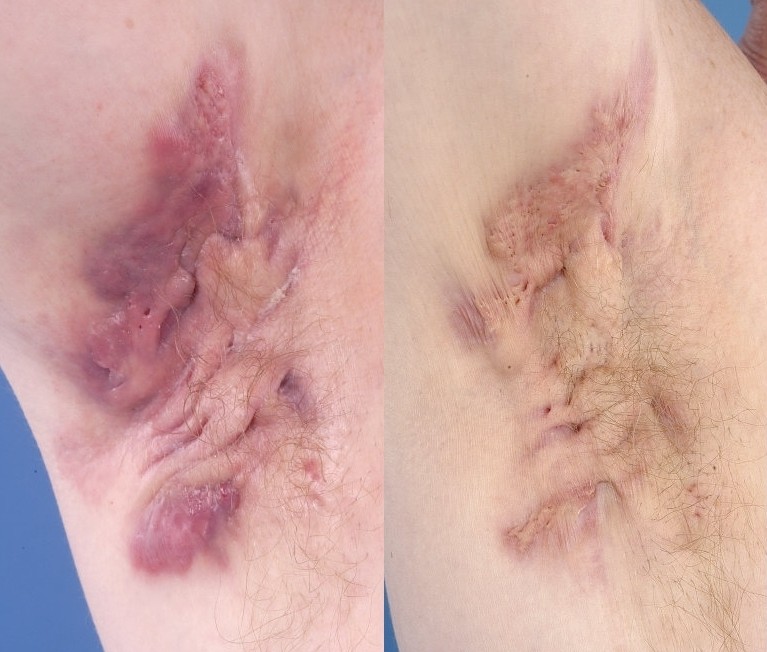
The photo above clearly shows the effects of treatment with TNF-alpha inhibitors. The left image shows the situation before starting treatment. The patient's armpit is severely inflamed, as evidenced by the purple color and swelling. The photo on the right was taken two weeks later, after starting the medication. The purple color and swelling have disappeared. The inflammation has subsided. This patient was treated with infliximab infusions, but adalimumab injections achieve similar results.
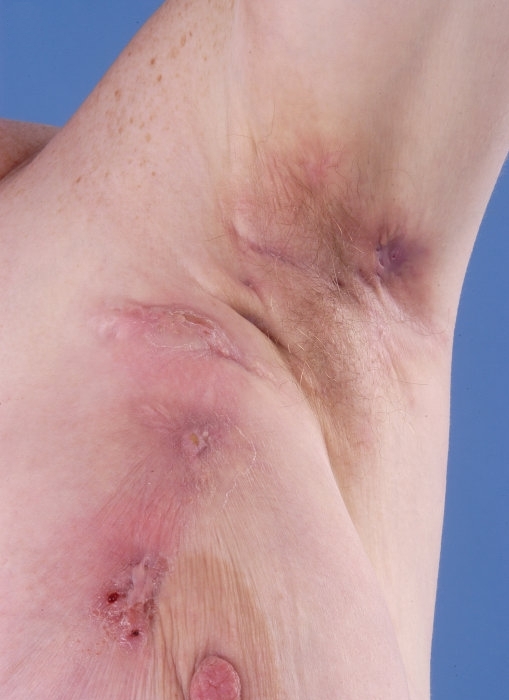
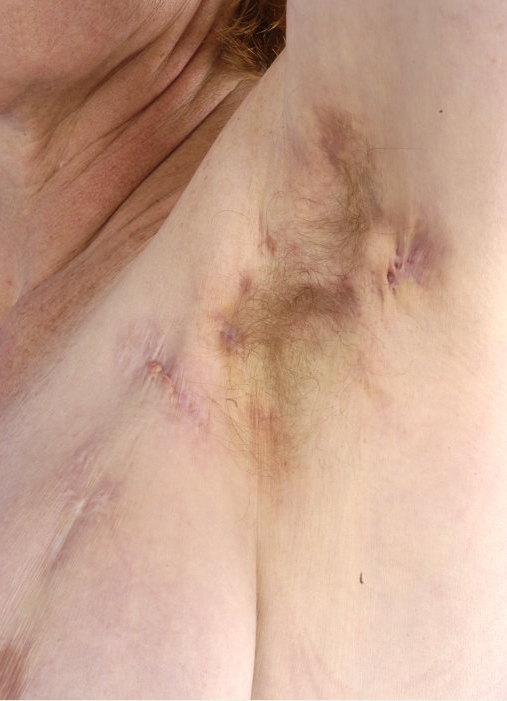
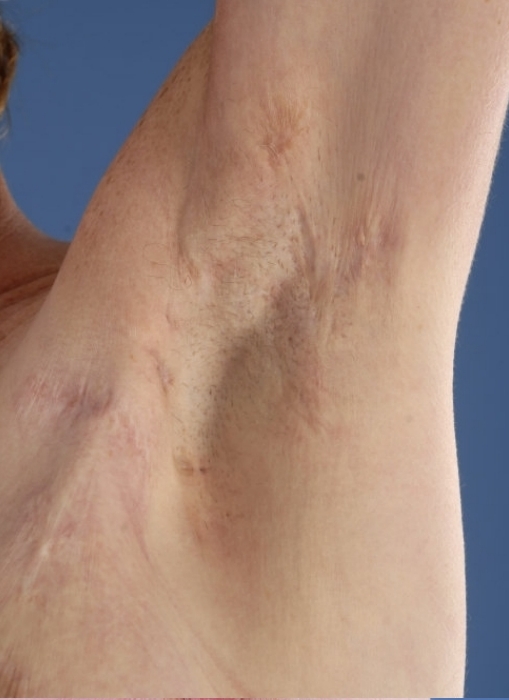
The effect of TNF-alpha inhibitors can last for a very long time. The left photo was taken before starting the medication. Purple inflammation is visible, as well as fistula openings and cords under the skin. The patient cannot move her armpit properly. Due to the scarring, the breast is pulled upward when the arm is raised. Subsequently, the TNF-alpha inhibitor infliximab was started. The middle photo was taken after 6 weeks. The inflammation has subsided, the swelling and cords have disappeared, and the mobility of the armpit has returned to normal. The right photo was taken after 3 years. The armpit is still calm, and no new lesions have developed. Similar results can be achieved with adalimumab.
Blood tests also show that the inflammation is disappearing from the body. The erythrocyte sedimentation rate (ESR) decreases, indicating improvement.
As the inflammation subsides, it becomes easier to identify any remaining fistulas or abscesses under the skin. These can then be surgically removed to prevent the condition from recurring. Once all the lesions are gone, treatment with adalimumab can be discontinued.
5. CAN I BE COMPLETELY CURE WITH ADALIMUMAB? Complete recovery is achievable for some patients if the treatment is combined with other treatments such as surgery. A significant improvement can be expected for most patients. The effect of adalimumab also depends on the type of hidradenitis. Hidradenitis suppurativa is a generic term for all kinds of inflammation originating in the hair follicles, but there are different types that respond differently to adalimumab.
Adalimumab and other TNF inhibitors such as infliximab are primarily administered to patients with classic hidradenitis suppurativa of the armpits and groin who experience significant inflammation (purple discoloration) around the hidradenitis patches. TNF inhibitors suppress the inflammation. Because the inflammation decreases, the symptoms subside. There is less pus formation, less redness, less purple discoloration, less swelling, and less pain. This significantly improves the condition of patients with this type of hidradenitis. Some patches disappear completely. However, after discontinuing adalimumab, the patches can return.Fistulas and abscess cavitiesBoils that recur in the same location usually do not respond, or not sufficiently, to TNF inhibitors and must be surgically removed.
There are also patients who only have fistulas , sometimes just one or a few, with little inflammation around them. These patients expect little benefit from adalimumab: surgical removal of the lesions is a much better treatment.
There are also patients who primarily have boils and abscesses in the folds of the body, who are overweight . These boils and abscesses develop due to sweating and sweltering in body folds that overlap, for example, under the breasts or in the abdominal folds or groin. Sometimes these patients also have diabetes, also related to being overweight. This form is sometimes called hidradenitis because fistulas can also develop locally, but the correct medical name is furunculosis in cases of obesity . Adalimumab is not the first-choice treatment for this type either. Losing weight is the most important. Short or long courses of antibiotics can also be used.
Sometimes patients (especially men) have fistula openings on the buttocks that strongly resemble hidradenitis suppurativa, but upon closer inspection, they are actually fistulas connected to the anus ( perianal fistulas ). These fistulas can be several centimeters long and radiate across the entire buttock. This type of fistula also requires surgical treatment. This variant should be treated by surgeons experienced in operating around the anus.Fistulas in the gluteal cleftThese can be associated with yet another condition called pilonidal sinus ( pilonidal cyst ). This form of fistula can also only be treated surgically.
Several patients have already been described in whom adalimumab is ineffective or ineffective. In some of these patients, it is ineffective without any known explanation. And in some of these patients, it does work somewhat, but the inflammation and fistula formation have progressed to the point that they cannot be controlled even with adalimumab.
There are also patients who initially respond well to adalimumab, but later fail. This is often because the body produces antibodies against adalimumab. These antibodies block the drug, rendering it ineffective. Blood tests can determine whether antibodies are present. The amount of adalimumab in the blood can also be determined. If antibodies have been formed (>12 U) and the amount of adalimumab in the blood is low, there is little point in continuing treatment.
Some patients recover completely. Most patients who ultimately achieve complete recovery received a combination treatment of adalimumab, antibiotics, and surgery. Adalimumab was initially administered for as long as necessary. Then, surgical removal of any remaining lesions began. Laser epilation with a medical hair removal laser is often also used to preventively remove all hair follicles. In approximately one in three patients, this approach successfully cures hidradenitis. Complete recovery means: all lesions have disappeared and further treatment is no longer necessary.
The treatment of hidradenitis suppurativa with TNF-alpha inhibitors such as infliximab and adalimumab has been used since 2003, and hundreds of patients worldwide have now been treated. The results are good. Much is also known about the side effects, as many thousands of patients with Crohn's disease, rheumatoid arthritis, or psoriasis have been treated with infliximab or adalimumab. The side effects are not too bad. See the package insert for adalimumab for more information.
6. HOW LONG DOES THE EFFECT LASTS? Studies on this subject provide mixed results. In some patients, the effect lasts for months to years after discontinuation. However, in most patients, adalimumab remains effective for as long as it is given, but after discontinuation, the inflammation gradually returns. Therefore, it is important to begin surgically removing any remnants during the period when the condition has subsided.
7. CAN I UNDERGO SURGERY IF I USE ADALIMUMAB? Surgery creates a wound that needs to heal, and wound infection can sometimes occur. TNF-alpha is involved in both processes, so theoretically, wound healing or clearing of infections could be impaired in patients taking adalimumab. Therefore, the package insert states that you must inform the patient that you are taking adalimumab if surgery is required, and that in some cases, adalimumab must be stopped well in advance, for example, in the case of planned major or serious surgery.
Patients with hidradenitis suppurativa often require minor or major skin procedures. In practice, there are no known examples of hidradenitis patients who experienced additional problems with wound healing or wound infection due to adalimumab use during these types of procedures. Therefore, you may undergo surgery. For this special category of patients with hidradenitis suppurativa, adalimumab is often administered specifically to ensure smooth surgery. It is therefore not necessary to discontinue adalimumab or postpone a procedure. However, you must inform the surgeon that you are using adalimumab. For surgeries other than those on the skin, you must consult your attending physician.
8. HOW AM I ELIGIBLE FOR TREATMENT WITH ADALIMUMAB? The first step is to be referred to a dermatologist with experience in treating hidradenitis suppurativa with adalimumab. The most important condition for being eligible for treatment is that you have a very severe form of hidradenitis suppurativa that cannot be controlled with other medications or surgical intervention. In addition, adalimumab has been shown to be particularly effective for those variants of hidradenitis with significant inflammation, recognizable by purple discoloration and swelling and hardening of the skin around abscesses and fistulas. It is up to your dermatologist to assess this and to determine the expected success of adalimumab treatment. Some patients have a form of hidradenitis that benefits more from antibiotic treatment and/or a series of minor procedures to clear the fistulas. If this is the case, your dermatologist will inform you honestly. You should then be confident that adalimumab treatment is not the right choice for you at this time.
9. IS ANY SPECIAL TESTING REQUIRED? Before you can start taking adalimumab, it must be certain that you do not have any underlying infections such as tuberculosis (TB) or hepatitis (liver inflammation). These can flare up when taking adalimumab. Therefore, blood tests are performed prior to treatment. To rule out tuberculosis, a lung X-ray is also taken, and a Mantoux test is administered in your arm. This is a skin prick that tests whether you have ever been exposed to the tuberculosis bacteria. The Mantoux test is read after 3 to 5 days; no lump should be visible at the injection site. If a lump does appear (positive Mantoux), you should see a pulmonologist to determine whether you have a history of TB.
To document the severity, X-rays are usually taken before and during treatment. Blood tests are also performed occasionally during treatment to see if the inflammation is decreasing. Sometimes health questionnaires are distributed to assess your condition before and after treatment.
10. WHAT CAN I EXPECT FROM TREATMENT WITH ADALIMUMAB? The result you can expect from treatment with adalimumab is that the inflammation will subside. The pain and swelling will decrease. The amount of pus that comes out will also decrease. Some areas will disappear completely, and fistulas can also disappear entirely. Blood tests (blood tests) will show that the inflammation is disappearing from the body. The erythrocyte sedimentation rate (ESR) will decrease, indicating improvement. As the inflammation subsides, it will also become more visible where there are still channels (fistulas) or cavities (abscesses) under the skin. These can then be surgically removed to prevent the condition from recurring.
Surgical intervention is not always necessary, but often is. If hidradenitis suppurativa persists for a long time, large cavities and deep fistulas can develop, completely lined with ingrown skin. Fistulas can disappear spontaneously with adalimumab, but this does not happen in all cases. Any remaining lesions must be surgically removed.
Ideally, treatment with TNF inhibitors is part of a comprehensive approach to the problem:
1) if you benefit from antibiotics, they are continued;
2) the inflammation is calmed with TNF inhibitors;
3) fistulas and abscesses are cleared through multiple minor and major procedures; and
4) you try to quit smoking.
5) you are trying to lose weight if you are overweight
![Combination therapy for hidradenitis suppurativa (click on photo to enlarge) [source: www.huidziekten.nl]](../../images/figures/combinatietherapiew.jpg "Combination therapy for hidradenitis suppurativa (click on photo to enlarge) [source: www.huidziekten.nl]")
11. WHERE DOES TREATMENT WITH ADALIMUMAB TAKE PLACE? Adalimumab is an expensive medication. Treatment costs thousands of euros per year. Currently, all expensive medications are paid for from hospital budgets. Most academic hospitals and larger hospitals have a budget for expensive medications and can prescribe adalimab. Smaller treatment centers do not always have a budget for expensive medications.
12. IS ADALIMUMAB REIMBURSEMENT? Medications are usually dispensed by your own pharmacy and billed to your health insurance. Some medications are not reimbursed or are partially reimbursed. The process is different for adalimumab. Adalimumab is an expensive medication and is paid for from the hospital budget. Therefore, it can only be collected from the hospital pharmacy. It is not a given that there is sufficient budget to prescribe all expensive medications; hospitals must apply for funding for this, and the problem is that more and more new, expensive medications are being introduced, while healthcare costs cannot be allowed to rise too much.
13. WHAT ABOUT THE FLU? DO I NEED TO GET VACCINATED? Adalimumab is a drug that suppresses the immune system. This means that once you use this drug, you fall into the category of "patients with reduced resistance to infections" and are eligible for the flu shot. The current recommendation is to get vaccinated as soon as the vaccine becomes available.
It is also wise to contact your GP now to inquire whether their records indicate that you fall into the category of "patients with reduced resistance" eligible for the flu shot.
14. WHAT CAN I STILL DO? The most important advice is to quit smoking! It has been shown that most patients with severe hidradenitis smoke. While the percentage of smokers in the Netherlands has dropped to below 25%, it appears that more than 80% of patients with severe hidradenitis smoke. This is a very significant and significant difference. There's a theory that hair follicle openings become clogged by chemicals in cigarette smoke, such as tar and dioxins. It's very difficult to quit smoking, and patients don't like this advice and sometimes become very frustrated by it. But it's important that you try. Quitting smoking is also wise for other reasons. Existing deep abscesses and fistulas won't disappear if you stop smoking, but it's about limiting future damage.
Overweight patients need to lose weight . This is also difficult. A dietitian can be helpful.
If hidradenitis suppurativa is in hairy areas such as the armpits or pubic hair, the hair can be removed with laser epilation. This is preventative. If there are no hair follicles left, they can no longer become infected. However, it is not effective for abscesses and fistulas that have already formed.
More information about hidradenitis suppurativa (other treatments, surgery):
hidradenitis suppurativa (brochure about the clinical picture)
fistulas under the skin (brochure about fistulas)
surgery for hidradenitis suppurativa (brochure about the procedures).
See also www.hidradenitis.eu (website with photos) |

![Combination therapy for hidradenitis suppurativa (click on photo to enlarge) [source: www.huidziekten.nl]](../../images/figures/combinatietherapie.jpg "Combination therapy for hidradenitis suppurativa (click on photo to enlarge) [source: www.huidziekten.nl]")