WHAT IS PYODERMA GANGRENOSUM?Pyoderma gangrenosum is a very rare skin disease in which ulcers develop spontaneously or after skin damage, which slowly enlarge. It is a serious skin disease that can cause significant damage if not recognized and treated promptly. The name is confusing because pyoderma means (pus-filled) skin infection, but this skin disease is not caused by bacteria. Gangrenosum does indeed mean the formation of dead tissue.
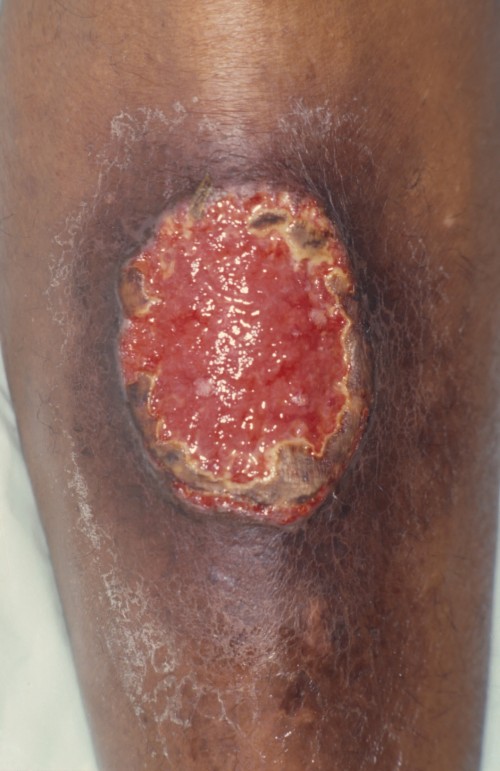
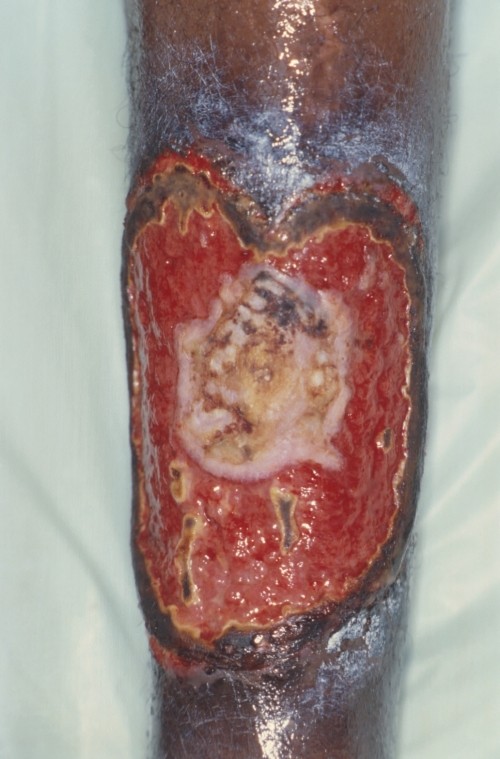
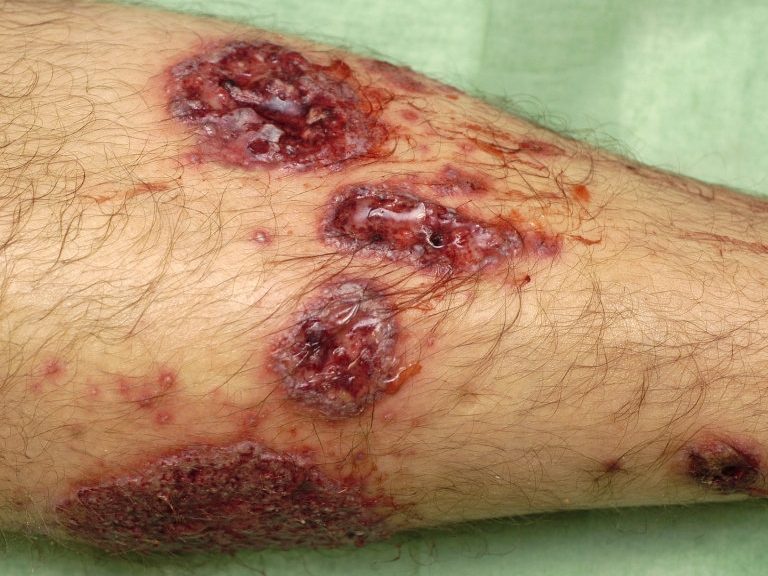
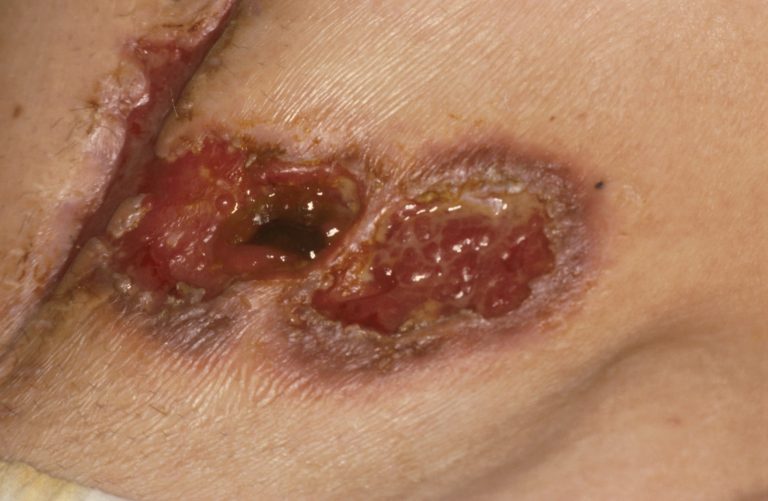
The major problem with pyoderma gangrenosum is that it is so rare that many doctors have never heard of it and don't know how to recognize or treat it. Because of its rarity, the average surgeon, internist, or general practitioner will never see a patient with pyoderma gangrenosum. In the early stages, it resembles an out-of-control infection. The classic treatment for pyoderma gangrenosum is that patients are given one antibiotic after another, increasingly powerful drugs, which have no effect whatsoever. The wounds simply become larger and larger. Until finally a dermatologist is consulted who recognizes the picture, purely based on how it looks.HOW TO RECOGNIZE PYODERMA GANGRENOSUM?Pyoderma gangrenosum causes ulcers (deep wounds) that gradually enlarge. The edges are often slightly purple, giving the wound an inflamed appearance. The skin at these purple edges breaks and separates from the underlying layer, causing the wound to enlarge. The wounds can originate as a small spot, sometimes from a pimple, and then gradually expand in all directions. They can also spread, for example, from the foot to the lower leg. Sometimes the center of the wound has already healed, while the edges are still active. Pyoderma gangrenosum is, of course, very painful because it causes deep wounds. The wounds can also develop due to skin damage, for example, in a surgical scar or around a stoma. In that case, it is difficult to distinguish from a wound infection.
Patients with pyoderma gangrenosum may also experience fever, a general feeling of illness, and joint pain. Blood tests often show an elevated erythrocyte sedimentation rate (ESR), an excess of white blood cells (leukocytes), and anemia.
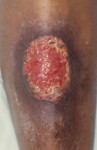 |
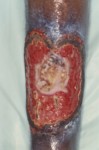 |
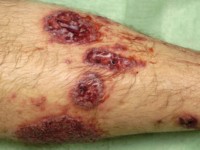 |
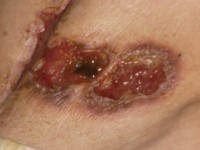 |
| after bumping |
after 1 week |
pyoderma in Wegener's |
pyoderma in Crohn's |
HOW IS THE DIAGNOSIS CONFIRMED?Unfortunately, there is no test that can confirm pyoderma gangrenosum. A biopsy (a piece of skin) can be taken for further examination under a microscope. The pathologist can see in this material that there is significant inflammation and that the skin and subcutaneous tissue are dying, but cannot definitively say that it is pyoderma gangrenosum. At most, a result such as "the picture is consistent with the suspicion of pyoderma gangrenosum" may be given. The diagnosis is therefore primarily based on the appearance of the wound and its progression.
Pyoderma gangrenosum can occur in patients suffering from an internal disease, such as a bowel disease like Crohn's disease, or an autoimmune disease like rheumatoid arthritis. If such an "underlying disease" is present, it is somewhat easier to diagnose pyoderma gangrenosum.COULD IT ALSO BE ANOTHER DISEASE?Several other conditions can also cause wounds that resemble pyoderma gangrenosum. These include infections, vasculitis, clotting disorders, and lymphomas. These other causes can be ruled out through additional testing, such as wound cultures and blood tests, or a skin biopsy.WHAT CAUSES PYODERMA GANGRENOSUM?The cause is unknown. It's an out-of-control inflammatory response that draws a large number of white blood cells (leukocytes) to the wound area. It's a normal immune system response that these cells move to a problem area. The inflammatory cells are attracted by various chemicals (called cytokines) that are released at the site. The white blood cells trigger a cleanup response; they can clear away bacteria and damaged tissue with the help of enzymes. In normal reactions, the inflammation eventually subsides. With pyoderma gangrenosum, the stop signal is somehow missing, and an increasing number of inflammatory cells then begin to attack healthy skin.HOW DO I FIND OUT IF I HAVE AN UNDERLYING INTERNAL DISEASE?As mentioned previously, pyoderma gangrenosum can occur in patients with an internal disease. This is the case in approximately half of the patients. In the other half, pyoderma gangrenosum occurs spontaneously, without the presence of another disease.
There is a long list of internal diseases in which pyoderma gangrenosum can occur. The most important are inflammatory bowel diseases (Crohn's disease and ulcerative colitis) and autoimmune diseases with joint complaints, such as rheumatoid arthritis, seronegative arthritis, and psoriatic arthritis.
If there is an underlying disease, it usually also causes symptoms such as abdominal pain, diarrhea, blood in the stool, joint pain, etc. It is therefore important to carefully determine whether you have or have had any of these symptoms. In addition, underlying internal diseases can be detected by performing blood tests or other further investigations.HOW IS PYODERMA GANGRENOSUM TREATED?PrednisoneIn the case of serious wounds or rapidly spreading wounds, it is necessary to stop the disease immediately to prevent further damage. This is usually done with prednisone. Prednisone works quickly; within two days, the disease process can be seen to be halted. Sometimes, a high dose is necessary. Once the disease is under control, the daily dose of prednisone is gradually reduced to the lowest effective dose.CyclosporineBecause long-term use of prednisone can cause side effects, it's recommended to switch to other medications that also have anti-inflammatory properties. One example is ciclosporin. Ciclosporin doesn't work as quickly as prednisone and can also have side effects, but if well tolerated, it's a medication that can be used for months or years without any problems.Sulfasalazine and mesalazineThese are originally antibiotics, but they also have an inhibitory effect on all kinds of inflammation. These agents are also used for inflammatory bowel disease and sometimes for rheumatoid conditions. They also appear effective in a large proportion of pyoderma gangrenosum patients. The main side effects are gastrointestinal discomfort and nausea, especially initially.TNF-alpha blockersTNF-alpha is a chemical (cytokine) that plays a key role in all kinds of inflammation in the body and attracts white blood cells. By inhibiting TNF-alpha, inflammation can be nipped in the bud. Examples of TNF-alpha-inhibiting drugs include Remicade and Remsima (infliximab), Enbrel (etanercept), and Humira (adalimumab). Remicade has been used for years for inflammatory bowel disease and has also proven to be very effective for pyoderma gangrenosum. These new agents are highly effective and work quickly. The disadvantage is that they can only be administered intravenously or as an injection, and they are very expensive.Local treatmentFor small wounds that do not spread quickly, local anti-inflammatory creams or ointments can be used. These can be corticosteroid creams, possibly alternating with antibacterial ointments, or hormone-free anti-inflammatory ointments such as Protopic (tacrolimus) ointment or Elidel (pimecrolimus) cream.Local wound careGood wound care is also important. There are many different products on the market for wound care. These can be simple moist gauze pads, possibly soaked in an antibacterial solution, or modern wound dressings that only need to be changed once a day, such as hydrogels. Antibiotics are not effective for pyoderma gangrenosum, but sometimes wounds are so contaminated with bacteria that it is wise to use them. For wounds with dead tissue, it is common to surgically remove it. However, with pyoderma gangrenosum, this can be counterproductive: cutting only makes the wound worse. Surgical intervention is not permitted until the disease has been controlled with medication. This also applies to skin grafts. Treatment with a vacuum pump helps some patients.WHAT ARE THE OUTLOOK?Once anti-inflammatory treatment has begun, healing begins. Eventually, the wounds will heal completely. The length of time this takes and the appearance of the scars depend on their size and depth. Once the wounds are completely closed, treatment can be gradually reduced and eventually stopped altogether. After that, the course of the disease varies. Some patients experience this condition only once, following a surgical procedure or skin injury, and then never again. It's also possible for pyoderma gangrenosum ulcers to reappear with each subsequent procedure or minor skin injury. However, because the patient is now aware of the condition, it will never escalate, as it is recognized and treated promptly. Preventative prednisone can be administered for planned procedures if necessary. It's important to inform the surgeon of your history of pyoderma gangrenosum during planned procedures, and that this can cause problems during surgery.
Unfortunately, it also happens that the ulcers return spontaneously, sometimes for years, or that continuous treatment with prednisone or other anti-inflammatory drugs is necessary to prevent the ulcers from recurring. However, this is an exception. |