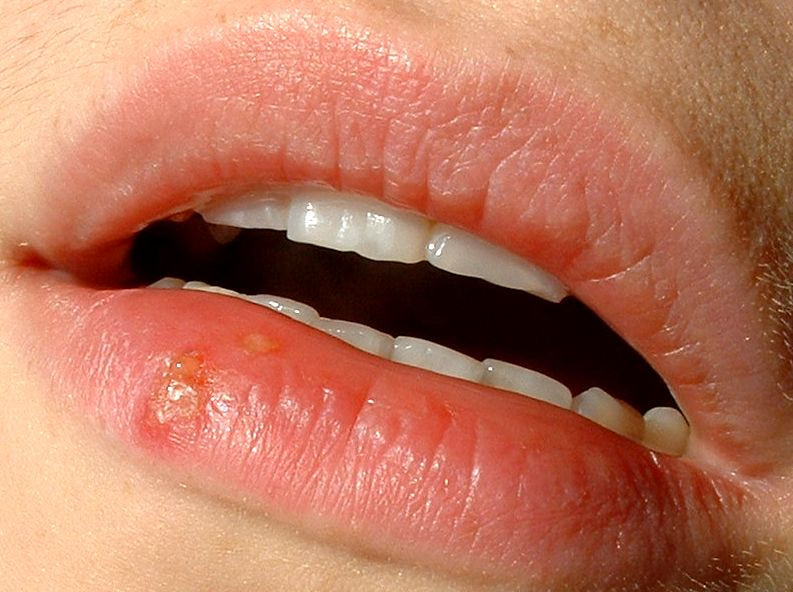
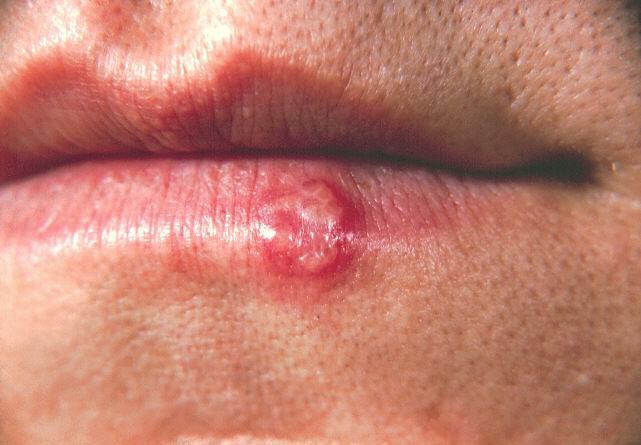
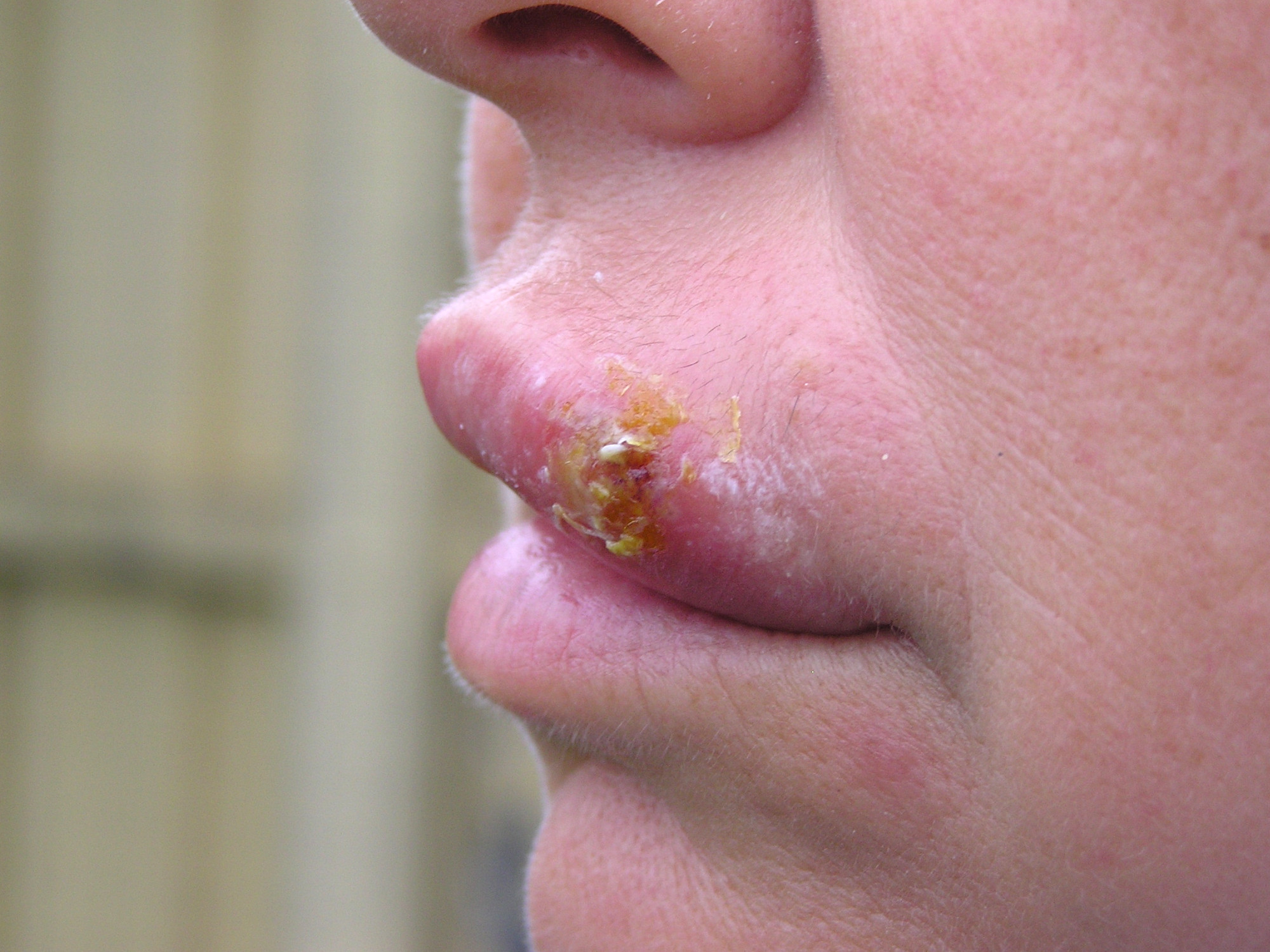
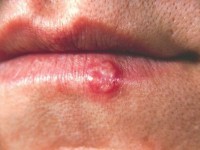
WHAT IS A COLD SORE?A cold sore is an infection with the herpes simplex virus. It usually starts as a blister on the lip, later developing into a painful ulcer. It usually clears up on its own, but it's bothersome and can recur.
 |
 |
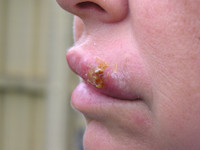 |
| herpes simplex labialis (HSV-1) |
herpes simplex labialis (HSV-1) |
herpes simplex labialis (HSV-1) |
Photos: Metju12, CDC Atlanta, and Ben Tillman - Wikimedia (Creative Commons License 1.0 / 2.0 ).
HOW DOES A COLD SORE DEVELOP?A cold sore (also called fever blister) is caused by herpes simplex. There are two different types of the herpes simplex virus: type 1 causes herpes on the lips and face, while type 2 causes herpes on and around the genitals.
Most people with cold sores first contracted the herpes simplex virus type 1 at a young age without realizing it, often as early as toddlerhood (thanks to kissing grandmothers and aunts). The virus then hides in a dormant state within the body. The virus penetrates local nerve endings and travels along nerve pathways to the corresponding nerve node. In the Netherlands, 50-70% of the population carries the virus. Under certain circumstances, usually when someone is feeling unwell (for example, with a cold or the flu with a fever), the virus flares up and develops a cold sore or fever blister.
So, you don't get a new infection every time. You carry the virus yourself, and under certain circumstances, it reappears. How often this happens varies from person to person. Some people infected with the virus never get a cold sore, some only once or twice a year, and unlucky ones, every month.WHAT ARE THE PHENOMENA?Herpes simplex type 1 can occur anywhere on the body, but it's most common on the lips or around the mouth. It can also appear in or on the nose. Small blisters initially develop, which may feel painful or burning. Later, the blisters dry up into crusts, which eventually fall off spontaneously. The course of herpes on the lips is often very mild, but sometimes the pain is severe and cosmetically disfiguring skin lesions develop.HOW DOES THE FIRST HERPES SIMPLEX INFECTION PROCEED?The first infection often occurs at a young age and is usually asymptomatic and unnoticed. Infection occurs through contact with people with cold sores. After 3 to 9 days, symptoms may develop, such as inflammation of the cheek, gums, tongue, or lips, swollen lymph nodes, and sometimes general symptoms and fever. The virus then establishes itself in the nerve fibers. Later, various factors, including fever, sunlight, menstruation, or stress, can trigger the virus to reactivate and travel from the nerve node to the originally infected area of the skin or mucous membrane, causing a new cold sore.HOW DOES CONTAMINATION OCCUR?Infection occurs primarily through direct contact with a carrier of the virus. Transmission is possible through direct skin or mucous membrane contact (kissing, sexual contact), but also via certain objects. Touching the herpes rash with your fingers can also transmit the virus.HOW IS THE DIAGNOSIS MADE?The diagnosis of an HSV infection of the skin and mucous membranes is usually made based on its appearance (the presenting symptoms). If there is any doubt, a culture can be taken.HOW IS A COLD SORE TREATED?Because cold sores resolve on their own, treatment isn't strictly necessary. An antiviral cream (acyclovir cream, Zovirax) can be applied; these are available at drugstores or pharmacies. These medications are available without a prescription and are no longer reimbursed. In severe cases, often in patients with compromised immune systems, antiviral tablets can be administered. If the cold sore recurs frequently, for example, monthly, these antiviral medications can also be administered preventatively, daily for months. Special lip patches (Compeed) are available to camouflage the sores.HOW DO I PREVENT THE SPREAD OF THE VIRUS?Don't touch herpes sores with your fingers, so don't scratch the scabs either. When applying cream or ointment to herpes, use a cotton swab. When applying or removing cosmetics from your face, avoid any contact with the herpes sore. Don't wear lipstick while herpes is present on your lips. When washing, avoid any contact between the herpes sore and a washcloth or towel. Wash your hands immediately after contact with herpes sore.HOW DO I PREVENT OTHERS FROM BECOMING INFECTED?If you have a cold sore on your lips, keep toiletries, eating utensils, and drinking utensils strictly for private use. Make sure no one else uses them and wash them thoroughly immediately after use. Avoid direct contact with other people's lips; for example, avoid kissing or hugging babies. Stay away from pregnant women if you have a cold sore, especially if the pregnant woman has never had one herself. Also be careful with children or adults with atopic eczema. With atopic eczema, the herpes virus can spread rapidly across the entire skin and cause sores everywhere.WHAT ARE THE OUTLOOK?Once infected with the herpes virus, people carry it for life. Most people experience no symptoms at all. In some, the virus becomes active occasionally, causing symptoms to recur. In a very small group, this happens so frequently and severely that it becomes truly distressing. Over time, however, even in these people, the attacks decrease in severity and frequency. |