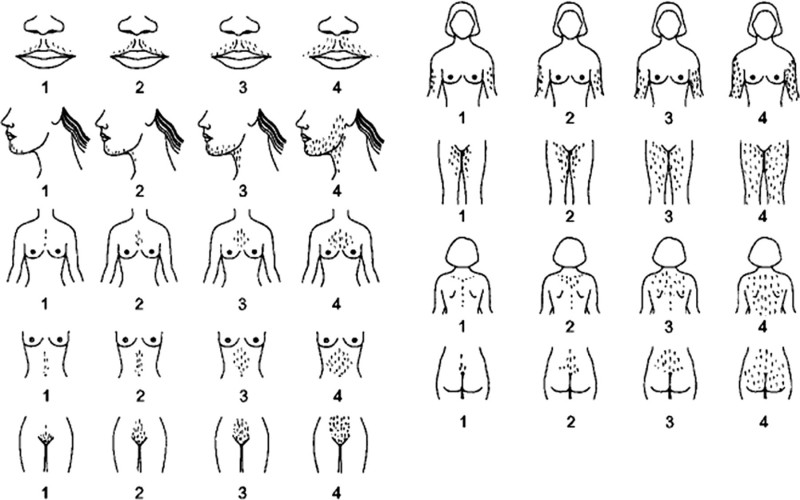
WHAT IS HIRSUTISM?HirsutismHirsutism is excessive hair growth in women, in a male-pattern. This means that hair grows in places where women normally don't have hair, such as on the face (beard and mustache), neck, chest, around the nipples, on the lower abdomen between the navel and pubic area, and on the legs. The hair is also dark and thick, much more visible than the light-colored, fine hairs normally found on the face and body of women, which are barely visible.
Hirsutism is common; approximately 5% of women of childbearing age suffer from it. Health insurers consider it purely a cosmetic problem, but the women who suffer from it suffer greatly. It is caused by a hormonal imbalance.
![Hirsutism (excessive hair growth in women, in a male pattern) (click on photo to enlarge) [source: internet]](../../images/hirsutisme-1z.jpg "Hirsutism (excessive hair growth in women, in a male pattern) (click on photo to enlarge) [source: internet]") |
![Hirsutism (excessive hair growth in women, in a male pattern) (click on photo to enlarge) [source: internet]](../../images/hirsutisme-2z.jpg "Hirsutism (excessive hair growth in women, in a male pattern) (click on photo to enlarge) [source: internet]") |
![Hirsutism (excessive hair growth in women, in a male pattern) (click on photo to enlarge) [source: internet]](../../images/hirsutisme-3z.jpg "Hirsutism (excessive hair growth in women, in a male pattern) (click on photo to enlarge) [source: internet]") |
| hirsutism |
hirsutism |
hirsutism |
WHAT IS THE CAUSE?The cause is usually an excessively high level of testosterone (a male hormone) in the blood. Testosterone causes beard and mustache growth, as well as hair growth elsewhere on the body. Men have a lot of testosterone in their bodies, but women also have a small amount. If this level becomes too high, excessive hair growth in a male pattern occurs.
In some women, hirsutism is hereditary. It therefore runs in their families; all women suffer from excessive hair growth. This is sometimes seen in Turkish, Moroccan, or Greek families. They may have too much testosterone in their blood, but it is also possible that the testosterone level is normal, but the hair is overly sensitive to it.
There are also conditions in which too much testosterone is produced. In women, it can happen that numerous cysts have developed in the ovaries, which produce too much testosterone. This is called polycystic ovary syndrome (PCOS). In women with PCOS, in addition to hirsutism, women also experience irregular menstruation and can also experience infertility. Polycystic ovary syndrome is also often associated with obesity and diabetes mellitus.
Testosterone is produced not only by the ovaries but also by the adrenal glands. Adrenal gland disorders can also cause hirsutism. In addition, certain medications can cause hirsutism (certain oral contraceptives, anabolic steroids, testosterone, danazol, metoclopramide, methyldopa, valproate, reserpine, phenytoin, hydralazine, minoxidil, tamoxifen, cyclosporine, prasterone, and others).WHAT DOES HIRSUTISM LOOK LIKE?Hirsutism causes dark, coarse hairs to appear on the upper lip, chin, neck, chest, around the nipples, abdomen, back, and inner thighs. There are varying degrees of hair growth, from a few dark hairs to heavy hair growth.
HOW IS THE DIAGNOSIS MADE?The diagnosis is based on the clinical picture and its appearance. The areas of the body with excessive hair growth are examined, and whether the hair is vellus (normal) or dark and coarse. The severity of the hair growth on various parts of the body can be expressed as a score (see the score card above). Furthermore, the diagnosis is made for symptoms that indicate a hormonal disorder, such as irregular menstruation, or symptoms consistent with high testosterone levels (hair loss on top of the head in a male-like pattern, a deep voice, genital abnormalities).
If there are reasons to suspect hormonal disorders, such as irregular menstruation, further investigation is necessary. The dermatologist can perform blood tests themselves or refer the patient to a gynecologist or an internist/endocrinologist. The gynecologist is usually the one consulted, because a common cause is polycystic ovary syndrome (PCOS). This requires a gynecological examination, plus an ultrasound of the ovaries.HOW IS HIRSUTISM TREATED?The first step is to look for an underlying cause. If PCOS is present, the gynecologist will prescribe treatment. This usually consists of a contraceptive pill such as Yasmin (which contains ethinylestradiol and drospirenone). For more information about PCOS, see the brochure on polycystic ovary syndrome from the Dutch Association for Obstetrics and Gynecology.
Treatment with a contraceptive pill often has a beneficial effect on hirsutism and can also regulate the menstrual cycle. Treatment with a combination preparation of ethinylestradiol and cyproterone acetate (Diane 35) is preferred. It is possible to add separate cyproterone acetate tablets to the treatment (50 or 100 mg per day) according to a fixed schedule. Cyproterone acetate is a hormone-like substance that resembles the male hormone testosterone. Cyproterone acetate displaces testosterone from its binding sites in hair follicles, thereby inhibiting the action of the male hormone.
Using a contraceptive pill can cause the following side effects: nausea, headache, breast tenderness or tenderness, and an increased risk of thrombosis. Cyproterone acetate can have side effects. Sometimes women may experience weight gain, mood swings, or irregular vaginal bleeding. There is also an increased risk of developing meningiomas.Diane-35 in the newsThe Diane pill received unfavorable press in 2013: dozens of deaths from thrombosis were reported to have occurred due to the pill. It's unfortunate that these scare stories were circulated by the media and Lareb, because the Diane pill is necessary for a number of conditions, such as severe acne and hirsutism. The fact is that all contraceptive pills carry an increased risk of thrombosis. The risk with Diane is twice as high as with other contraceptives, but in absolute numbers, the number of cases is very low. Because millions of women use contraceptives, a number of deaths are bound to occur over 30 years of use. The Diane pill has been evaluated by the Dutch and European Medicines Agency, which found no reason to ban it. Their recommendations are that it should only be used for acne and hirsutism, and not for regular contraception, and that women should be informed about the risk of thrombosis, which occurs primarily in the first year of use.
If there are objections to hormonal treatment, treatment with the drug spironolactone can be chosen. This drug blocks the effects of male hormones but can also have unpleasant side effects, such as increased urine production, nausea, breast tenderness, and menstrual irregularities. Because of these side effects, it is not commonly used. Furthermore, there is a possibility that spironolactone is not safe for the unborn child. Therefore, the drug is not suitable for women who are trying to conceive.
Hair Removal
If it is not possible to treat hair growth with hormonal drugs, or if these are not sufficiently effective, excessive hair growth can be treated in various ways.
Excessive hair can be treated with hair bleaching, depilatory cream, shaving, epilation, waxing, or treatment with a laser or flash lamp. For more information about laser and flash lamp treatment, please refer to the brochure " Laser Treatments in Dermatology .
" Laser or flash lamp treatment is usually performed by a skin therapist. Women with dark skin have an increased risk of developing pigmentation disorders and scars as a result of epilation, waxing and laser or flash lamp treatment.WHAT CAN YOU STILL DO YOURSELF?You can remove hair yourself using depilatory creams, shaving, plucking, and waxing. However, the effect will only be short-lived. Removing hair yourself does not affect its thickness. Therefore, hair does not become coarser or grow faster after shaving, waxing, or plucking. If you are overweight, it is advisable to lose weight. In women with PCOS, even a 5% weight loss leads to lower testosterone production and less hirsutism; this also increases the chance of fertility.WHAT ARE THE OUTLOOK?The condition does not go away on its own, but sufficient improvement can usually be achieved with the treatments mentioned above. |

![Hirsutism (excessive hair growth in women, in a male pattern) (click on photo to enlarge) [source: internet]](../../images/hirsutisme-1.jpg "Hirsutism (excessive hair growth in women, in a male pattern) (click on photo to enlarge) [source: internet]")
![Hirsutism (excessive hair growth in women, in a male pattern) (click on photo to enlarge) [source: internet]](../../images/hirsutisme-2.jpg "Hirsutism (excessive hair growth in women, in a male pattern) (click on photo to enlarge) [source: internet]")
![Hirsutism (excessive hair growth in women, in a male pattern) (click on photo to enlarge) [source: internet]](../../images/hirsutisme-3.jpg "Hirsutism (excessive hair growth in women, in a male pattern) (click on photo to enlarge) [source: internet]")