WHAT DOES LASER MEAN?Laser stands for Light Amplification by the Stimulated Emission of Radiation.
A laser can emit a huge amount of light in a very short time.
The first laser device was built in 1959, and since then, laser technology has become an indispensable part of everyday life. Music CDs and price-reading devices at cash registers are examples of modern-day laser technology.
Lasers are also increasingly used in medicine. In addition, lasers are also used for cosmetic purposes.HOW DOES A LASER DEVICE WORK?A laser device consists of:
- A chamber filled with a medium that can be a gas, liquid, or solid.
- Mirrors are placed on either side of the chamber.
- A power source supplies energy to the medium inside the chamber, creating light.
- The light is bounced back and forth between the mirrors, producing a large amount of light in a very short time.
- One mirror has a hole with a shutter.
- Opening the shutter releases a beam of light.
- This laser light has a specific wavelength, depending on the medium inside the light chamber.FLASH LIGHTS OR INTENSE PULSED LIGHT (IPL)This is a different technique than laser devices. The difference is that a laser device emits a single wavelength, while a flash lamp emits multiple wavelengths. However, the effect on the skin is more or less the same, so what is stated about the effects of laser devices largely applies to flash lamps as well.WHAT DOES LASER LIGHT DO TO THE SKIN?When the laser beam strikes the skin, some areas can be damaged while others are spared. The laser is therefore able to selectively damage certain skin structures. Which structures are damaged and which are not is determined by factors such as the type of laser and the intensity of the radiation.
The skin structures that can be treated with lasers and flash lamps are:
- Blood vessels: Treatable with wavelengths from 500 to 600 nanometers (nm) and from 755 to 1064 nm (blood vessel lasers and flash lamps).
- Pigment: Treatable with wavelengths between 600 and 1064 nm (pigment lasers and flash lamps).
- Collagen (support tissue) disorders: Treatable with wavelengths from 585 to 595 nm and from 1064 to 1540 nm.
- Water: Treatable with wavelengths above 2000 nm. Because the epidermis is 70% water, epidermal abnormalities are treated with lasers that emit light at 2940 and 10,640 nm (evaporative lasers).
This means that not all skin abnormalities can be treated with a single laser device.
To achieve good results, the right device must be selected.
However, a single flashlight device can treat multiple skin abnormalities.
BLOOD VESSEL LASERSThe vascular lasers and flash lamps have the following effects on the skin:
- The epidermis is not damaged; the laser light passes through the epidermis as if it were glass.
- Overly dilated blood vessels in the dermis are destroyed.
- Normal blood vessels are spared.
- The skin's supporting tissue becomes more supple.
These devices can treat:
Vascular abnormalities:
- Port-wine stains
- Couperose vessels on the face
- Dilated vessels, for example, after X-rays:
- Spider veins .
Supportive tissue abnormalities:
- Thick and thin scars
- Stretch marks and stretch marks
- Signs of skin aging.
Skin diseases:
- Psoriasis
- Acne
- Warts.
Possible side effects of vascular lasers:
- Mild pain; local anesthesia is generally not necessary.
- Blue spots. These are small bruises that disappear within 1 to 2 weeks. - White spots mainly occur with tanned skin; therefore, it is recommended
to avoid sunlight on the skin to be treated
for 6 weeks before the laser treatment.
These white spots almost always disappear spontaneously.
- Dark spots usually develop due to sunlight exposure after laser treatment. It is recommended to avoid exposing the treated body parts to sunlight or sunbeds for four weeks after treatment.
- Scarring resulting from vascular laser treatment is rare.
These side effects also apply to a lesser extent to flashlights. After flashlight treatment, you can return to the sun after two weeks. Because the epidermis is not damaged, no wounds develop, so a bandage is not necessary.
Vascular laser (pulsed dye laser)
ABLATIVE LASERSVaporizing lasers can remove thin layers of epidermis with great accuracy. These devices are therefore suitable for skin imperfections such as raised moles, scars, early skin cancer, as well as wrinkles and signs of aging.
There are two types of vaporizing lasers: carbon dioxide (CO2 laser) and erbium laser. Of the two, the CO2 laser is more effective but also carries a higher risk of side effects.
The vaporization creates a superficial wound that heals within 3 days (erbium laser) or 1 to 3 weeks (CO2 laser). After the treatment, a bandage is applied, and treatment is usually prescribed to prevent wound infection with bacteria and viruses. After wrinkle treatment with the CO2 laser, and to a lesser extent with the erbium laser, there is initial excoriation of the face and wound fluid is released in the first few days, requiring frequent dressing changes. The face then becomes red and swollen. The redness and swelling do disappear, but this can take 3 weeks to 3 months. With the Erbium laser, this takes 1-2 weeks. The beneficial effect on wrinkles lasts 1-5 years.
Treatment with vaporizing lasers is painful. Superficial treatment with the Erbium laser can be performed without anesthesia, but deeper treatment requires local anesthesia. The CO2 laser treatment is much more painful and requires local or general anesthesia.
Possible side effects of vaporizing lasers:
- White spots that do not always disappear.
It is recommended to avoid sunlight for 6 weeks before treatment.
- Dark spots that usually disappear.
For these, it is recommended to avoid sunlight for 6 weeks after the Erbium laser treatment and for 3 months after the CO2 laser treatment.
- Wound infection (see above).
- Scar formation. This occurs more often with the CO2 laser than with the Erbium laser.
- Redness that does not disappear. This is a rare side effect of the CO2 laser and can be effectively treated with the vascular laser.
- Rosacea. This is a facial condition involving red bumps and pimples that is predisposed but can be worsened by laser treatment (especially the CO2 laser). This condition is treated with antibiotics (see also the rosacea leaflet ).
- Milia and transient acne.
- Allergic reactions to dressings may occur in rare cases.
Due to the potential side effects of the CO2 laser, in particular, non-ablative lasers are increasingly being used to treat scars and wrinkles. These lasers do not damage the epidermis and only improve the supporting tissue in the dermis. Multiple treatments are necessary to achieve sufficient results.
In older skin, the epidermis often appears sallow, especially in smokers, and this does not improve with non-ablative laser treatment. By combining this treatment with the Erbium laser or chemical peel, the desired result can still be achieved.
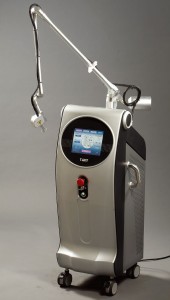 |
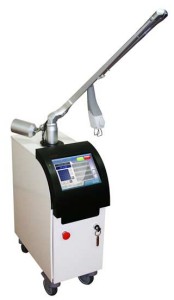 |
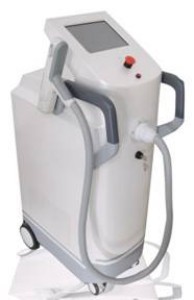 |
| CO2 laser |
CO2 fractional laser |
Erbium YAG laser |
PIGMENT LASERSPigment lasers and flash lamps work on the pigment in the skin. This pigment is called melanin.
Skin conditions containing pigment can be treated with these lasers, such as moles, age spots, and tattoos.
These lasers are also used for hair removal because hair follicles contain melanin during their growth phase. Resting hair follicles do not contain melanin and therefore do not respond to laser treatment. Over time, the resting hair follicles return to their growth phase and become sensitive to laser treatment again. This is why multiple treatments are required for hair removal.
Blonde, white, and gray hair contains no melanin at all, even during the growth phase. Therefore, the results for people with blonde, white, or gray hair are poor. New techniques are being developed in which the hair follicles are colored with melanin, which is injected into them via a spray. If sufficient melanin has been introduced into the hair follicles this way, laser hair removal of blonde, white, and gray hair is still possible.
Possible side effects of pigment lasers and flash lamps:
- The treatment is minimally painful; Anesthesia is not necessary.
- White spots, especially in people with dark skin.
- Dark spots, especially if the treated skin is exposed to sunlight within 4 weeks of treatment.
- Infections and scarring are rare.
These side effects also apply to a lesser extent to flash lamps (see previous text).WHAT IS THE FUTURE?Lasers and flash lamps have revolutionized the possibilities of cosmetic dermatology in particular. New techniques are being developed with the aim of achieving better results with a reduced risk of side effects. |