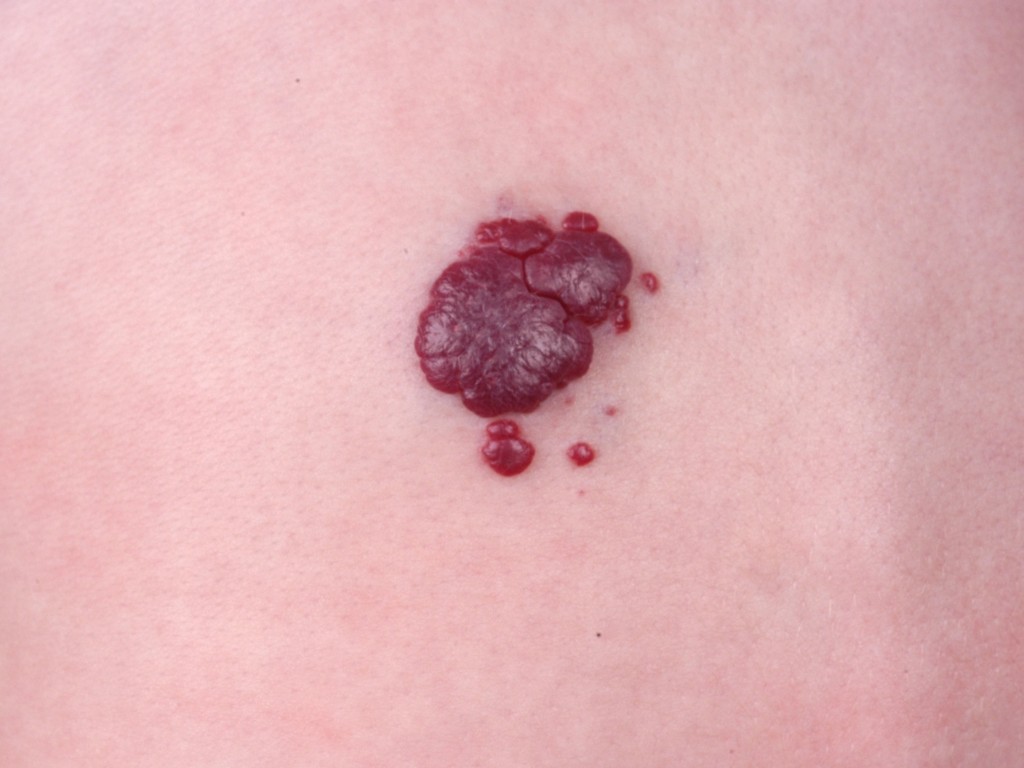
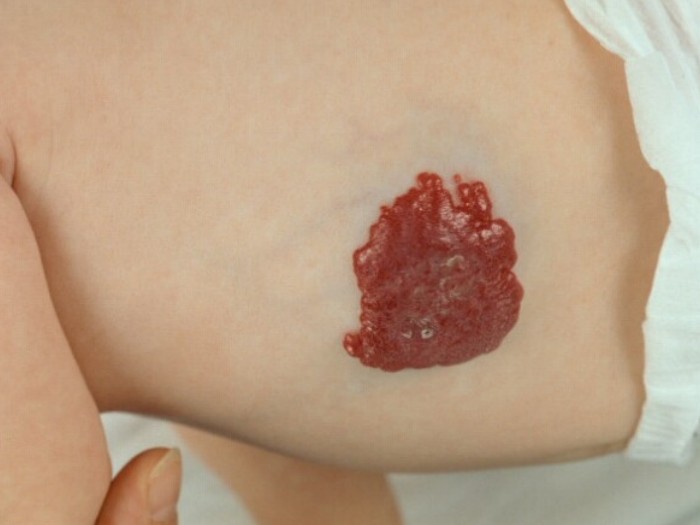
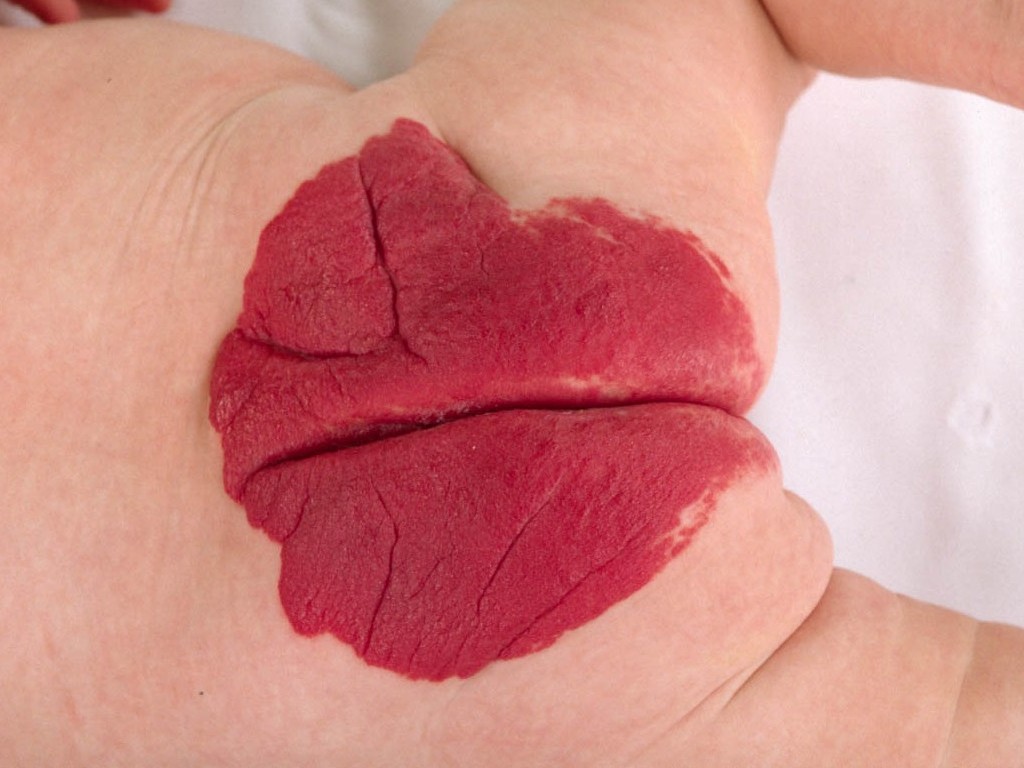
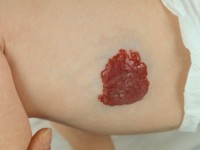
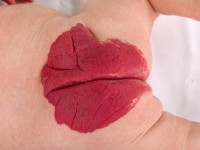
WHAT IS A HAEMANGIOMA?In short, a hemangioma is a benign blood vessel tumor. It develops due to the proliferation of small blood vessels, known as capillaries. These blood vessels are immature (like those of a fetus) and form a tangle through which blood flows relatively slowly. No one knows exactly how these swellings develop.
 |
 |
 |
| hemangioma |
hemangioma |
hemangioma |
Missing Hormones:
Since hemangiomas usually develop immediately after birth, it is suspected that hormones are missing, which are transmitted from mother to child in the womb via the placenta. After birth, these hormones are not yet produced by the newborn. The condition is also called strawberry or raspberry spot or cavernous hemangioma. Using all these names can lead to confusion; therefore, we use: hemangioma.
Different Hemangiomas:
10% of all babies have a hemangioma, sometimes even multiple ones. Depending on their location, hemangiomas look different:
close to the surface of the skin, they resemble a strawberry.
Deep under the skin, in muscle or gland, you see a swelling that appears blue.
Often, you see a combination of a deep and a superficial hemangioma.
The color of the hemangioma depends on the speed at which the blood flows through it: red if the blood flows quickly (during excitement or heat), blue if the blood flows more slowly. Coughing, crying, or straining can cause a hemangioma to swell and turn blue.
While resting, a hemangioma can be compressed to half its size. When you let go, it fills up like a sponge absorbing water and returns to its original size. This is completely normal. Hemangiomas can occur anywhere on the body, but unfortunately, they are most common in the head and neck area. The reason for this is unknown.DEVELOPMENT OF HAEMANGIOMASHemangiomas are rarely present at birth; their origins are unknown. Sometimes a pale or red spot appears at the site of the hemangioma's development. Ninety percent develop in the first month after birth, the rest in the following five months.
Adjacent, raspberry-like swellings can merge into a large spot. The final size is usually reached six months after onset. Babies can develop multiple small hemangiomas. These can also grow very large (up to 25 cm in diameter).
Any child can develop a hemangioma. Girls and premature babies have a higher risk. Hemangiomas are not hereditary, so subsequent children in the family have no increased risk of developing one.
There is no evidence that events during pregnancy are related to the development of hemangiomas.What is the course of the disease?Once a hemangioma becomes visible, a period of growth begins. This growth can be rapid or slow. It is impossible to predict how large a hemangioma will become at an early stage. After six months, almost all hemangiomas return to normal. Ultimately, 95% of hemangiomas disappear more or less completely. It does not matter whether they are deep or superficial, nor where they are located.
A general rule is:
in 20% of children, the hemangioma is gone by the age of 2;
in 40% of children, the hemangioma is gone by the age of 4;
in 70% of children, the hemangioma is gone by the age of 7.
Unfortunately, not 100% of hemangiomas are gone by the age of 10. Residual swelling often remains in hemangiomas on the nose, eyes, and lips. This can also occur in other locations. A hemangioma that disappears 'late' has a greater chance of disappearing incompletely. Medical intervention can reduce residual symptoms.
The first signs of the hemangioma's disappearance are the softening and appearance of gray spots. These gray spots merge, and the hemangioma's mass diminishes. A small scar usually remains: the skin resembles cigarette paper, and superficial blood vessels are visible.COMPLICATIONSBleeding and wounds.
Superficial—usually large—hemangiomas can bleed. This can last quite a while (it can ooze for up to an hour). The bleeding appears worse than it actually is and is rarely alarming. Applying pressure can help, but you should hold it for at least 10 minutes.
Poorly healing wounds are fortunately rare, especially with hemangiomas located near the anus or labia. Passing stool and urine is painful in these cases. Because poorly healing wounds can cause scarring, it is advisable to see a doctor promptly, especially if the wounds are on the ears and nose.
Hemangiomas can cause complications in various locations:
Internal hemangiomas.
Hemangiomas can occur not only on the skin but also in internal organs, such as the lungs, bladder, and muscles. Sometimes complications arise, depending on their location, but they usually go unnoticed. Children with more than three hemangiomas are examined for internal complications.
Kasabach-Merritt syndrome.
Very rarely, complications with blood clotting occur. These usually involve large, deeply located hemangiomas. These then extract particles from the blood that are important for blood clotting. The first signs are bleeding and/or bruising near a hemangioma.
Vision problems.
A hemangioma that blocks the eye in the first year of life—even if only for a few days—can permanently damage vision and lead to, among other things, a "lazy" eye. An eye that can no longer open due to a hemangioma is always an emergency. Even if a hemangioma does not completely block the eye, vision can be affected by it, for example, by increasing pressure on the eyeball.
Airway obstruction.
A hemangioma deep in the neck can press on the airways. This can cause difficulty breathing, recognizable by snoring and wheezing. An affected nose can cause problems in newborns, as they breathe only through their noses.
Hearing:
Sometimes the external auditory canal becomes blocked by a hemangioma. Hearing will then be somewhat impaired, but this will not have a negative effect on hearing in the long run.
Difficulty feeding:
Hemangiomas in the oral cavity and nose can make swallowing food and drink difficult.
Heart failure
Sometimes the amount of blood flowing through the hemangioma is so high that the heart cannot adequately supply the other organs. Fortunately, this serious complication is rare, only occurring in babies with multiple or large hemangiomas.
If you experience any of the above complications, contact your general practitioner or pediatrician, who will refer you to an ophthalmologist, dermatologist, or plastic surgeon. Very serious complications are treated in a hospital with a pediatric intensive care unit.TREATMENT OF HEMANGIOMASIf there are no complications and the appearance is not too disfiguring, it is better to wait until the spot disappears on its own. However, it is advisable to closely monitor hemangiomas during the growth phase, especially if they are located in problematic areas. If a hemangioma ulcerates or bleeds continuously, affects breathing, feeding, or vision, or is located in a cosmetically disfiguring area, treatment should be considered.
In recent years, hemangiomas are usually treated with propanolol oral solution. Superficial, small hemangiomas can also be treated with propanolol gel.
Other treatments include taking corticosteroids (prednisone) or injecting corticosteroids into the hemangioma. Interferon, laser treatment, surgical removal, and embolization (closing of blood vessels) are also used. Since the introduction of propanolol, these other treatments are rarely necessary.
Interferon can be effective against hemangiomas but has significant side effects, such as flu-like symptoms, liver problems, and changes in white blood cell counts. Laser treatment is effective in the early stages, when the hemangioma is still flat, and in cases of ulceration. Laser treatment can also cause the hair-like vessels to disappear once the hemangioma is gone. Surgical treatment can be considered for ulcers, for example, or if eyelid swelling persists. Embolization is only effective just before surgery and sometimes in cases of Kasabach-Merritt syndrome. The result is very short-lived, because other vessels take over the hemangioma's blood supply.
Impact on the child:
Whether having a hemangioma affects a child's behavior and emotions is, of course, difficult to say. Much depends on the child's personality. For example, whether they are sensitive by nature or very concerned about others. Generally, children are not very concerned with their appearance until they are about four years old.
Immediate environment:
If parents and family are not too distressed by the hemangioma and it is not a constant topic of conversation, the child will not suffer too much. If the environment reacts with stress and attention, the child will become aware of the abnormality and react more problematically.
Going to school:
If the child is primary school-aged and problems arise in dealing with the hemangioma, you should contact the teacher. At an earlier stage, you can also contact the preschool or daycare teacher. It turns out that part of the problem is solved when information is provided to teachers, other parents, and classmates. Explaining helps them understand what a hemangioma is. |