WHAT IS AN OINTMENT AND WHAT IS A CREAM?An ointment is a fatty ointment, while a cream is a water-based ointment with a small amount of added fat. Unlike an ointment, a cream dries out the skin.HOW DO YOU CARE FOR DRY SKIN?Dry skin causes itching. Itching means scratching. Scratching often worsens skin conditions (eczema, psoriasis). It's important to keep your skin moisturized. You can use a neutral ointment, such as paraffin-vaseline, without restriction to keep your skin moisturized and supple. Sometimes using a greasy ointment is uncomfortable because it occludes your skin too much. In that case, you can consult with your doctor to find a different ointment that is more comfortable for your skin. The use of creams and body lotions is not recommended. These contain a lot of water and dry out your skin too much.SHOWER OR BATHShowering sometimes helps with the itching. However, this is often short-lived. Water dries out the skin. The few remaining oils in your skin are lost when you bathe. However, the ointment or cream is better absorbed into your skin after showering or bathing. The following advice applies to showering and bathing:
- Use bath oil instead of soap. You can also use bath oil, which has a cleansing effect, in the shower as a liquid soap. Keep in mind that the bath oil can make your bath or shower slippery;
- Take short showers or baths: three to seven minutes;
- Do not use water that is too hot or too cold. Otherwise, your skin will be over-irritated, causing more itching.
- Apply skin care ointments preferably immediately after drying.CHILDREN AND WATERThese tips, of course, also apply to children. However, here's an extra tip for your child when swimming: Before swimming, apply a protective layer to your child's skin with a moisturizing ointment (such as paraffin-Vaseline). After swimming, rinse your child thoroughly in the shower and then apply the ointment again
to prevent their skin from drying out.
HOW DO YOU USE A HORMONE OINTMENT (CORTICOSTEROID)?
Your doctor has prescribed a hormone ointment. Alternating therapy is often chosen: for example, a hormone ointment once a day for three consecutive days and a non-hormone ointment the other four days. Daily use of a hormone ointment can lead to a certain degree of tolerance.
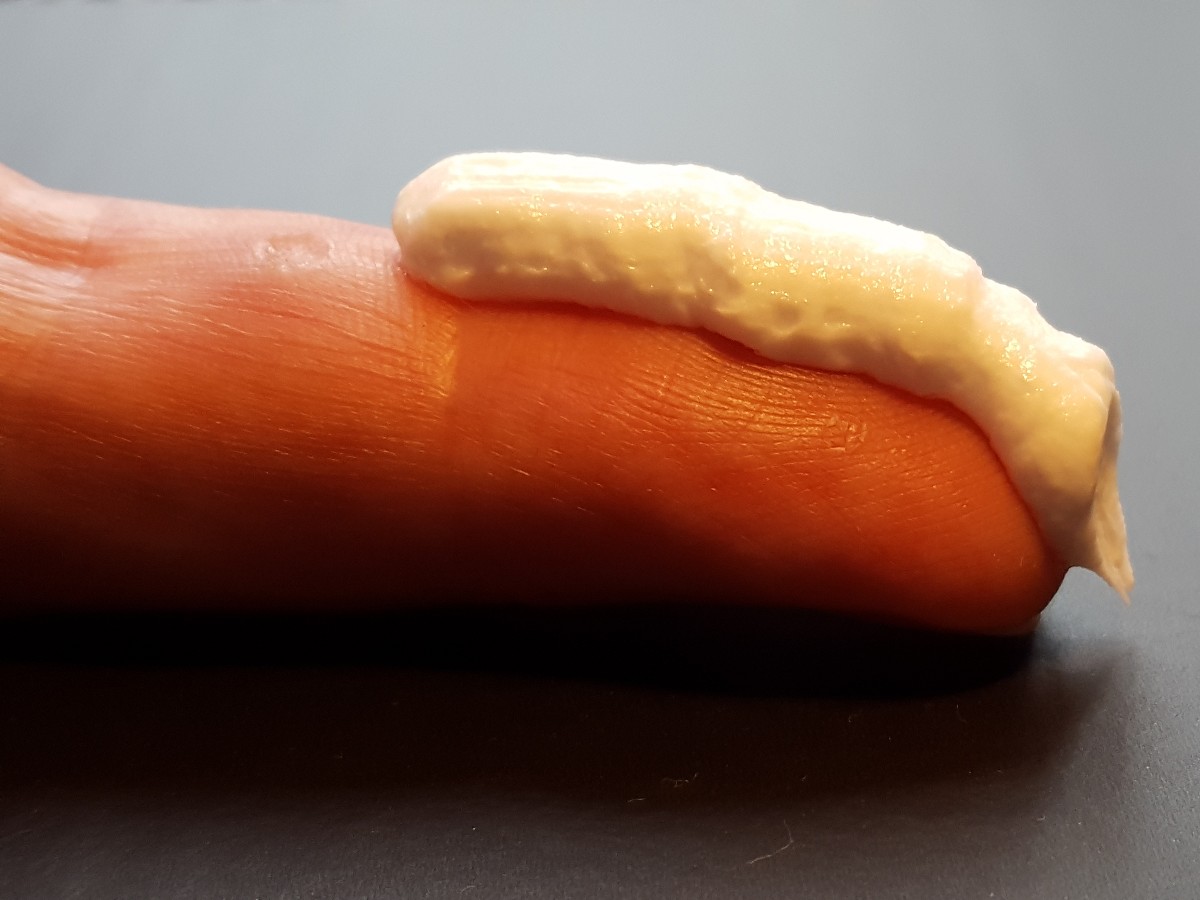
Apply the hormone ointment thinly to the affected skin. Applying it thickly does not provide better results, as the skin only absorbs a certain amount of hormone. To determine how much ointment is needed per body part, the chart below has been devised. This chart uses the fingertip as the unit of measure. A fingertip unit is the amount of ointment that fits on the tip of your index finger. A strip of ointment from a standard tube is squeezed along the entire length of the end phalanx, as shown in the photo below. A fingertip unit corresponds to approximately 0.5 grams of ointment.
| Number of fingertip units of ointment per body part, for different ages |
| age |
face
and neck |
arm
and hand |
leg
and foot |
for
side
hull |
back and
buttocks |
whole
body |
grams per week
when applying once a day |
| 3-12 months |
1 |
1 |
1.5 |
1 |
1.5 |
8.5 |
30 g |
| 1-2 years |
1.5 |
1.5 |
2 |
2 |
3 |
13.5 |
50 g |
| 3-5 years |
1.5 |
2 |
3 |
3 |
3.5 |
18 |
65 g |
| 6-10 years |
2 |
2.5 |
4.5 |
3.5 |
5 |
24.5 |
85 g |
| 11-16 years |
2.5 |
3 |
6 |
5 |
6 |
31 |
110 g |
| adult |
2.5 |
4 |
8 |
7 |
7 |
40 |
140 g |
An adult needs approximately 40 grams to apply the ointment to their entire body. A 100g tube will therefore be empty after applying it to the entire body 2-3 times.
You can use the prescribed hormone ointment on any open sores, such as those caused by scratching. The instructions often state otherwise.
The word "hormone" often has a negative connotation. However, if you use the hormone ointment responsibly, as prescribed by your doctor, it can help with your skin condition and has few negative effects on your skin. Unfortunately, hormone ointment does not have a healing effect, but a suppressive effect. If you stop using the hormone ointment, the skin condition often returns.
GENERAL COMMENTS ON THE USE OF HORMONE OINTMENTThe face is sensitive to the side effects of hormone ointment, particularly thinning of the skin and the development of red capillaries. A lighter concentration of hormone ointment is often prescribed once a day for three days.
Do not apply hormone ointment to the eyes. You may use it on the eyelids, but only if prescribed by a doctor.
It is best to avoid using hormone ointment in the ear canal due to thinning of the eardrum.
Do not use hormone ointment in cases of a suspected fungal infection (such as athlete's foot), as this will worsen the fungal infection. Similarly, do not apply hormone ointment around the area affected by a cold sore.HORMONE OINTMENT FOR CHILDRENParents often find it unpleasant to use hormone ointment on children. Sometimes it's unavoidable. The skin condition (often eczema in children) can be so severe that your child's development lags behind. The itching and scratching dominate their life. Responsible use of hormone ointment is a solution in such cases. It suppresses the eczema and itching. Your child will then often be able to do other things again.
If your child has bowler hat warts, also called water warts, you should not use hormone ointment. This is because hormone ointment promotes the number and growth of warts.
In young children, the skin does not thin easily. A possible side effect of (too) much hormone ointment over a long period is stunted growth. Once the hormone ointment is stopped, your child will catch up. It is important to have your child's height and weight checked regularly, every six months. This can be done by the general practitioner, a specialist, or at the child health clinic. |