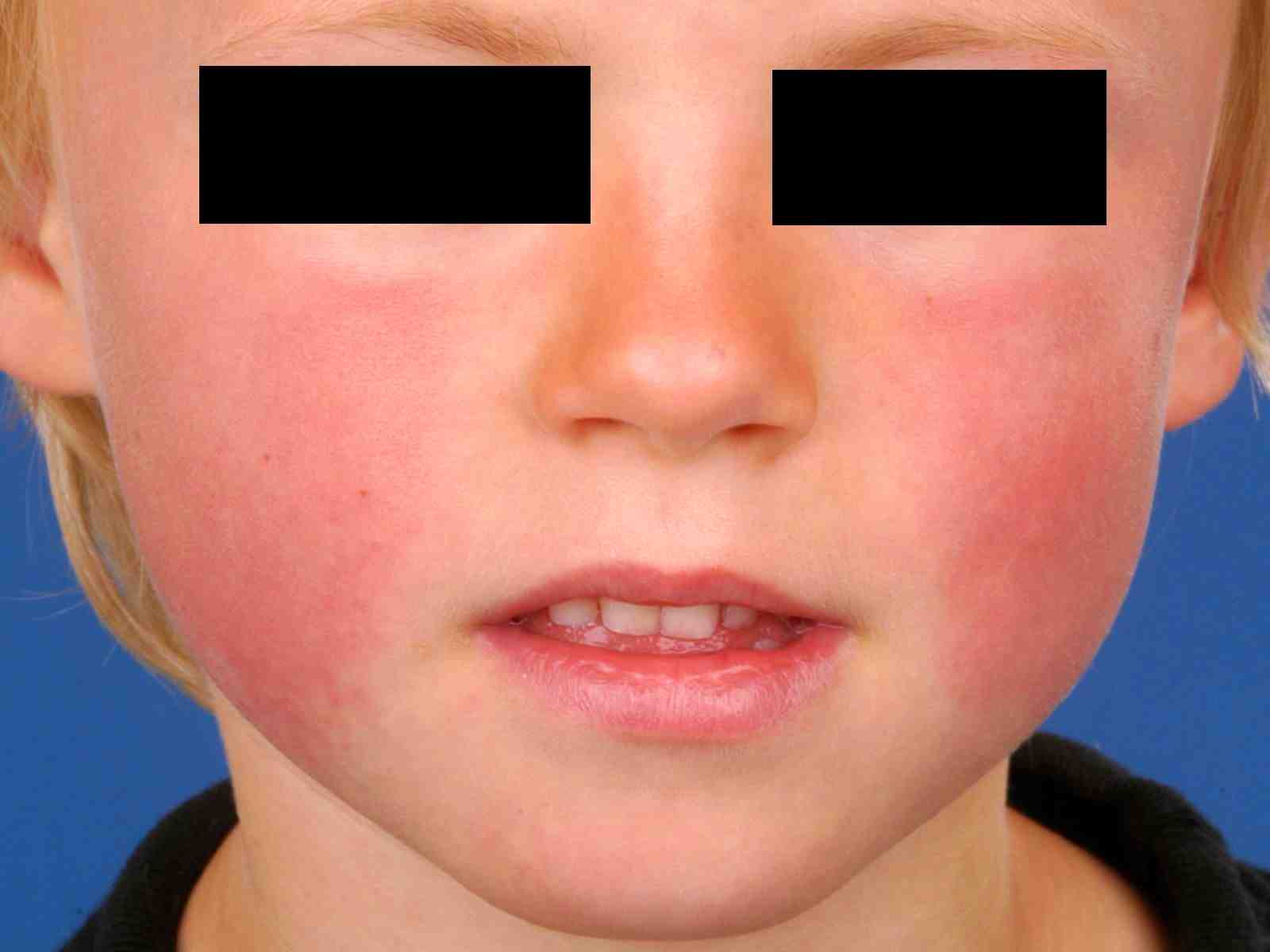
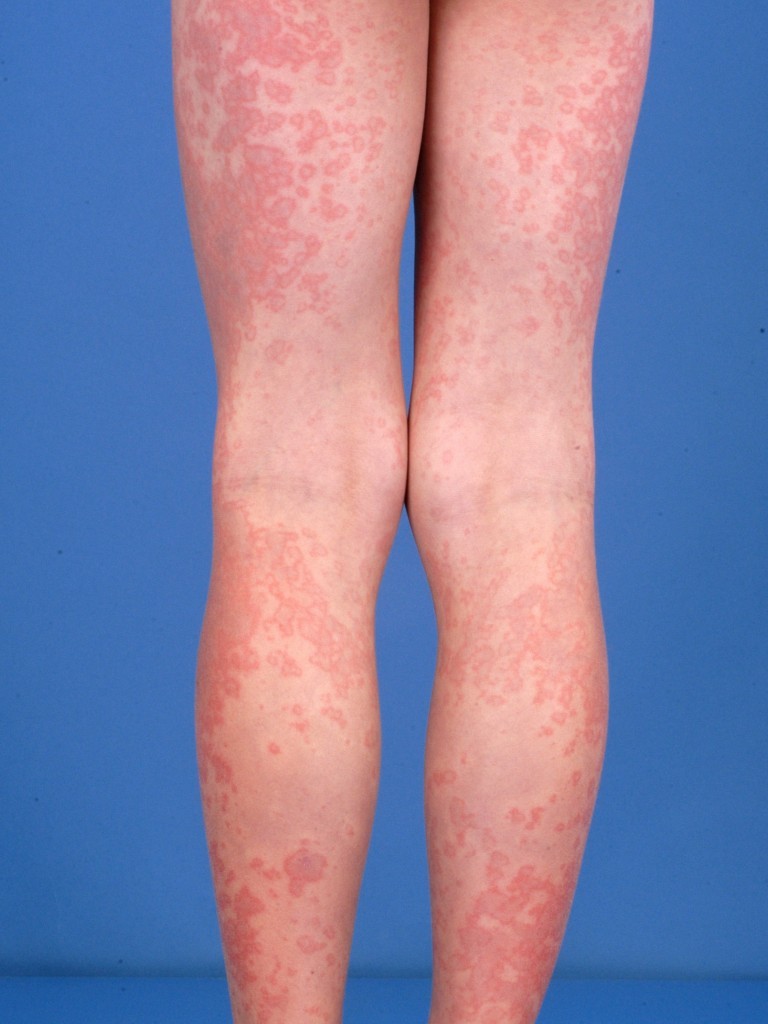
WHAT IS THE FIFTH DISEASE?Fifth disease is a childhood illness in which spots appear on the cheeks and later on the rest of the body. Fifth disease is also called erythema infectiosum (meaning red and contagious). It is caused by a virus (Parvovirus B19). Fifth disease is contagious to anyone who has not had it before.
There are other similar spotty illnesses that mainly occur in children, such as measles, rubella, and scarlet fever. The striking thing about fifth disease is that children are not very ill and that it starts with red cheeks.
 |
 |
| red cheeks |
rash on body |
WHAT ARE THE SYMPTOMS OF FIFTH DISEASE?Children are rarely affected by fifth disease. In the week before the red cheeks appear, there are sometimes mild flu-like symptoms : fever, listlessness, muscle aches, headache, and itching. Then, the red cheeks develop . Later, a red, blotchy rash can spread over the entire body. The area around the mouth remains clear. The blotches may be ring-shaped. After about a week, everything disappears again. A small percentage of children (5-10%) experience short-term joint pain in the hands, feet, knees, and wrists.
Adults can also get fifth disease. Adults, especially women, experience joint pain more often. Often, the blotches are absent, and only joint pain is present. The joint pain also persists longer, sometimes for months. It can resemble a mild form of rheumatism.
If pregnant women contract the infection in the first 20 weeks of pregnancy, it is dangerous for the unborn child. There is a risk of miscarriage. This rarely happens in the Netherlands, because most women (60-70%) had fifth disease as a child and are immune (they cannot get the virus again).WHO CAN GET THE FIFTH DISEASE?Fifth disease is a contagious viral infection. It primarily affects children in primary schools and daycare centers, and their families. Children aged 5-15 are particularly susceptible. Occasionally, epidemics occur (many cases simultaneously), especially in winter and spring. Teachers and childcare workers can also contract the disease if they haven't had it in childhood. After infection with the virus, the body produces antibodies, and people are then immune to the virus for life.HOW DO YOU GET INFECTED WITH FIFTH DISEASE?Infected people have the virus in their throats. Coughing, sneezing, and talking release tiny droplets containing the virus into the air. People can inhale these droplets and become infected. Someone with fifth disease can infect others from one week before becoming ill, until the spots appear. By the time the spots appear, the person is no longer contagious.
Fifth disease is not highly contagious; you have to be in close proximity to someone with the virus for a long time to catch it. Therefore, it is most commonly contracted within the family, or at a daycare center, preschool, or school. Not everyone who has been near someone with fifth disease becomes ill. The time between becoming infected and becoming ill is usually one to three weeks.HOW IS FIFTH DISEASE TREATED?There's no treatment for it, and there's no need for it. It goes away on its own.SHOULD AN INFECTED CHILD BE KEEPED AT HOME?That's not necessary, because by the time the spots appear, the virus has already disappeared and is no longer contagious. If the child feels well, they can go to daycare, preschool, or school as usual. However, do tell the child's supervisor or teacher. They can then (after consulting with the Municipal Health Service (GGD)) inform other parents. Parents can then watch for symptoms of fifth disease in their child.
An adult who has fifth disease and feels well can go to work as usual.WHAT IF I'M PREGNANT?Infection with fifth disease in the first half of pregnancy can be dangerous for the child. There is a risk of miscarriage. For most women, pregnancies proceed normally and there are no consequences for the baby. A pregnant woman can only be infected if she has never been exposed to the virus and therefore has no antibodies. Blood tests can detect the presence of antibodies.
Are you pregnant and does someone in your family have fifth disease? Consult your doctor. You can still pick up and drop off your children at a childcare center; the risk of infection during pick-up and drop-off is small. The situation is different for a pregnant teacher or childcare worker who has no antibodies and is less than 20 weeks pregnant: if there is an outbreak of fifth disease at school or childcare center, it is better for her to stay home. The workplace is safe again three weeks after the last child has had fifth disease, or if the pregnancy is more than 20 weeks.WHAT CAN I DO TO PREVENT FIFTH DISEASE?There is no vaccination against fifth disease. There are also no medications that can prevent the disease. There are tips to prevent the spread, such as using a tissue when coughing and sneezing, covering your nose and mouth with your hand, or coughing and sneezing into the crook of your elbow, and washing your hands regularly with soap and water. |