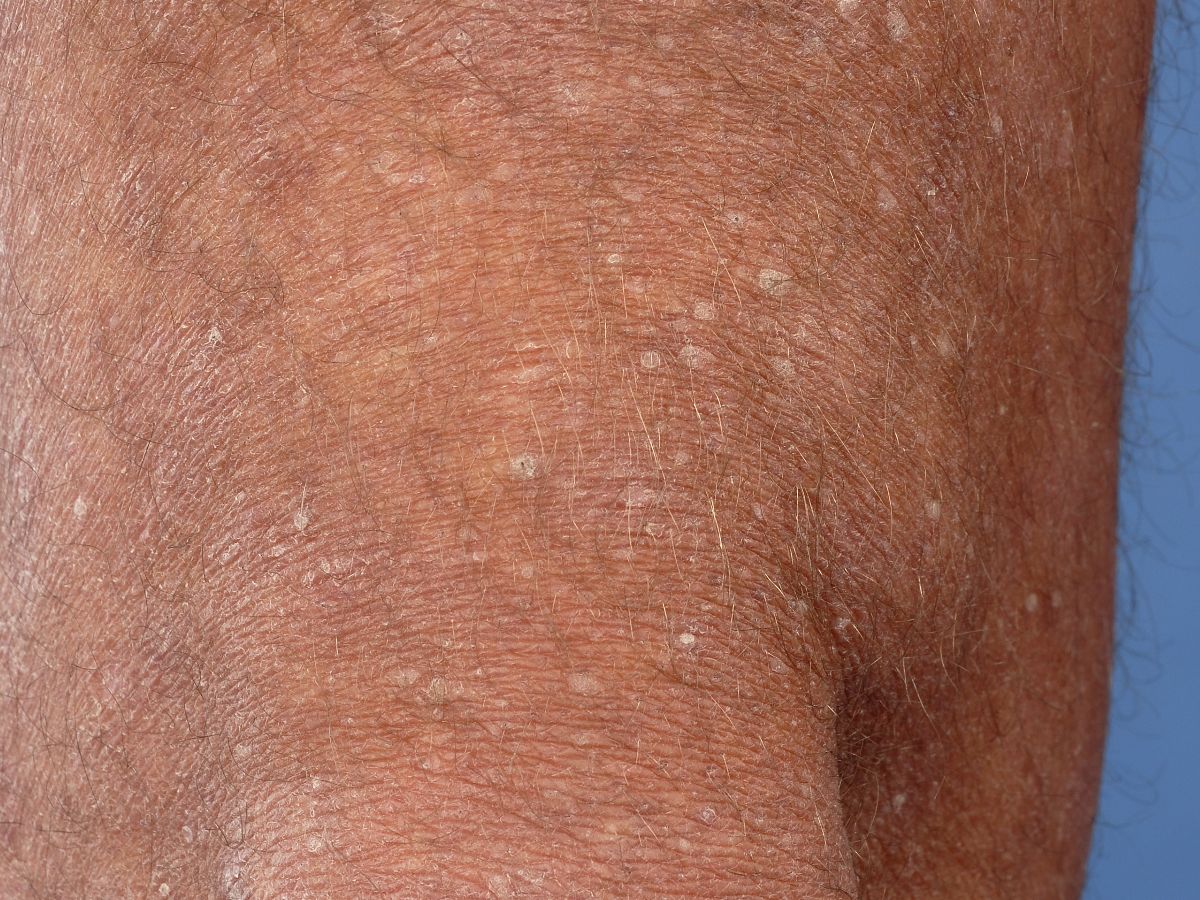
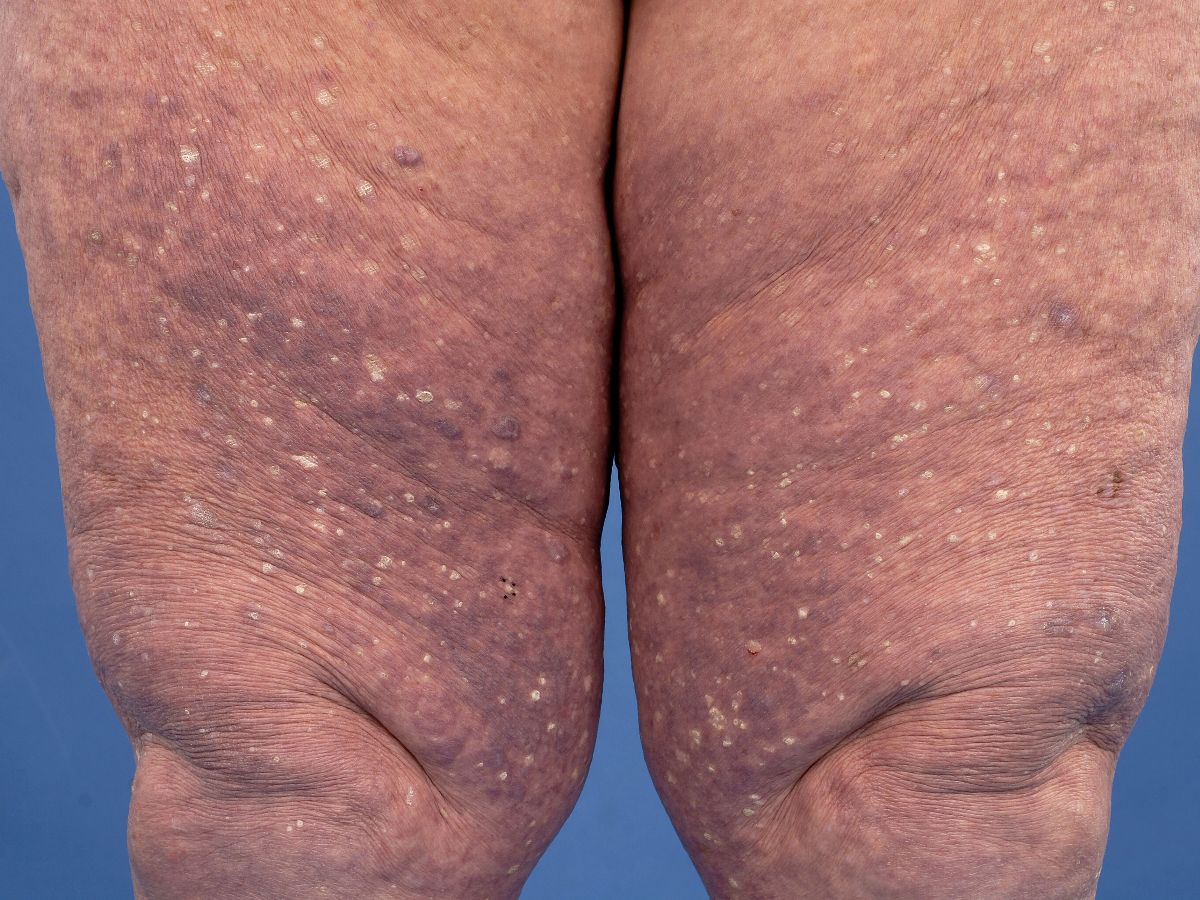
WHAT ARE STUCCOKERATOSES?Stuccokeratoses( Stuccokeratosis ) are small, whitish-yellow, scaly patches on the lower legs and sometimes the forearms. Stuccokeratosis is 1-5 mm in size, feels hard, adheres to the skin, and is difficult to scratch off. Stuccokeratosis develops in old age, usually starting around the age of fifty. They are actually a type of age wart. It is a benign skin condition.
 |
 |
| stuccokeratosis |
stuccokeratosis |
HOW DO STUCCOKERATOSES OCCUR?It's thought that stuccokeratoses develop as a reaction to years of sun exposure, as they often appear on the lower legs. This isn't entirely certain. Stuccokeratoses are also more common in people with dry skin.HOW IS THE DIAGNOSIS MADE?The diagnosis is based on the clinical picture and its appearance. Viral warts, of the flat type, may resemble stucco keratosis. Additional testing, such as a skin biopsy, is rarely necessary.HOW IS STUCCOKERATOSIS TREATED?Stuccokeratosis is a benign condition; treatment is not necessary and, due to the large number of lesions, it is also not easy. If desired, they can be removed by scraping them off with a sharp spoon (curettage), by electrical cauterization (electrocoagulation), or by freezing them off (cryotherapy). Stuccokeratosis can also be removed with a CO2 laser.WHAT CAN YOU STILL DO YOURSELF?You can apply a cream or body lotion to the skin to prevent it from drying out. Moisturizing creams or ointments such as urea ointment can also be used. Stuccokeratoses can be partially removed or smoothed with exfoliation, but they won't disappear completely and may become thicker again.WHAT ARE THE OUTLOOK?Stuccokeratoses don't go away on their own. But they're harmless and don't cause any symptoms. |