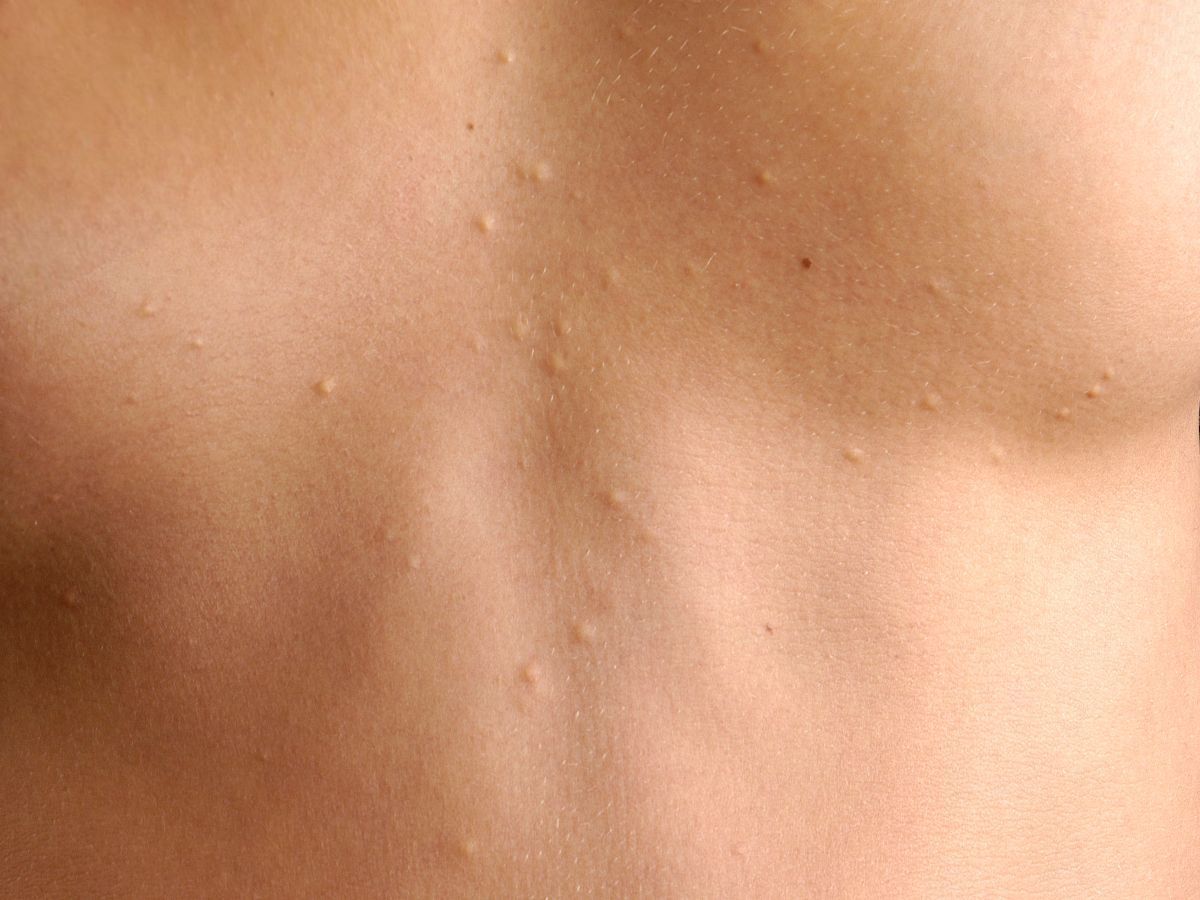
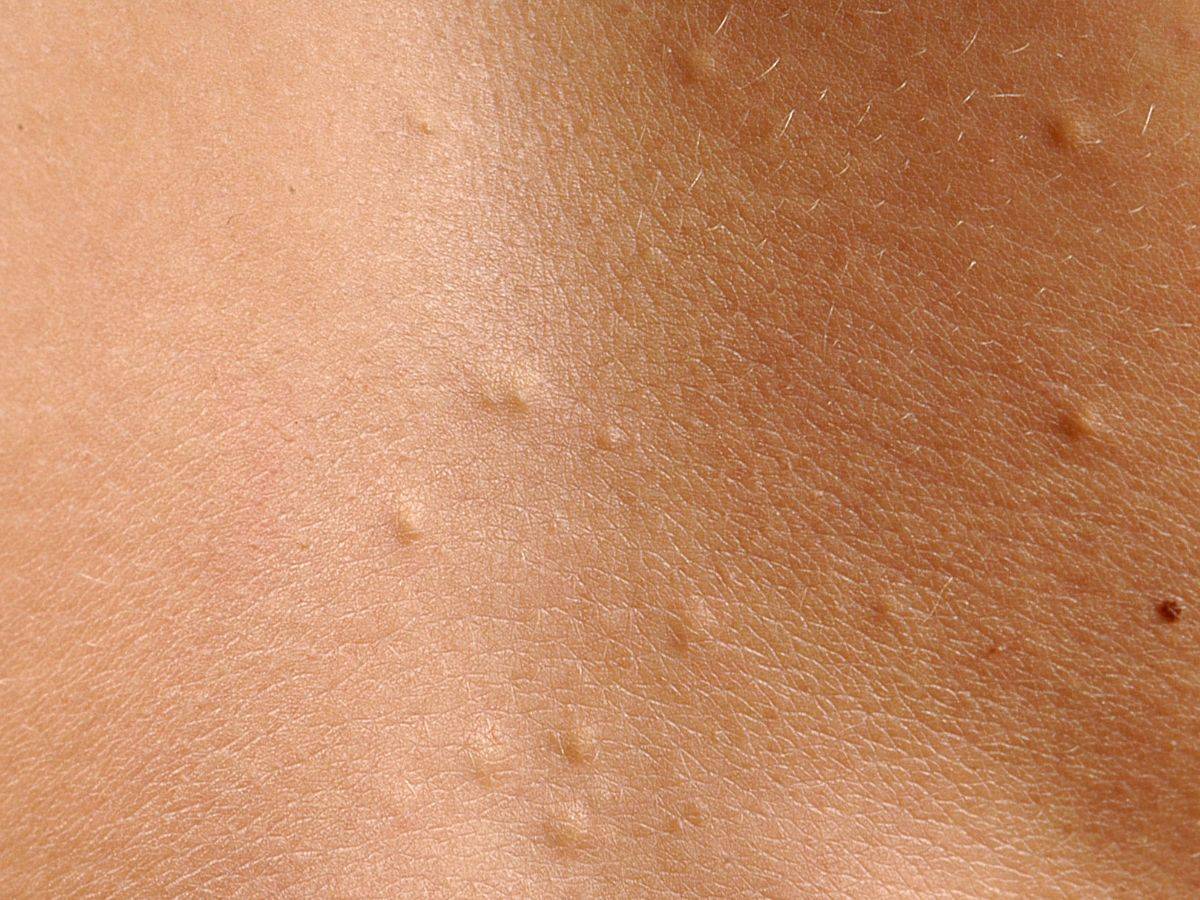
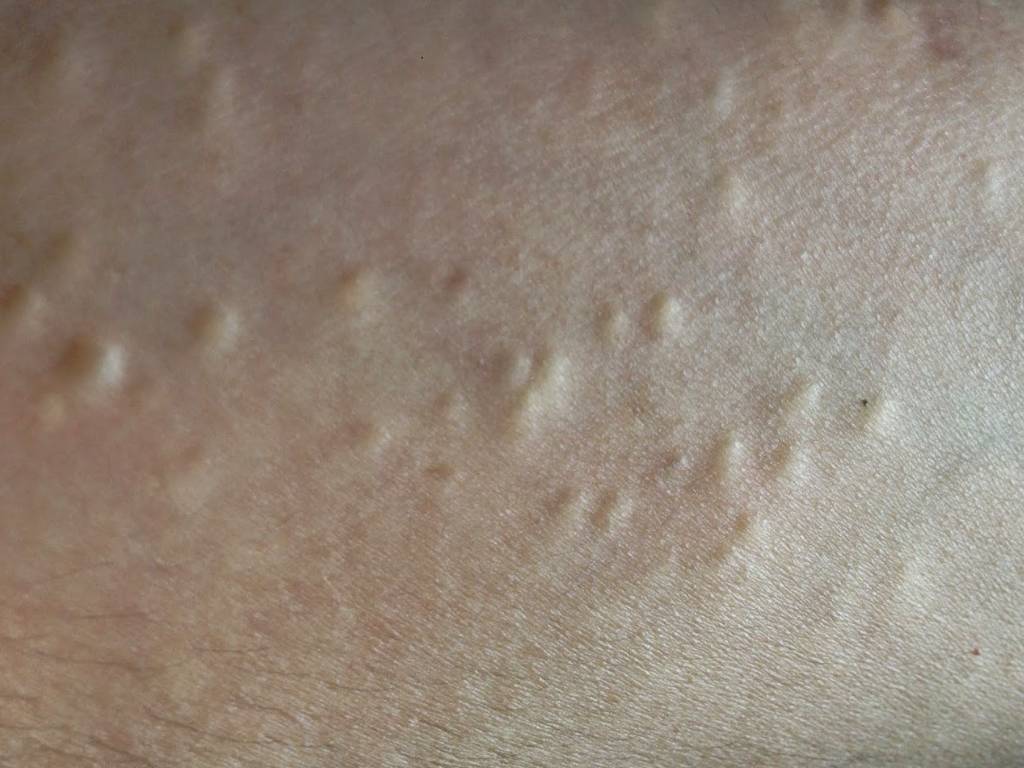
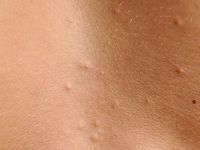
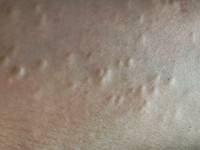
WHAT IS STEATOCYSTOMA MULTIPLEX?Steatocystoma multiplexis a rare condition in which yellowish, translucent bumps appear all over the body. There can be just a few or hundreds of them. These are cysts (closed sacs) filled with sebum or an oily substance. While benign, they are bothersome and cosmetically disturbing. They are also difficult to treat because they are so numerous.WHAT DOES STEATOCYSTOMA MULTIPLEX LOOK LIKE?Dozens to hundreds of cysts (fats-filled, sealed sacs) are present throughout the body . The cysts range in size from a few millimeters to a few centimeters. They have a translucent yellowish or bluish hue. They are filled with white or yellowish sebum, or an oily substance that is clear, yellow, green, or black in color. Unlike regular clogged sebaceous glands (atheroma cysts), there is no visible central opening. The cysts can be located anywhere, but they are most common on the chest, neck, arms, armpits and groin, behind the ears, and sometimes on the forehead. The cysts are present at birth, but very small and not yet visible. Only after puberty do they begin to fill with fat, becoming visible and palpable. They increase in size, and there appears to be an increasing number of them.
 |
 |
 |
| steatocystoma multiplex |
steatocystoma multiplex |
steatocystoma multiplex |
HOW DOES STEATOCYSTOMA MULTIPLEX OCCUR?Steatocystoma multiplex is caused by a congenital abnormality of the sebaceous glands. Normally, sebaceous glands are connected to a hair follicle via a duct. The sebaceous gland produces sebum, an oily, fatty substance that is secreted along the hair and provides a protective layer of lipids to the skin and hair. In steatocystoma multiplex, the duct is missing in many sebaceous glands. The sebum produced by the gland cannot escape, resulting in a small lump that grows larger over the years. The blocked sebaceous glands are present at birth, but not yet visible. Only after puberty, when sebaceous glands become active under the influence of hormones, do they begin to grow and become noticeable. Sometimes steatocystoma multiplex is hereditary: it then runs in families, and there is a 50% chance that parents will pass it on to their children (this form of inheritance is called autosomal dominant). In the hereditary form of steatocystoma multiplex, the gene responsible for the disorder has also been discovered. The disorder is located in the gene for keratin 17, a protein found in the sebaceous glands, as well as in nails and hair. In most cases, however, steatocystoma multiplex is not hereditary: it develops spontaneously, doesn't run in the family, and no genetic abnormalities are found.WHAT KIND OF COMPLAINTS DOES STEATOCYSTOMA MULTIPLEX CAUSE?Steatocystoma multiplex is a benign condition. However, it causes considerable discomfort, particularly because it is cosmetically unsightly. The development of so many cysts and the increasing number of new ones is distressing and can be psychologically distressing for some. Furthermore, the cysts can rupture, releasing their oily contents under the skin. This causes inflammation. Sometimes a painful infection develops around a ruptured cyst. Inflammation occurs primarily in the armpits and groin, due to movement, heat, and sweating.HOW IS THE DIAGNOSIS MADE?The diagnosis can be made based on the clinical picture, its appearance. However, it is often necessary to remove a cyst for examination by a pathologist. Under the microscope, it can be determined whether it is a steatocystoma or another type of cyst. There are conditions that strongly resemble these, such as common sebaceous cysts with a blocked duct (atheroma cysts). Another very similar condition is eruptive vellus hair cysts. These are smaller cysts originating from hair follicles. Some patients have both steatocystomas and vellus hair cysts. Another similar condition is scrotal cysts. In these cases, multiple cysts develop on the scrotum (scrotum). These are not steatocystomas, but common blocked sebaceous glands.HOW IS STEATOCYSTOMA TREATED?Steatocystoma is difficult to treat. There are no medications that can eliminate or improve the condition. In case of infection, a temporary antibiotic can sometimes be used.
The only possible treatment is to open and drain the most bothersome cysts. This is usually done by making a small incision under local anesthesia and expressing the contents. This does leave a small scar. Various alternative treatments are possible, such as making a larger incision and extracting the entire cyst. However, this causes a larger scar than simply making a small incision. Draining with a large needle is also an option. Cysts can also be opened with an electric needle or a CO2 laser. All these treatments work the same way.
The problem is that surgical treatment is still feasible for a few cysts, but not for hundreds. With so many cysts, it is simply too much to treat them all. An additional problem is that the treatment is often not covered by health insurers because it is a benign condition. Therefore, only cysts that cause symptoms, such as being very large, obstructive, inflamed, or located in highly visible areas, are often removed.WHAT CAN I STILL DO MYSELF?It's important not to squeeze it. With regular clogged sebaceous glands, squeezing them can sometimes be successful, but with steatocystoma multiplex, this won't work because there's no drainage duct. Squeezing is counterproductive, causing the cyst to rupture and cause inflammation.WHAT IS THE PROGNOSIS?Steatocystomas will not disappear on their own. Over the years, more and more will appear. |