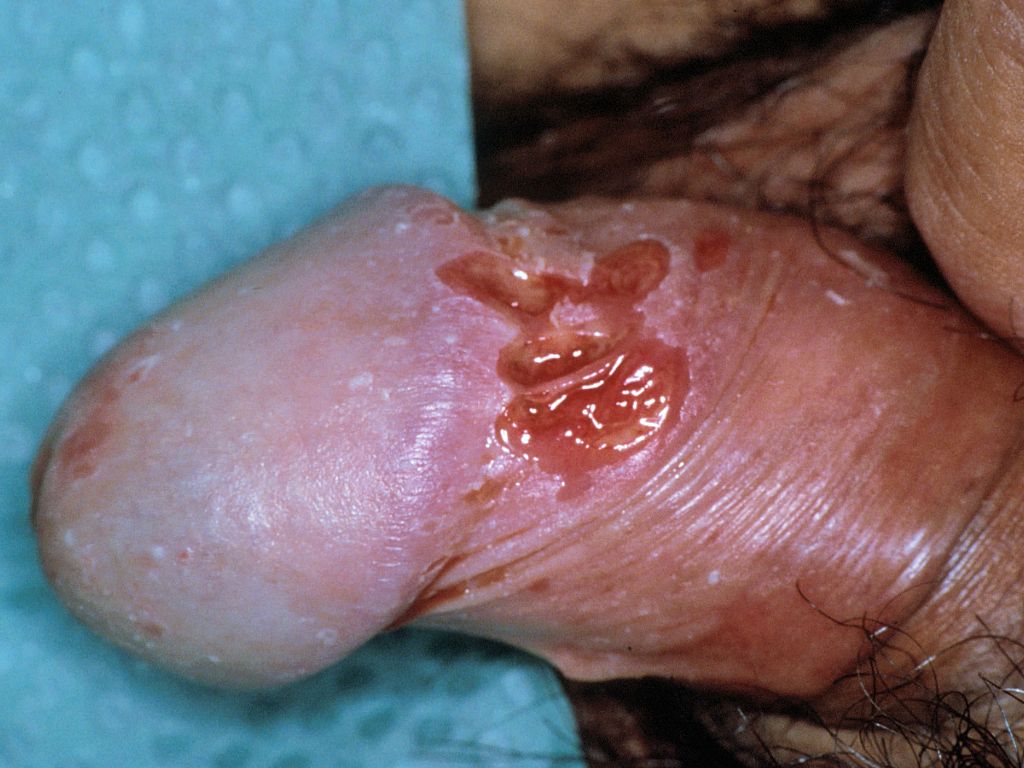
Genital herpes is an STD (sexually transmitted infection) caused by a virus. In most cases, this is the herpes simplex type 2 virus (HSV-2). The virus causes an infection of the skin and mucous membranes in and around the genitals.
Besides genital herpes, there are other forms of herpes, which also cause infections of the skin and mucous membranes, but on different parts of the body. The most common herpes infection is herpes labialis, the well-known cold sore. Herpes labialis is usually caused by the herpes simplex type 1 virus (HSV-1). Infection with this virus often occurs in childhood. The infection is often symptomless and goes unnoticed. A cold sore can develop if the immune system is weakened. In rare cases, HSV-1 can also cause genital herpes. This often occurs through oral sex, which involves touching the genitals with the mouth (oral sex). Other herpes infections include shingles (herpes zoster) and mononucleosis.
This leaflet only covers genital herpes, a herpes infection of the genitals.THE TRANSFERGenital herpes can only be transmitted through intimate sexual contact between people who have herpes and who don't. Therefore, genital herpes is an STI. You can't get genital herpes simply by being "in close proximity" to someone who has herpes. You must come into contact with the rash on the skin or mucous membranes of the mouth, penis, vagina, or anus to become infected. The risk of infection is greatest around the time someone has blisters or sores.PHENOMENAIf you have contracted a herpes infection, you may experience the first symptoms within about a week. These often include itching and an irritated, burning sensation. Red spots appear on the skin or mucous membranes. After one to one and a half days, blisters or sores become visible. These are usually on or around the penis, labia, the vaginal opening, or around the anus. Sometimes these symptoms also occur inside the vagina, on the cervix, or in the anus. The blisters and sores are then difficult to see. The severity of the symptoms varies from person to person. Initial attacks can be accompanied by pain, fever, swollen glands in the groin, and sometimes vaginal discharge. Women, in particular, often experience painful urination. After anal contact (butt sex) with someone who has herpes, rectal inflammation can develop. This is sometimes accompanied by bleeding or mucus and painful bowel movements. The blisters and sores dry up after about three weeks and usually heal without scarring. It's possible to transmit the herpes infection to another part of the body, such as the eyes, via your own fingers. You can also get a herpes infection on one or more fingers this way. Therefore, it's recommended to touch the infected area with blisters and sores as little as possible and always wash your hands thoroughly after any contact.
 |
| genital herpes infection |
RECURRING ATTACKSOnce the symptoms of the initial infection have disappeared, it seems as if the herpes virus has been eliminated from the body. Unfortunately, this is not the case. The virus has retreated from the skin into a nerve cluster, where it remains dormant. However, the virus can multiply again and cause blisters on the skin or mucous membranes. Think of a cold sore, which can also recur regularly. It is impossible to predict how often an attack will recur. Some people have an attack of genital herpes almost every month, while others rarely or never experience it again. This varies from person to person.
Recurrent attacks are generally less severe than the initial attack. It is unknown why attacks recur frequently in some people and only occasionally or never in others.
It is known, however, that good general health is important. Attacks mainly occur in situations where the immune system is less effective, such as just before menstruation or during a bout of the flu. Stress also increases the risk of attacks.COMPLICATIONSIf the immune system is severely weakened, a genital herpes infection can be much more severe and last longer. This is the case, for example, if you have HIV or are taking medication for rejection symptoms, for example, after an organ transplant.PREGNANCYIf you've had genital herpes, you can still get pregnant. It's very important, however, that you tell your GP, midwife, or gynecologist. The risk of infecting your baby during childbirth is very small. Therefore, you can have a vaginal birth. Sometimes, as a precaution, the baby is tested for the presence of the herpes virus after delivery. Only if you contract herpes for the first time in the last month of pregnancy is there a risk to the baby, and a cesarean section will be considered.TO THE DOCTORIf you suspect you have genital herpes, it's important to see a doctor as soon as possible. They can determine whether you actually have a herpes infection. Because of the risk of infection, it's important for you and your partner(s) to know whether it's an STI. Moreover, if you get tested promptly, the doctor can prescribe a medication that can shorten the duration and severity of the attack.RESEARCHBefore the examination, the doctor will ask several questions about physical complaints and other symptoms, (un)safe sexual contact, and possible infection from or through your partner(s).
During the physical examination, the genitals will also be examined. In women, a speculum is used for an internal vaginal examination. For certain complaints, the doctor will also examine the rectum through the anus using a proctoscope (a viewing tube). An internal examination is unpleasant but may be necessary.
To make a definitive diagnosis, fluid is usually collected from the blisters or sores and sent to the laboratory for analysis. Sometimes, for complete certainty, a test is also performed to determine whether you have another STI.THE TREATMENTThere is no medication that completely eliminates the herpes virus from the body. Therefore, the virus can resurface. Good physical and mental condition contributes to a reduction in the number of attacks. Painkillers are rarely necessary. The use of regular creams is usually not very effective.
There are medications available that can reduce the duration of attacks, such as valacyclovir (Zelitrex), acyclovir, and famciclovir (Famvir). These substances inhibit the replication of the virus in the body and thus prevent further spread of the attack. The severity of the symptoms is reduced and the duration of the attack is shortened. It is important to start treatment as soon as possible after the onset of the attack. The medication is available by prescription. The dosage depends on the symptoms and the number of attacks per year.
There are several options:
Treatment of acute attacks: One tablet several times a day for five days. The first attack, in particular, can be severe.
For frequently recurring and/or severe attacks, you can take tablets daily for a long period (maintenance dose). Currently, only valaciclovir (Valtrex), one tablet daily, and aciclovir, one tablet twice daily, are registered for this type of treatment. Valaciclovir (Valtrex) and intravenous peniciclovir (Famvir IV) are also registered for the treatment of genital herpes in HIV-infected patients.
It can be helpful to always have (a prescription for) a course of treatment for several days on hand and to start taking the tablets at the first signs of an attack.
For effective treatment, it is important that the doctor knows how often you have attacks of genital herpes and how severe they are. If the immune system is weakened, such as with HIV infection, the above treatment is not always sufficient. Sometimes longer treatment or a higher dose is required.
If you talk openly about your problems as a result of herpes, the doctor is better able to provide accurate information.
INFORMING YOUR PARTNER(S)
If you have a steady partner, it is certainly advisable to discuss the herpes infection. Your partner may have been infected before, during your current or previous sexual relationship, without experiencing any symptoms. For casual or changing partners, informing or warning them is not considered strictly necessary. If you know who you may have contracted the herpes infection from, it is wise to inform them. This can help limit the further spread of the virus.
PREVENTION OF CONTAMINATION
If you or your partner are experiencing a herpes outbreak (i.e., have/have signs and symptoms), it is best to avoid sexual intercourse. If you do have sexual intercourse, use a (female) condom.
It is best to avoid oral sex (or oral sex) if you or your partner have/have a cold sore or if there are symptoms of genital herpes on the penis, labia, or around the anus.
Avoid touching the blisters as much as possible. Touching the genitals of a partner who is experiencing a herpes outbreak can spread infection if you subsequently touch your own genitals.
There is no complete protection against genital herpes infection, even if you know your partner is infected and are taking precautions. For example, you can have a herpes infection without experiencing any symptoms. There will be no blisters or red spots, but you can still be contagious to others. You can also unknowingly transmit the virus because the blisters are in places where they are not (clearly) visible, such as on the cervix or in the anus. Because a condom never completely covers the genitals, infection is also possible if the blisters extend beyond the condom rim. By being careful and having protected sex, you can significantly reduce the risk of a herpes infection.LEARNING TO LIVE WITH HERPESGenital herpes is an STI that often evokes feelings of guilt. Feelings of regret, anger, and shame can also surface. These feelings are often exacerbated by the fact that the attacks can recur and the herpes virus remains in your body. Usually, over time, you come to terms with the possibility of recurrence. Sometimes the number of attacks decreases or disappears over the years. Besides the physical discomfort, a herpes infection can also cause problems in your relationship. You may have become infected during current or previous sexual relationships. In either case, this can lead to tension between you and your partner. Understanding the other person's (emotional) reaction is important, and talking about it honestly and openly is always the best course of action, even if it is painful for you or the other person.
It is important that you and your partner(s) understand that only the first attack of genital herpes is caused by sexual contact. Each subsequent attack is triggered by the body itself, as the virus resurfaces. Although subsequent attacks are usually less severe, genital herpes remains an unpleasant condition that cannot be completely cured. You have to learn to live with it. People with genital herpes sometimes find it difficult to start a new relationship. You can also discuss this with your doctor or the social nurse at the Municipal Health Service (GGD). They may be able to help you overcome the barriers and learn to cope with the risk of infection. You can also contact HISO, the patient association for people with herpes.SUGGESTIONS AND TIPSIf you think you have genital herpes, see your doctor immediately.
Try to inform your doctor as openly and completely as possible about your problems.
It's important for the doctor to know how often you have attacks and how you experience them. You can also discuss any problems you're having with your partner due to herpes with the doctor.
Try to inform the person who probably infected you. They can, after consulting a doctor, take (additional) measures to limit further spread of the virus.
Sexual intercourse is not recommended during an attack. If you do have sexual intercourse, at least use a (female) condom; this offers some protection.
Avoid oral sex (or oral sex) if you have symptoms of a cold sore or genital herpes.
Because the herpes virus can also be transmitted through kissing, it's best to avoid kissing if either partner has symptoms of a cold sore. Be especially careful when cuddling babies.
Touching the genitals of a partner with signs and symptoms of genital herpes also carries a risk of infection.
If you are pregnant and have genital herpes (or have ever had it), tell your midwife, GP, and/or gynecologist.
During an outbreak, wear comfortable clothing that causes as little irritation as possible. Avoid wearing tight pants.
Wash infected areas with water only and gently pat dry.
Try to avoid stressful situations, as stress triggers attacks.MORE INFORMATION AND CONFIDENTIAL ADVICE?At the GP.
At the Municipal Health Service (GGD), Infection Control Department.
There are more than 45 GGDs in the Netherlands where you can get personal and anonymous information about STIs/HIV and safe sex.RESEARCH AND TREATMENTAt the general practitioner:
At accessible STI outpatient clinics (free and anonymous if necessary) under the responsibility of specialists in skin and venereal diseases (dermatologists) in Amsterdam, Rotterdam, The Hague or Utrecht.
At easily accessible STI outpatient clinics under the responsibility of specialists in skin and venereal diseases (dermatologists) in other major cities (referral from your general practitioner required; for free and anonymous testing, a referral via the STI/HIV social nurse of the Municipal Health Service (GGD) is required).
At gynaecologists (gynecologist; referral from your general practitioner required).
At some Municipal Health Services (GGDs) (referral via the STI/HIV social nurse of the GGD required). |