Schistosomiasis is an infection with certain worms called Schistosoma. The term "Bilharzia" is often used to describe the disease.
Life cycle:
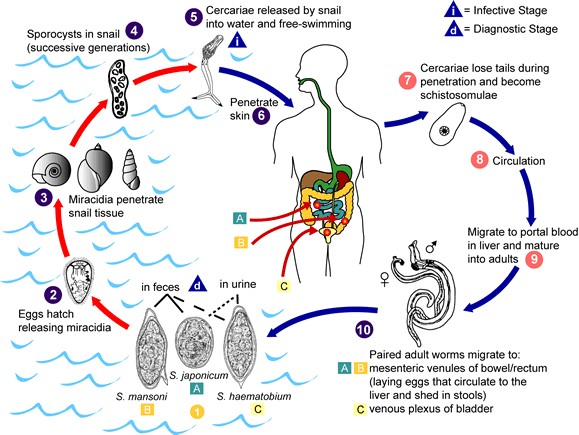
The adult worms reside in small blood vessels of the intestines or bladder. Female worms lay eggs that penetrate the wall of the intestines or bladder and are excreted in the feces or urine. If these eggs end up in fresh (surface) water, a larva hatches and enters certain aquatic snails. The larva develops and multiplies within the snail. New larvae emerge from the snail and swim around in the water. These larvae can penetrate intact human skin. They are carried by the bloodstream and travel via the lungs to the liver, where they mature and from there ultimately reach their final destination: the small blood vessels of the intestines or bladder. The eggs laid by the female can become lodged in the lining of the intestine or bladder, causing damage. Eggs can also be carried by the bloodstream to the liver, and sometimes to other parts of the body. The abnormalities and problems caused by schistosomiasis result from tissue reactions to worm eggs in the organs.
Schistosomiasis in travelers:
Travelers almost always experience a mild infection, meaning there are few worms and few eggs. Therefore, travelers do not experience any serious problems. Serious abnormalities of the intestines, liver, bladder, and kidneys are found in locals who are regularly exposed to the contaminated water.
Five species of Schistosoma worms occur in humans, but in practice, two species are important for Dutch travelers and expatriates, causing intestinal schistosomiasis and bladder schistosomiasis, respectively.
Schistosomiasis is common in Africa. Anyone planning to swim in a river or lake in Africa should be aware that almost all of this water could be contaminated, even if it has a reputation among locals and expatriates as being "bilharzia-free."
Schistosoma mansoni infection (intestinal schistosomiasis)
occurs in most of sub-Saharan Africa and in parts of South America, including Suriname.
Symptoms:
The adult worms, which are several centimeters long, live in blood vessels around the large intestine. The passage of eggs through the intestinal wall creates a small wound, which sometimes causes blood to be seen in the stool. Severe infections can eventually cause severe abdominal complaints and liver abnormalities. This is due to a tissue reaction (similar to a scar) around the eggs, which are not excreted but remain lodged somewhere in the body. In Europeans, who usually have (had) limited contact with contaminated water, mild infections with few or no symptoms are almost always found. They have a low risk of serious organ damage.
Schistosoma haematobium infection (bladder schistosomiasis)
occurs in most of sub-Saharan Africa and in some places in the Middle East. Both intestinal and bladder schistosomiasis occur in many areas of Africa.
Symptoms:
The worms live in blood vessels around the bladder; eggs are excreted in the urine.
The person carrying the worms experiences blood in their urine, usually at the end of urination. Urinary problems (pain, frequent urination) may occur, and severe infections can eventually lead to serious abnormalities of the bladder and kidneys. Again, the milder the infection, the lower the risk of significant symptoms. Serious abnormalities of the bladder and kidneys are common in the local population.
Some unusual manifestations of schistosomiasis:Katayama syndrome ("acute schistosomiasis")Sometimes a reaction to the worms occurs while they are developing from larvae to adults in the body: this is a type of hypersensitivity reaction. This reaction occurs approximately 4 to 6 weeks after contact with water. The reaction is accompanied by fever (sometimes high and prolonged) and skin symptoms such as hives or swelling of the skin, for example, around the eye, lip, or cheek. Cough, shortness of breath, and sometimes diarrhea also occur. At this stage, eggs are often not yet present in the urine or feces. However, antibodies against the schistosomes can be detected in the blood. This reaction is called "Katayama syndrome."“Swimmers itch”When larvae penetrate the skin, a reaction can occur with itching and a rash. This disappears after a few days.
Swimmer's itch can also occur in the Netherlands. This is caused by schistosoma species found in birds. These larvae remain lodged in the skin of humans; they cannot develop further in humans. A rash and severe itching can result. Certain anti-sensitivity and anti-itching medications can alleviate the symptoms.
Diagnosing schistosomiasis:
In travelers, the first step is usually a blood test for antibodies against Schistosoma worms. This is a sensitive test; meaning that most infections are detected with it. Urine or fecal egg tests are less sensitive because travelers usually have mild infections and shed very few eggs. Treatment:
Schistosomiasis
can be effectively and effectively treated with praziquantel (Biltricide®), administered once a day at a dose of 40 mg per kilogram of body weight.
Prevention (preventing schistosomiasis)
Vaccination against "bilharzia" is not possible.
If you do not have contact with surface water in areas where schistosomiasis occurs, you cannot contract bilharzia. Therefore, it is recommended to avoid contact with surface water (lakes, rivers).
Drying thoroughly immediately after swimming in contaminated water may be helpful. Taking praziquantel immediately after swimming is pointless; praziquantel is ineffective or ineffective against the larvae. |