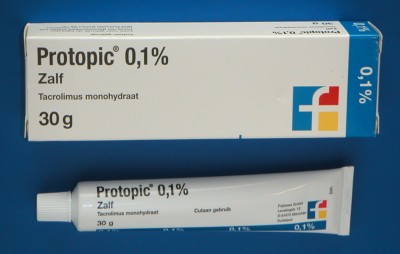
Protopic ointment(active ingredient tacrolimus ) is an ointment for the treatment of moderate to severe atopic eczema . The ointment has been registered in the Netherlands since November 2002. The ointment is only available with a doctor's prescription. Protopic ointment is available in two strengths, 0.1% and 0.03%, and in tubes of 30 or 60 g. The 0.1% is intended for adults (>16 years), the 0.03% for children (>2 years). The product is applied twice a day for a period of approximately 3 weeks. If this is successful, the lower concentration can be used, or applied once a day. Besides atopic eczema, Protopic is also prescribed for other skin conditions, but for the time being, the product is only registered for atopic eczema.
A 30g tube (0.1% tacrolimus) costs approximately €28, while the 60g tube costs €57. The 0.03% concentration costs €26 (30g) and €52 (60g), respectively. The current price of the medication can be found on the website medicijnkosten.nl . The medication is slightly more expensive than the commonly prescribed medications for atopic eczema, corticosteroids. Currently, Protopic is fully reimbursed for atopic eczema.HOW DOES IT WORK?Tacrolimus suppresses the immune system. It has an inhibitory effect on some white blood cells (lymphocytes). In atopic eczema, the immune system overreacts. Lymphocytes play a key role in this; they can be found in large numbers in the eczema areas and produce various substances that cause inflammation: redness, swelling, warmth, itching, and weeping skin. Tacrolimus inhibits all these inflammation symptoms and thus soothes the skin.
WHAT ARE THE CONSEQUENCES OF STOPPING THE IMMUNE SYSTEM?
The disadvantage of inhibiting lymphocytes, and thus the immune system, is an increased risk of skin infections. Lymphocytes play a useful role in clearing bacteria and viruses. Inflammation of hair follicles (acne, folliculitis) can develop or worsen with Protopic use, and the risk of viral infections (cold sores, shingles) also increases. Therefore, Protopic is not recommended for extensive inflammation of the hair follicles, infected eczema, or infected wounds. It is possible after treatment of the infection, usually with antibiotics, sometimes with topical antibacterial agents.
Lymphocytes also play a role in building lasting immunity against various bacteria and viruses. This mechanism is used in vaccinations against various diseases. To rule out any negative effects of Protopic on the vaccination process, the current package insert recommends stopping Protopic for several weeks prior to vaccination. For live, attenuated vaccines (such as measles, mumps, rubella, or oral polio), the package insert specifies a waiting period of 28 days, and for inactivated vaccines (such as tetanus, diphtheria, whooping cough, or influenza), a waiting period of 14 days. More recent information from the manufacturer indicates that this advice was primarily issued out of caution, as caution is always required when testing new medications. However, in practice, no problems have arisen with vaccinations, i.e., no abnormal inflammatory reactions to the vaccine, nor any reduced effectiveness of the information. However, the warning remains in the package insert.
Negative effects on the general immune system have not been reported. Safety has been tested in a large number of patients. When applied topically to the skin, the drug is barely absorbed into the body. Some absorption may occur in severely damaged skin. This can occur in the initial phase of treatment for severe eczema (oozing eczema, eczema with numerous sores and scratch marks), or very extensive eczema (erythroderma), and in conditions where the skin's barrier function is disrupted (Netherton's syndrome). Even in these cases, absorption is low, and there are no known negative effects on the immune system or general health.
WHO CAN USE PROTOPIC?
Protopic is intended for the treatment of moderate to severe atopic eczema in adults and children over the age of 2 who do not respond adequately to or cannot tolerate conventional treatments. It is not intended for other forms of eczema. The 2-year limit has been established because there is no experience with younger children. This does not mean that the product is dangerous for young children.
WHEN SHOULD YOU NOT USE PROTOPIC?
Do not use Protopic if you are allergic to tacrolimus or macrolide antibiotics (azithromycin, clarithromycin, erythromycin), or any of the other ingredients in the ointment (white soft paraffin, liquid paraffin, propylene carbonate, white beeswax, and hard paraffin). Do not use during pregnancy or breastfeeding.
WARNINGS / PRECAUTIONS
(Source: Protopic package leaflet)
Caution is advised when using this product in patients under 2 years of age.
Do not use on infected wounds or in cases of impaired skin barrier function such as erythroderma or Netherton syndrome. Avoid prolonged exposure to sunlight or artificial sunlight such as tanning beds. If you go outdoors after applying Protopic, apply a protective sunscreen and wear appropriate clothing to protect your skin from the sun. Also, ask your doctor for advice about other effective sun protection. If you are receiving light therapy prescribed by a doctor, inform your doctor that you are using Protopic. It is not recommended to use Protopic at the same time as light therapy.
If your lymph nodes swell during treatment with Protopic, consult your doctor.
If you are taking tacrolimus, drinking alcohol may cause your skin or face to become flushed, red, or feel warm.
Tell your doctor or pharmacist if you are taking or have recently taken any other medicines, even those not prescribed.
You may use moisturizing creams and lotions during treatment with tacrolimus. However, these products should not be applied within two hours before or after applying tacrolimus ointment.
The concomitant use of tacrolimus with other skin products or with oral corticosteroids (e.g., prednisolone), or medicines that affect the immune system has not been studied.
If you notice any side effects not mentioned in this leaflet, please inform your doctor or pharmacist.
SIDE EFFECTS
About half of patients using Protopic experience some form of skin irritation at the application site. Burning, itching, and skin redness are very common (> 10%). These symptoms are usually mild to moderate and generally disappear within a week of starting treatment with Protopic.
Other common (> 1%) side effects include increased skin sensitivity and tingling, folliculitis (inflamed or infected hair follicles), acne, and herpes simplex infections (cold sores). Facial flushing or skin irritation after drinking alcohol is also common.
IS PROTOPIC BETTER OR SAFER THAN HORMONE OINTMENTS (CORTICOSTEROIDS)?
Protopic is not a miracle cure. It is not better than corticosteroids. Corticosteroids are available in various strengths, broadly divided into four classes. The effectiveness of Protopic is roughly comparable to a class II-III corticosteroid. Therefore, Protopic will not be sufficient for the most severe cases of eczema. However, it is effective for a large number of patients. Another important aspect to consider is the side effects. Anyone who needs to use large doses of a class II-IV corticosteroid for an extended period to control their skin will eventually experience corticosteroid side effects. The most important of these are thinning of the skin (atrophy) and a decrease in the adrenal cortex's production of natural corticosteroids. These side effects do not occur with Protopic, even with prolonged use and when using large doses. Protopic can also be used on the face. The main side effects of Protopic are the initial irritation and a slightly higher incidence of skin infections. However, even when using corticosteroids, skin infections can occur more frequently. Considering the pros and cons, Protopic appears to be a good, and potentially safer, alternative to corticosteroids in the long term for the treatment of moderate to severe atopic eczema. A disadvantage is the slightly higher cost.
INSTRUCTIONS FOR USE
(Source: Protopic package insert)
| - |
When using Protopic, follow your doctor's instructions carefully. If in doubt, consult your doctor or pharmacist. If you feel the ointment is too strong or too weak, tell your doctor or pharmacist. |
| - |
Apply Protopic in a thin layer to the affected areas of your skin. |
| - |
Protopic can be applied to most areas of the body, including the face and neck and in the hollows of the elbows and knees. |
| - |
Avoid using the ointment in your nose, mouth, or eyes. If it does get into these areas, remove it thoroughly and/or rinse with water. |
| - |
The treated skin should not be bandaged or wrapped. Do not use occlusive dressings or film. |
| - |
Wash your hands after applying Protopic, unless of course the hands themselves need to be treated. |
| - |
After taking a bath or shower, the skin must be completely dry before applying Protopic. |
| - |
In adults, treatment is usually initiated with Protopic 0.1% ointment, applied twice daily, once in the morning and once in the evening, for a maximum of 3 weeks. Afterward, the lower-dose Protopic 0.03% ointment is prescribed if possible. In children (> 2 years), the milder Protopic 0.03% ointment is prescribed from the start, applied twice daily. Depending on the effectiveness of the ointment on the eczema, the doctor may decide whether the frequency of application can be reduced. |
| - |
Treat each affected area of skin until the eczema disappears. Improvement is usually seen within a week. If there is no improvement after two weeks of treatment, consult your doctor about other possible treatments. Treatment with Protopic can be repeated if symptoms recur. |
|