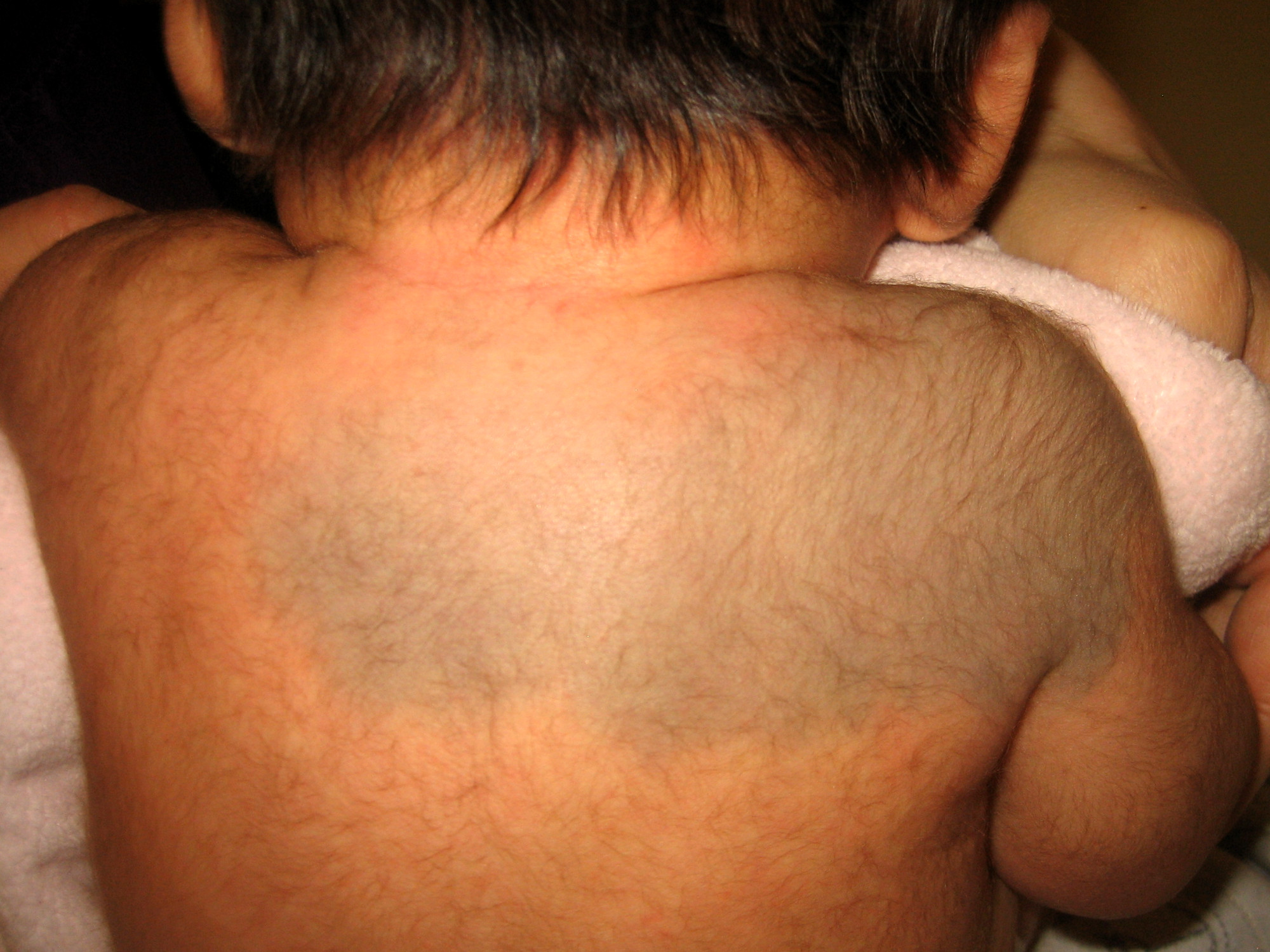
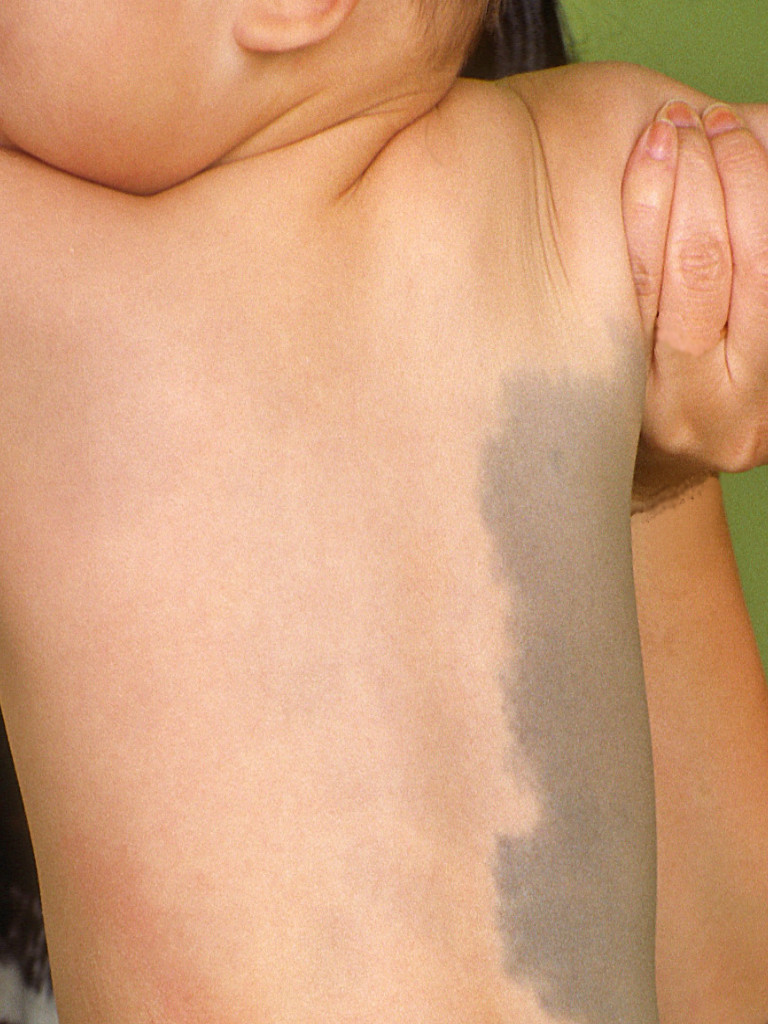
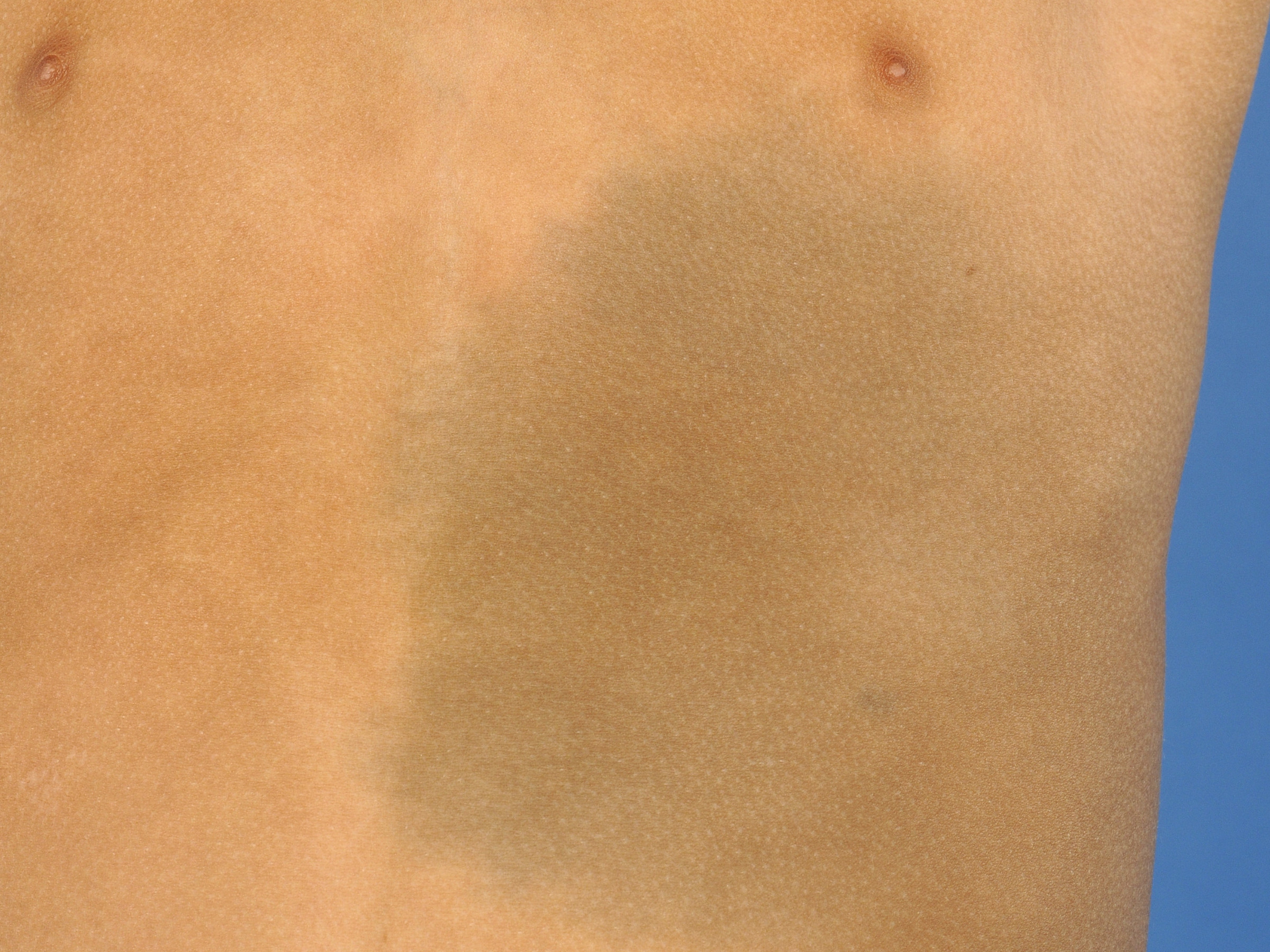
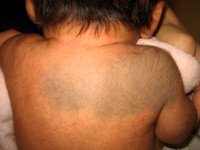
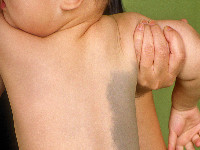
WHAT IS A NEVER OF ITO?A nevus of Ito is a blue-gray or blue-black discoloration, sometimes with brown tinges, on the shoulder or another spot on the upper back. Sometimes it appears on the collarbone. It is a type of birthmark, caused by a buildup of pigment cells under the skin . Nevus is the medical term for birthmark. Ito is the name of the Japanese physician who first described it in 1954. A nevus of Ito is primarily found in Asians, particularly Japanese. A nevus of Ito is usually present from shortly after birth, but can also become visible later, around puberty. The spot no longer increases in size after birth but does grow with the child. It is a benign condition and is usually not hereditary.WHAT DOES A NEVER OF ITO LOOK LIKE?A vaguely defined, irregular blue-gray to blue-black spot is seen on the shoulders, shoulder blades, or elsewhere on the upper back, and sometimes around the collarbone.
 |
 |
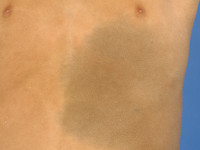 |
| nevus of Ito |
nevus of Ito |
nevus of Ito |
Photo left: Littlekidsdoc - Wikimedia (Creative Commons License 4.0 ).
HOW DOES A NEVER OF ITO OCCUR?The nevus of Ito consists of pigment cells ( melanocytes ) located beneath the skin, in the subcutaneous connective tissue. They shouldn't be there; pigment cells belong in the lower layer of the epidermis, where they protect the skin cells from sunlight by producing pigment. Due to a glitch in Mother Nature, something went wrong, causing the pigment cells not to reach the epidermis but to remain stuck deep within. This is also where they produce pigment, and if pigment is found deep within the skin, it takes on a bluish hue (on the surface, it's brown or dark brown to black). There are also other birthmarks with a bluish-gray color due to deep-seated pigment: the Mongolian spot , which is usually found low on the back, and the nevus of Ota , which is found around the eye.HOW IS THE DIAGNOSIS MADE?The diagnosis is based on the clinical picture, its appearance: the blue color and its location. There aren't many other similar symptoms. A Becker's nevus can also develop on the shoulder, but it usually develops later in life, during puberty. It's often somewhat browner and usually has thick or dark-colored hairs on it.IS A NEVER SURGERY OF ITO DANGEROUS?No, it is a benign and harmless condition. Other types of large congenital moles can sometimes develop into malignant moles, but with a nevus of Ito, the risk of this is negligible. Monitoring is not necessary.
A nevus of Ito can rarely occur as part of a syndrome in which other skin abnormalities are also present, particularly vascular abnormalities. Examples of these syndromes are Sturge-Weber syndrome, Klippel-Trenaunay syndrome, and the nevus pigmentovascularis.
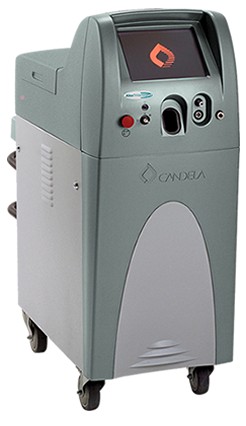
A nevus of Ito (on the shoulder) can occur in combination with a nevus of Ota (around the eye).HOW IS A NEVER OF ITO TREATED?Treatment is generally not necessary because it's a benign condition. The area may be cosmetically disturbing. A nevus of Ito can be treated with a pigment laser. Another option is to camouflage it with makeup. Protecting the area from sunlight is also an option, as this prevents the area from darkening and becoming more visible.Treatment with a pigment laserLaser therapy is effective for a nevus of Ito, but multiple treatments are needed to make the spot (almost) invisible. Because multiple treatments are needed, spaced 2-3 months apart, it can take up to two years. Several lasers are available for this purpose, such as the Q-switched (QS) ruby laser (QSRL, 694 nm), the QS Nd:YAG laser (1064 nm), the QS alexandrite laser (QSAL, 755 nm), and the fractionated Nd:YAG laser (1440 nm). These lasers are available in specialized laser clinics. Treatment is time-consuming and expensive and is not covered by all health insurers.
Laser for pigment disorders
CamouflageThe skin therapist can advise you on this and provide special camouflage make-up in the correct skin tone.Protect from sunlightExposure to sunlight can increase the pigment in the nevus of Ito, making it even more visible. Protecting yourself from the sun with a high-factor sunscreen can prevent this. |