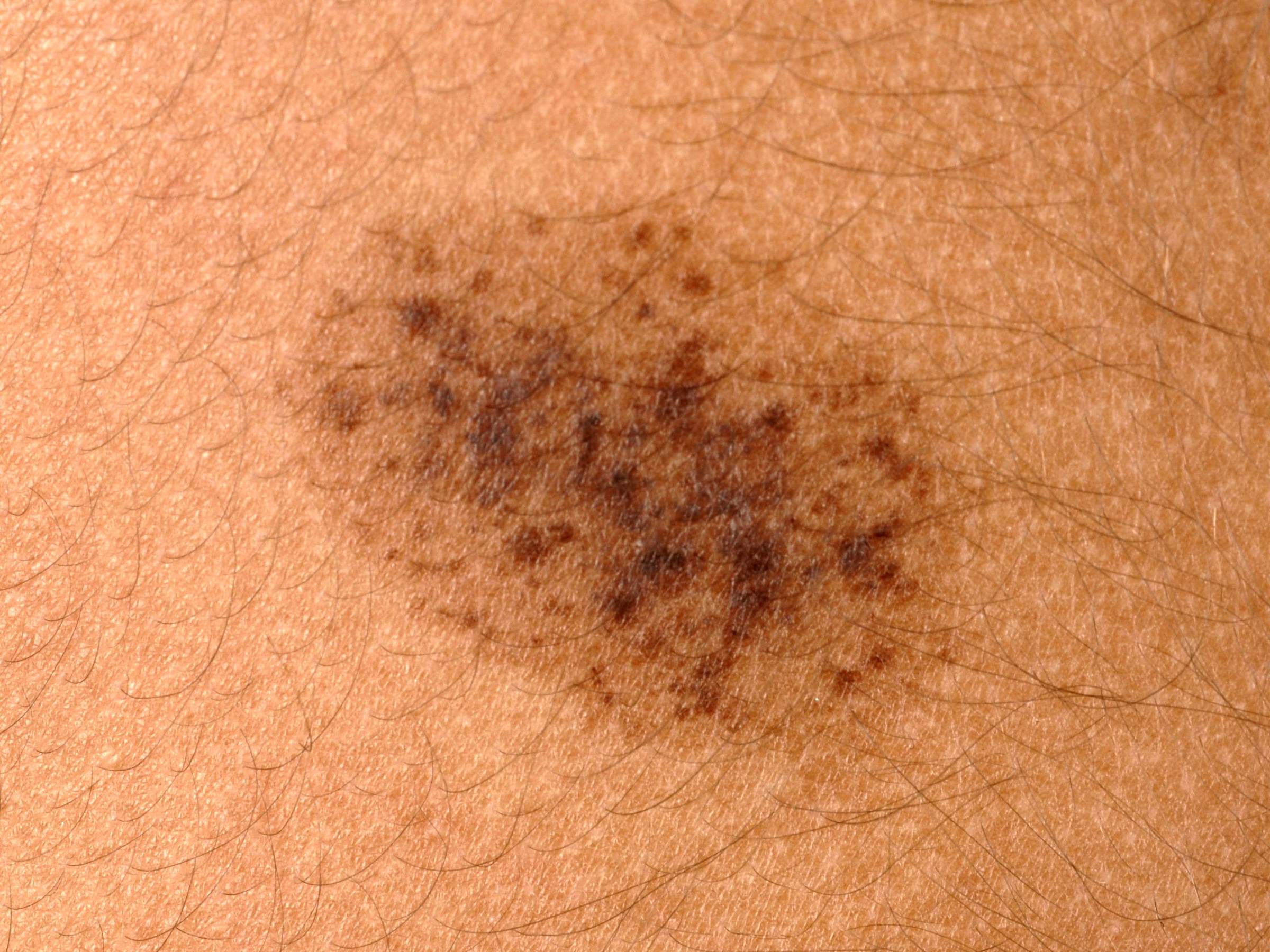
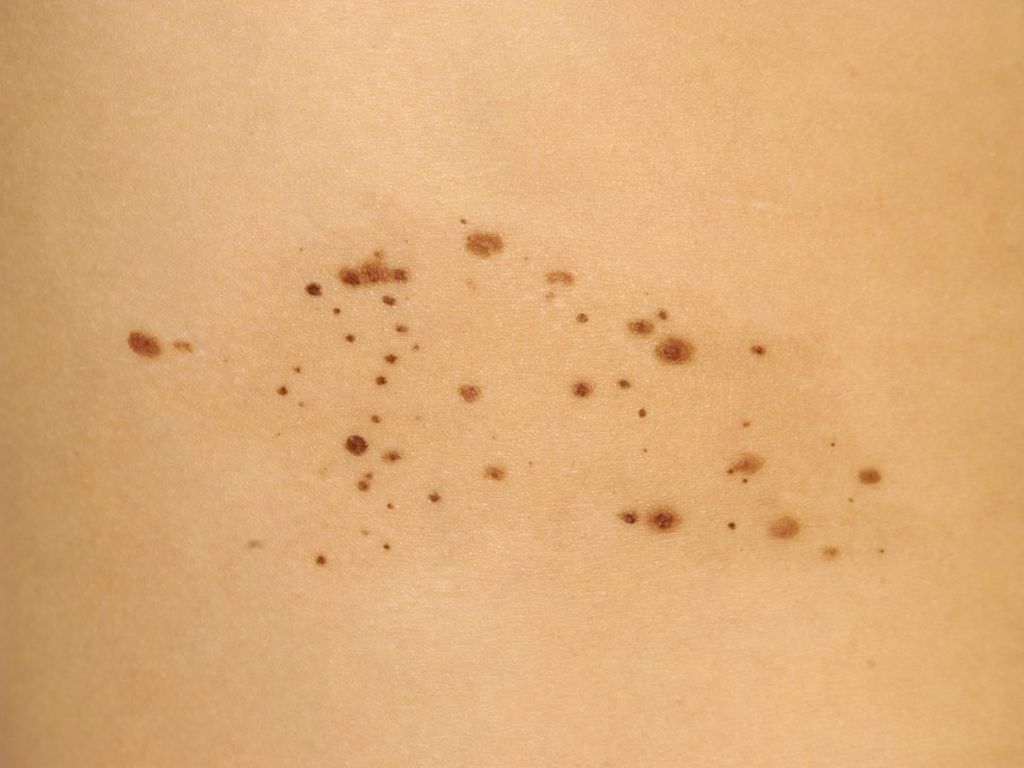
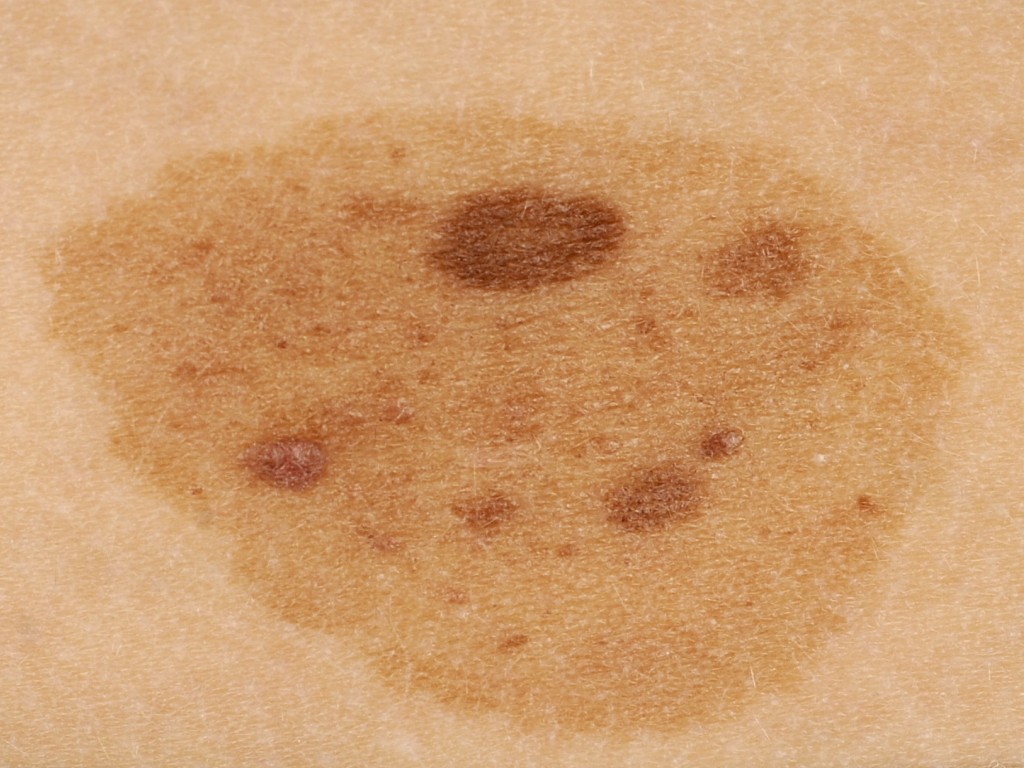
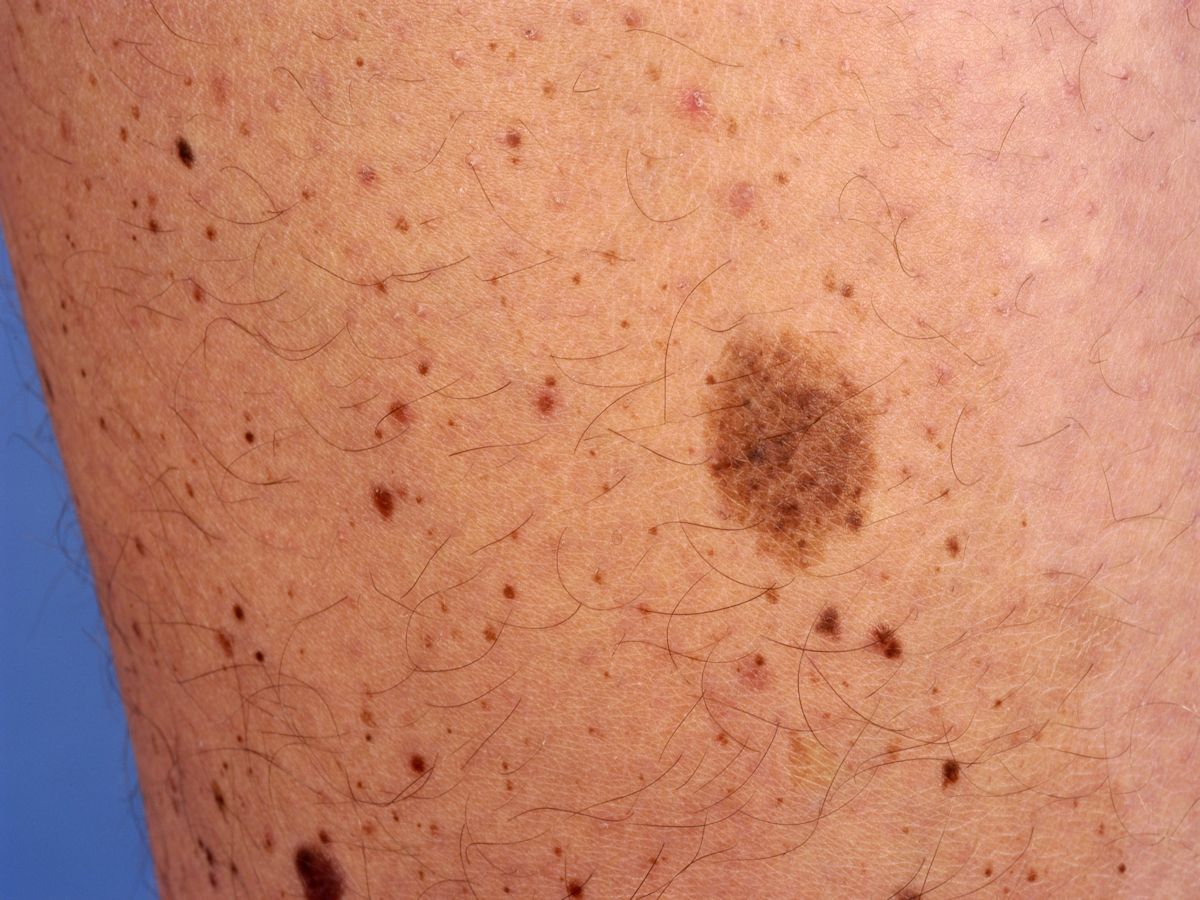
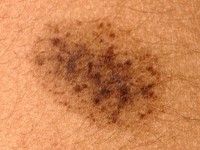
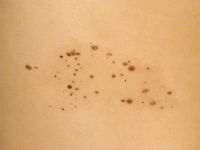
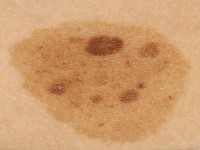
WHAT IS A NAEVUS SPILUS?A nevus spilus is a light brown mole with dark brown spots within it. It is also called a speckled mole . Nevus is the medical term for a birthmark. Spilus is derived from Greek and means speckled or blotchy. In English, a nevus spilus is called a " speckled lentiginous nevus ." A nevus spilus is a benign mole. It is often present from birth or becomes visible in the first two years of life. Initially, the spot may be very light brown and the spots may not yet be present, making the mole barely noticeable. A nevus spilus is common, found in 1-2% of school-aged children.
 |
 |
 |
| nevus spilus |
nevus spilus |
nevus spilus |
WHAT DOES A NAEVUS SPILUS LOOK LIKE?Most speckled moles are oval or round and 3 to 6 cm in size. But they can also be small (1 cm) or very large (60 cm). All sorts of shapes occur. Some are band-shaped and affect only one half of the body. Some are elongated. They can also form all sorts of irregular circles and lines, or take up a large portion of a leg or arm. It's also possible for one half of the body to have a nevus spilus and the other half not. They can appear anywhere on the body, including the face. They are equally common in men and women. The spots are light brown with dark brown spots or bumps within them; these are also moles. Various shades of color, from light brown to dark brown and almost black, occur.HOW DOES A NAEVUS SPILUS DEVELOP?A nevus spilus is a congenital birthmark. There are other types of congenital birthmarks, and they can also grow very large (congenital giant birthmark). Most congenital birthmarks are uniformly dark and often very hairy. A nevus spilus is a special light-colored and speckled variant. During the growth of an embryo (fetus), groups of cells specialize: some form skin cells, and others form pigment cells (melanocytes). If something goes wrong very early in embryonic development (a mutation) in some of the cells that will become melanocytes, a birthmark develops in the part of the skin where that group of cells ultimately ends up. If the abnormality develops late, or in a small group of cells, it becomes a small birthmark. If the abnormality develops early in embryonic development, a very large birthmark can develop.
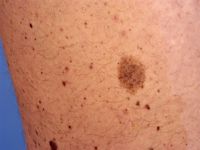 |
| large nevus spilus |
HOW IS THE DIAGNOSIS MADE?The diagnosis is based on the clinical picture, i.e., the appearance. No additional testing is necessary. A photo is often taken. If there are very large, dark, or irregular moles, it may be necessary to remove those parts for examination by a pathologist. This is rare.CAN A NAEVUS SPILUS OCCURRENTLY CONTAIN OTHER COMPLAINTS OR DISEASES?A nevus spilus can coexist with other conditions. However, this is extremely rare. There are congenital syndromes in which speckled moles can also occur. This occurs in Recklinghausen's disease (neurofibromatosis type I), in FACES syndrome , which consists of Facial features, Anorexia , Cachexia , and Eye and Skin anomalies (abnormal facial shape, underweight and malnutrition, eye abnormalities and skin abnormalities, namely a nevus spilus), and Ebstein syndrome (heart valve abnormalities, moles including nevus spilus and nevus sebaceous, and discoloration of the conjunctiva). It also occurs in association with vascular abnormalities and is called phakomatosis pigmentovascularis .CAN A NAEVUS SPILUS BECOME MALIGNANT?As mentioned, a nevus spilus is a benign mole. The dark spots in a nevus spilus are normal moles. Moles can sometimes become malignant and develop into melanoma. If you have a very large number of moles (more than 100), the risk of developing melanoma is slightly increased. If you have a very large nevus spilus, containing many individual moles, the risk of developing melanoma is also slightly increased. Fortunately, melanoma development in a nevus spilus is rare, but it has been documented. The risk is believed to be comparable to other congenital moles, such as the giant mole. Furthermore, it depends heavily on the size. For moles up to 20 cm in size, there is no increased risk of developing melanoma, and monitoring is not necessary. For moles larger than 20 cm, it is wise to keep an eye on the area, either by paying close attention to changes yourself or by having a doctor check it regularly (for example, once a year).HOW IS A NAEVUS SPILUS TREATED?A nevus spilus doesn't need to be treated because it's a benign mole. Treating it isn't easy either. Small spots can be surgically removed. Larger ones are problematic because they can cause unsightly scarring. A nevus spilus can be treated with a laser. The dark spots can be lightened, as can the light brown background. This doesn't always achieve the desired effect. Laser treatment of moles is generally not recommended. It's uncertain whether it's wise to do so; a mole can potentially become malignant due to the damage caused by laser treatment. It also becomes more difficult to assess, especially if only the top layer is burned away. It's better to accept the mole and leave it alone; camouflage is an option.WHAT ARE THE OUTLOOK?A nevus spilus is often present at birth but can become darker in color and more speckled. The lesion will not spread but will grow with the body's growth. It will not disappear spontaneously. The prognosis is good. In very large nevus spilus (greater than 20 cm in diameter), the risk of a malignant mole developing in the lesion is slightly increased, but still very small. Regular monitoring is recommended if the lesion is larger than 20 cm. |