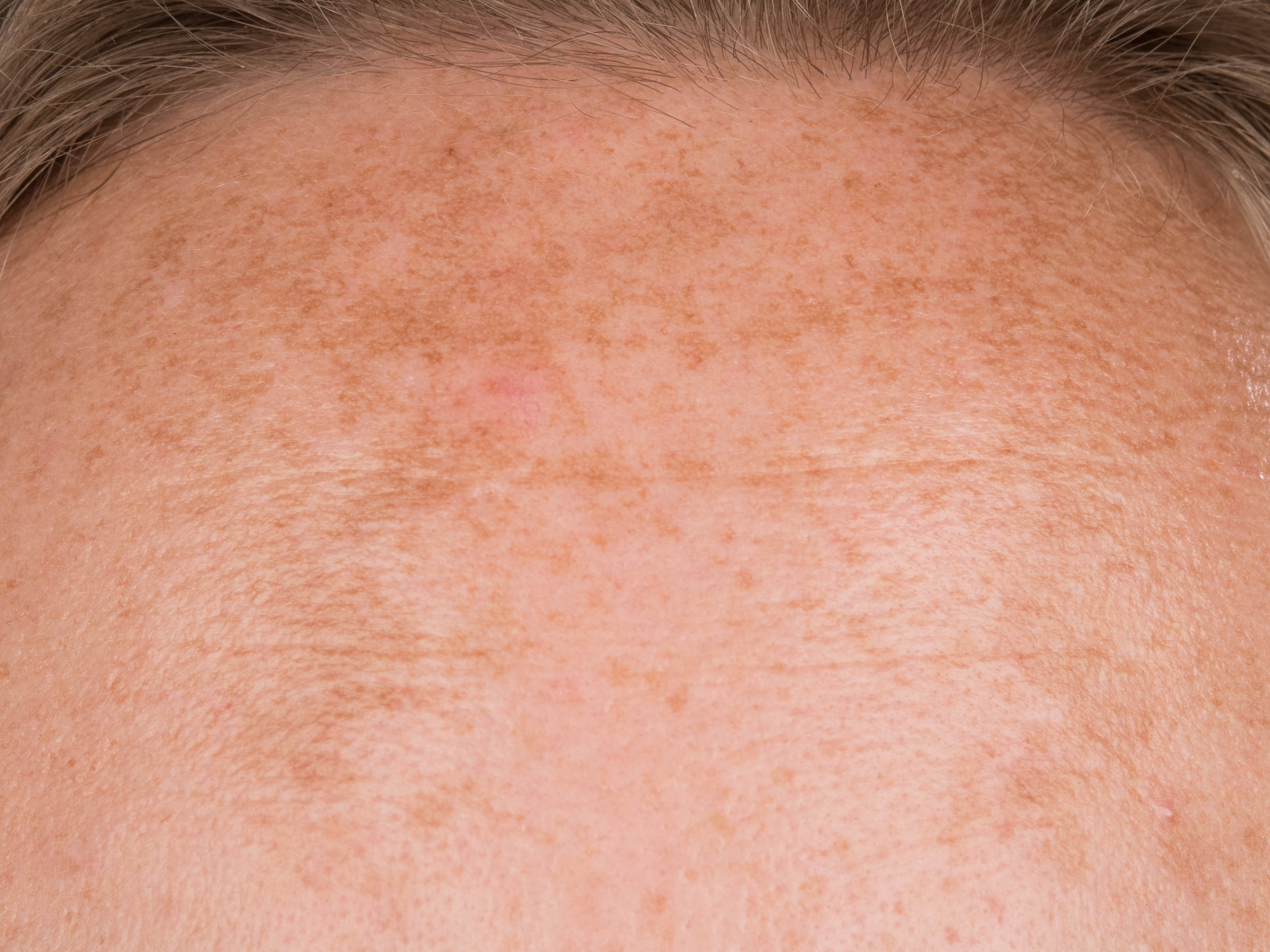
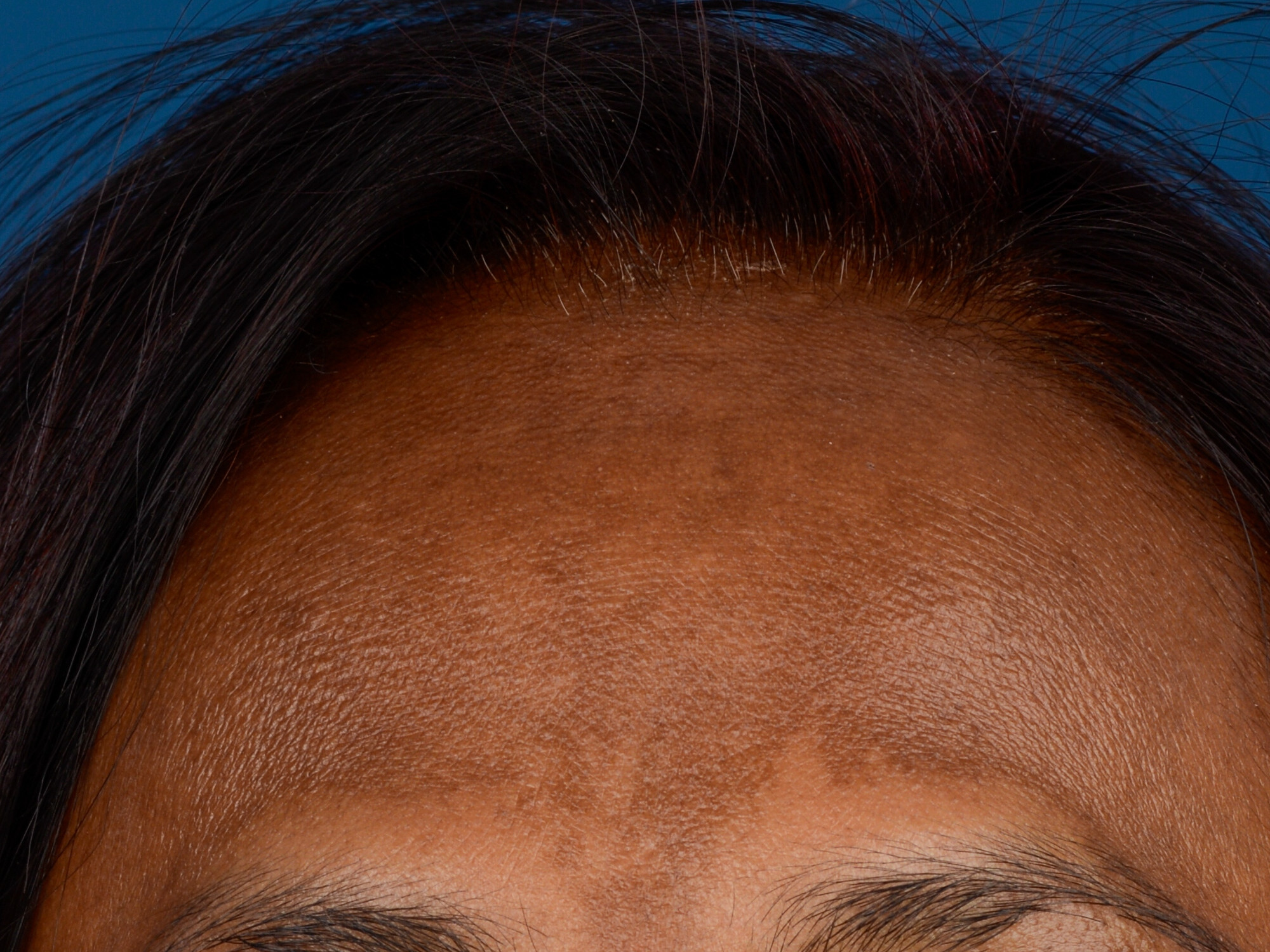
WHAT IS MELASMA?Melasma(also called pregnancy mask ) is a pigment disorder in which dark brown patches appear on the skin. These patches are moderately to sharply defined and usually irregularly shaped. Melasma primarily occurs on the forehead, cheeks, temples, around the eyes, and on the upper lip. Sometimes the patches also appear on the neck and arms. Although melasma is a benign condition, the often disfiguring patches can pose a psychosocial burden for the patient.
The dark patches are particularly noticeable after skin exposure to sunlight or artificial ultraviolet (UV) rays (tanning beds). Melasma primarily occurs in women of childbearing age. Very rarely, melasma also occurs in men.
 |
 |
| melasma |
melasma |
HOW IS PIGMENTATION FORMED?The skin consists of three layers: the upper epidermis (0.5-1 mm thick), the deeper dermis (1-2 mm), which contains the blood vessels and nerves, and the subcutaneous fatty tissue .
Pigment is a brown pigment produced by the pigment cells located in the lower layer of the epidermis. Pigment cells are therefore relatively superficial in the skin.
Within the pigment cell, the pigment is packaged in pigment granules and then released to the overlying epidermal cells. Only when the pigment is in the epidermal cells is the skin visibly pigmented. Every person, white or dark-skinned, young or old, has approximately the same number of pigment cells per unit of surface area. The activity of these pigment cells and the quantity, maturity, and size of the pigment granules determine a person's skin color, as well as the color of their hair and eyes. In darker races, pigment cells contain many more and larger, more mature pigment granules, and the epidermal cells are much more fully loaded with pigment granules than in fairer races.
Under the influence of UV radiation, the number of active pigment cells and pigment production increase. The result is a brown discoloration of the skin.HOW DOES MELASMA DEVELOP?The precise cause of melasma is still unknown. It is clear, however, that a hypersensitive pigment system is involved. Several risk factors can be identified that may be linked to the development or worsening of the spots.Pregnancyis recognized as one of the most important factors. Many women report that the spots appear during pregnancy. Fortunately, for some, these spots disappear after giving birth. Other triggers include natural and artificial UV radiation, heredity, use of the pill , the use of certain cosmetics, and some anti-epileptic medications.
All these factors can lead to increased activity of the pigment cells, resulting in increased pigment production. Because not all pigment cells in the skin react equally strongly, the result is not an even, but a more patchy brown discoloration of the skin. In some patients, no clear triggers can be identified.TYPES OF MELASMAMelasma is classified according to the depth of the excess pigment. There is a superficial type (the pigment is primarily in the epidermis) and a deep type (the pigment is primarily in the dermis). Unfortunately, it has been found that in most cases, the pigment is present in both the superficial and deeper layers.HOW IS MELASMA TREATED?Because the exact cause is unknown, there is no definitive treatment yet. Treatments are symptomatic, meaning they aim to eliminate or reduce the brown spots on the skin. Three objectives are pursued:
1. Preventing melasma from worsening.
a. It is recommended to always use a sunscreen with a high protection factor (at least SPF 25), a so-called sunblock, when exposed to UV rays. The product should be applied to the entire face (and possibly the neck), including areas where there is no melasma. The sunblock should be applied regularly, every hour, on sunny days. This is especially important between 11:00 AM and 2:00 PM, as the sun's intensity is highest then. Facial tanning is not recommended.
Many patients report that the spots become less noticeable during the winter months because there is less sun during this period. However, the use of sunblock is important during a winter sports holiday.
b. If there is a probable link between melasma and certain medications, you may consider stopping these medications or switching to an alternative. This should always be discussed with your doctor. However, no proper studies have yet examined the effect of stopping these medications on the severity of melasma. Stopping the birth control pill or switching to a different type of pill generally has no effect on the severity of the spots.
2. Inhibiting pigment production:
Several treatment options are available. The results of these treatments depend on the depth of the pigment. Superficial pigmentation can generally disappear easily. Deeper pigment in melasma cannot be effectively removed with current therapies.
a. Skin lightening creams:
These creams often contain the chemical hydroquinone. This substance inhibits pigment production. The substance is prescribed in concentrations of 2% to 5% in a cream. Higher concentrations are prohibited in the Netherlands. The higher the hydroquinone concentration, the greater the risk that not only pigment production will be inhibited, but also that the pigment cells in the skin will be (permanently) damaged. As a side effect, we see pinpoint white spots appear on the skin. Very rarely, even jet-black spots can appear on the skin as a result of hydroquinone use. The affected person's appearance is therefore even worse than before the treatment. Unfortunately, hydroquinone-containing creams are also available over the counter in certain drugstores. There is a warning against using such creams because the concentration of the hydroquinone they contain is often unknown. Other side effects of the cream include irritation and contact sensitivity.
The cream is applied once a day with a cotton swab, only to the dark spots (not to the entire face), in the evening before bed. The bleaching effect of hydroquinone-containing creams only occurs after 4 to 8 weeks.
b. Superficial chemical peel with fruit acids:
With a superficial chemical peel, a substance is applied to the skin that accelerates cell division. A kind of renewal of the epidermis occurs. As a result, the treated skin will flake off. With this flaking, the hope is that the excess pigment will also be removed. This ultimately results in a bleaching effect. The most effective acid is glycolic acid, which is used in concentrations of 10%-40%. Due to its small molecular size, this acid is easily absorbed by the various layers of the epidermis, where it exerts its effect.
c. Laser therapy:
Laser therapy aims for the specific removal of excess pigment in the skin while leaving the other skin structures intact. The laser emits light pulses of very short duration with very high intensity. The combination of the correct wavelength and ultra-short pulses results in maximum pigment destruction with minimal damage to normal skin. The main advantage of laser therapy is the low risk of scar formation.
Unfortunately, it has been shown that lasers only provide sufficient lightening of the spots in a small number of cases. Laser therapy usually doesn't have good results; after an initial lightening, the spots can return. Laser treatment can sometimes have a counterproductive effect, especially on darker skin; the spots can actually become darker. For these reasons, laser therapy is only performed in limited cases. A test area (the size of a dime) is treated first. If the test area darkens again after two months, further laser therapy is not recommended.
3. Camouflage
Because current treatments can sometimes take a long time (4-8 weeks) before a clear lightening effect is visible, many patients prefer to use makeup to make the spots less noticeable in the meantime. This is especially important during the day, at work, or during "public" occasions such as parties and receptions. Because there are so many of these types of makeup on the market, it is often difficult to choose the one that suits you best. It's also important that these products are applied to the skin correctly. Your skin therapist can help you with this. She can advise you on which products you can and cannot use. She will also demonstrate camouflage therapy so you can apply it correctly at home. By applying a special covering cream, bothersome lesions can be made virtually invisible. This has been shown to have a positive effect on the patient's self-confidence. For camouflage therapy, you must make a special appointment with your skin therapist.
Finally,
because current therapies are symptomatic, the spots can always return, even if they initially disappear with the treatment. This applies to all the treatment methods mentioned. For the rest of your life, you will have to be aware of factors that can stimulate pigment production, particularly sunlight. |