WHAT ARE LOCAL CORTICOSTEROIDS?Topical corticosteroids are anti-inflammatory ointments, creams, or lotions that can be applied to the skin. They are used for a variety of skin conditions, such as eczema and psoriasis. They soothe inflamed skin. Many skin conditions involve inflammation: red, warm, flaky, and sometimes damaged. Applying a corticosteroid cream eliminates these inflammation symptoms and allows the skin to heal. Topical corticosteroids are the most commonly used product in dermatology. They play an essential role in the treatment of skin conditions. Many patients have regained a more comfortable life thanks to corticosteroids.HOW DO LOCAL CORTICOSTEROIDS WORK?Topical corticosteroids are versatile and powerful: they inhibit inflammation, slow the accelerated cell division involved in some skin conditions like psoriasis, reduce redness, and reduce itching. Corticosteroids reduce or eliminate the symptoms of a skin condition, but they do not address the underlying cause. It's impossible to predict how long the effect will last. Sometimes they work only briefly, and sometimes they work for a very long time, or the symptoms don't return at all.WHERE DOES THE NAME COME FROM AND WHAT DOES IT HAVE TO DO WITH HORMONES?The body also produces corticosteroids itself, which are produced in the adrenal gland. The part of the adrenal gland where they are produced is called the adrenal cortex. The medical term for this is cortex; corticosteroids are steroids produced in the cortex. Another name for these substances is adrenal cortex hormones. This is where the name "hormone ointment" comes from.ARE CORTICOSTEROIDS SAFE?Corticosteroid ointments are safe, but they still have a bad reputation among many. This is because in the early days, when these products first came onto the market (decades ago now), they were applied for too long and with excessively strong ingredients. This led to an unnecessary number of side effects.
Because of these potential side effects, all of which are listed in the package inserts, and because of the negative reactions and vague fears evoked by the name "hormone ointment," many patients are hesitant to use corticosteroids. This is especially true for parents of young children with eczema. This is unjustified: with the current prescription of corticosteroids—not too strong, not for too long—there is no danger. The damage eczema causes to the skin is far worse than the side effects that can arise from corticosteroids. Those who don't use them, or use them too sparingly, are seriously harming themselves or their child.WHICH CORTICOSTEROID PREPARATION IS MOST COMMONLY USED?This depends on the skin condition and its location. For example, dry skin requires a rich ointment, moist skin a cream, and a lotion for hairy scalp. For thin skin, skin folds, and children, a mild corticosteroid is sufficient, but for thick skin, such as the palms of the hands and the soles of the feet, the strongest preparation is needed. You can also start with a strong corticosteroid every day, and when the condition improves, switch to a milder one, or limit the use to a few days a week.WHAT DIFFERENT STRENGTHS OF CORTICOSTEROIDS ARE THERE?Topical corticosteroids are divided into 4 classes according to strength: class 1 is the mildest corticosteroid, and class IV is the strongest.
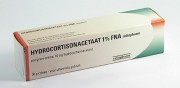 |
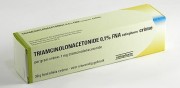 |
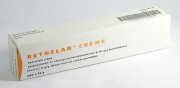 |
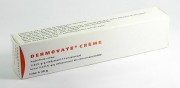 |
| Class 1 (light) |
Class 2 |
Class 3 |
Class 4 (strong) |
| Class I |
| substance name |
brand name: |
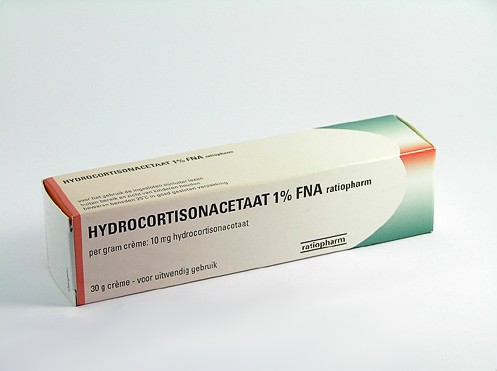
| hydrocortisone acetate 1% |
hydrocortisone cream, hydrocortisone ointment |
| Class II |
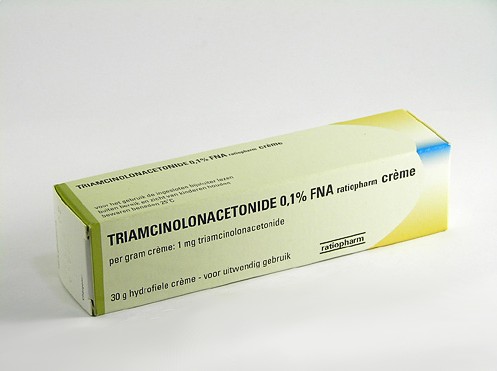
| triamcinolone acetonide 0.1% |
triamcinolone cream, triamcinolone ointment |
| flumethasone pivalate 0.02% |
Locacorten cream |
| Class II-III |
| hydrocortisone-17-butyrate 0.1% |
Locoid cream, emulsion, fat cream, oleogel, scalp lotion |
| fluticasone 0.05% |
Cutivate cream, Cortifil cream |
| fluticasone 0.005% |
Cutivate ointment |
| Class III |
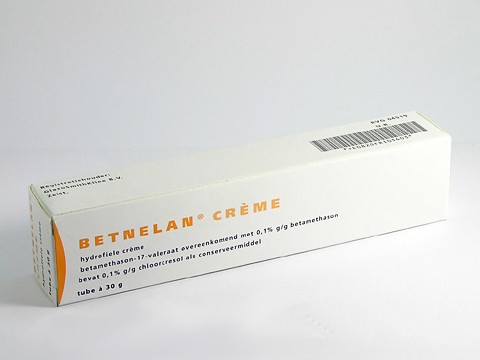
| betamethasone-17-valerate 0.1% |
Betnelan cream, ointment, skin emulsion, scalp lotion |
| momethasone 0.1% |
Elocon cream, ointment, lotion |
| desoxymethasone 0.25% |
Ibaril cream, Topicorte lotion |
| Class III-IV |
| betamethasone dipropionate 0.05% |
Diprosone cream, ointment, scalp lotion |
| Class IV |
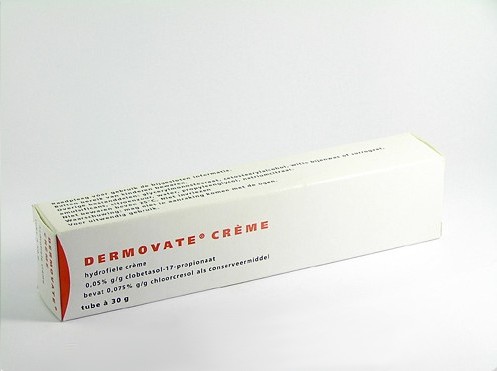
| clobetasol-17-propionate 0.05% |
Dermovate cream, ointment, scalp lotion, Clarelux foam, Clobex shampoo, Eczoria cream |
| betamethasone dipropionate 0.05% |
Diprolene hydrogel, ointment |
HOW SHOULD I USE CORTICOSTEROIDS?This varies depending on your skin condition; follow your doctor's instructions.
The package insert usually states that you should apply the cream or ointment once or twice a day. Often, once a day is sufficient; sometimes, applying it twice a day is recommended initially.
As the skin condition improves, the treatment can be adjusted. This can be done by using a weaker ointment, or by applying the cream only a few days a week, for example, 3 to 5 consecutive days. The other 2 to 4 days a week, apply nothing or a basic cream or ointment. Experience shows that applying the cream for a few consecutive days a week works just as well as applying it every day. It is also safer because you use less total per week.
Applying a thin layer is sufficient; there is no point in applying more. Using too much corticosteroid can cause side effects. This can happen for Class II and III preparations if you use more than 100 grams per week, and for Class IV if you use more than 50 grams per week. Sometimes, however, it's necessary to exceed these weekly amounts if you have a serious skin condition or if you use it on a large area. There's no weekly maximum for Class I preparations.
Children use much smaller amounts of corticosteroids per week, and usually no stronger than Class III. The skin of young children absorbs corticosteroids much better, so using stronger preparations isn't necessary.WHAT ARE THE SIDE EFFECTS?Local side effects
: Local side effects occur at the site where the corticosteroid is applied.
- The skin can become thinner. This is called atrophy.
- Stretch marks (stripes, wheals) can develop.
- Small red vasodilation can occur.
- Hair growth can accelerate.
- An acne-like rash (pimples) can develop on the face.
These local side effects only occur when corticosteroid ointments are applied daily for extended periods (months to years). Areas with thin skin are particularly susceptible to side effects, such as the face, but also the external genitals and the skin of body folds (armpits, groin).
The time it takes for local side effects to appear depends on the strength of the corticosteroid preparation and the amount used per week. A class I preparation rarely causes local side effects, while a class IV preparation sometimes does so after a few weeks to months.
The onset of atrophy (thinning of the skin) is gradual. In the initial phase, the skin can still recover. Only when the preparation is used for months to years at a time does truly irreversible damage to the skin occur.
When interval treatment is used in the maintenance phase, local side effects almost never occur, even after a long period of time.
An allergy to corticosteroid preparations can sometimes develop. This possibility should be considered if a skin condition does not improve unexpectedly with corticosteroid use. A corticosteroid allergy can be tested with allergy tests.
Systemic side effects:
Systemic side effects are general side effects. They occur because the corticosteroids applied to the skin penetrate the skin and enter the bloodstream.
- The face may become thicker
- Bone loss may occur
- The adrenal cortex may stop producing adrenal cortex hormones
- Eye problems (cataracts and increased intraocular pressure) may develop
- Growth retardation may occur in children who use large amounts of corticosteroids.
These systemic side effects rarely occur in adults. Children are more sensitive to systemic side effects because they have a relatively large body surface area in relation to their weight. In addition, their skin is thin, so more of the hormone passes through the skin. |