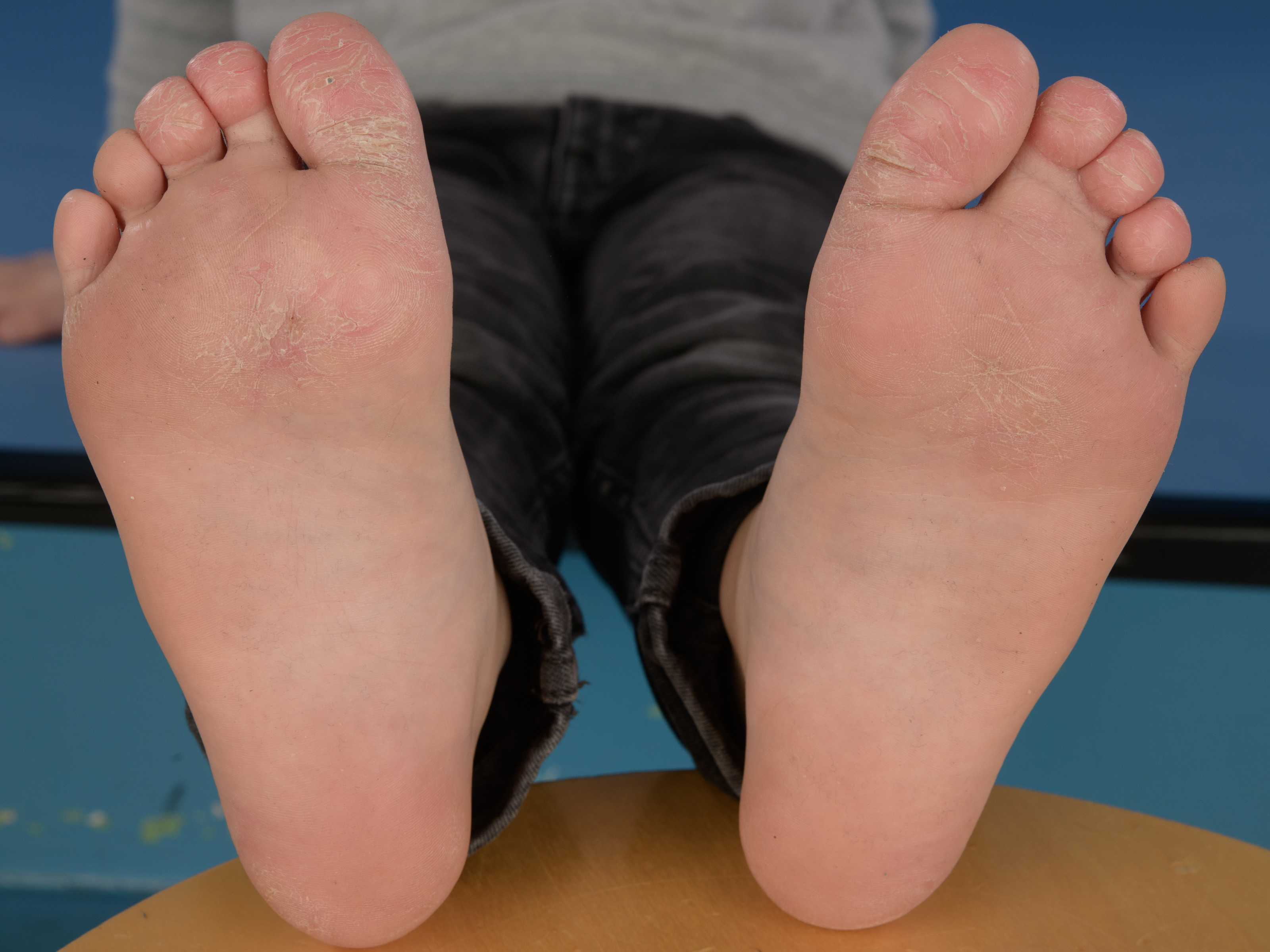
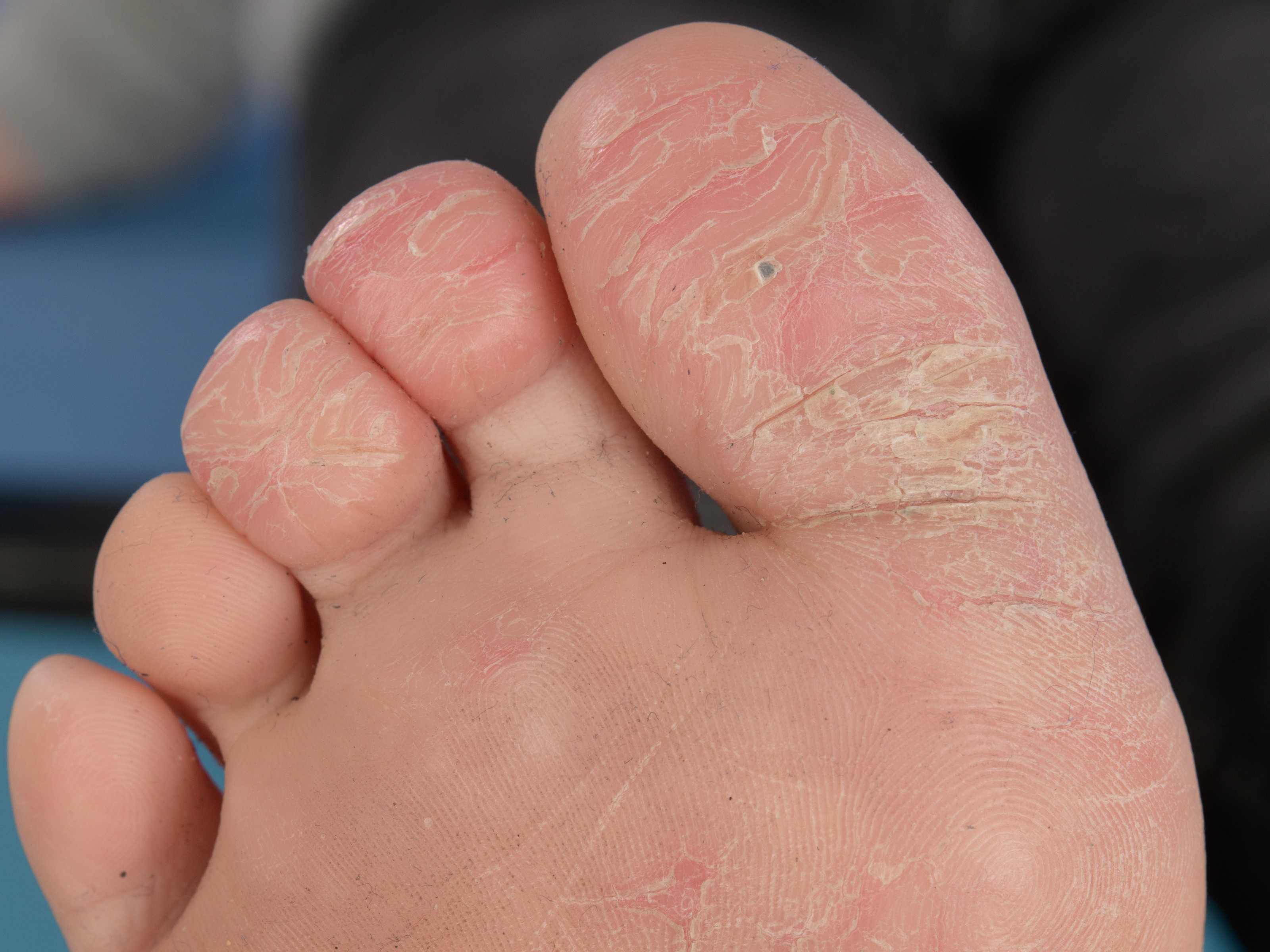
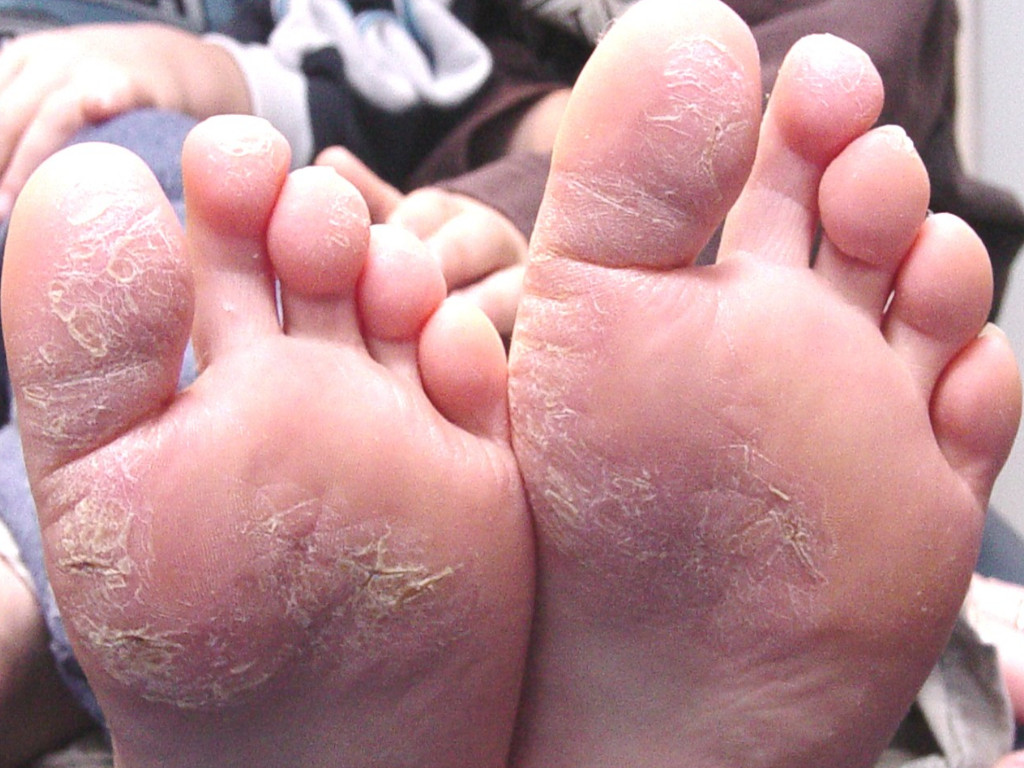
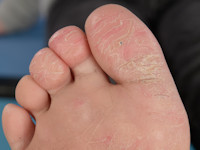
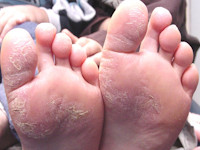
WHAT IS JUVENILE PLANTAR DERMATOSIS?Juvenile plantar dermatosis is an eczema-like condition on the soles of the feet that occurs only in young children. The skin on the soles of the feet is red, dry, flaky, and cracked. Juvenile means "in young people," plantar means "on the soles of the feet," and dermatosis means skin disease. The condition occurs in children aged 3-15, and within that group, most commonly in boys aged 4-8.WHAT DOES JUVENILE PLANTAR DERMATOSIS LOOK LIKE?The lesions occur on the soles of the feet, particularly at pressure points: the heel, the forefoot, and the bottom of the big toe. The skin appears red and shiny, sometimes with flakes. Painful cracks may develop. Juvenile plantar dermatosis can persist for a long time, sometimes for several years, but eventually resolves on its own, at least around puberty.
 |
 |
 |
juvenile
plantar dermatosis |
juvenile
plantar dermatosis |
juvenile
plantar dermatosis |
WHAT IS THE CAUSE OF JUVENILE PLANTAR DERMATOSIS?Juvenile plantar dermatosis is thought to be caused by the action of moisture on the skin, and that moisture in this case is sweat. If the skin on the sole of the foot is constantly moist, for example, if you suffer from sweaty feet or wear poorly ventilated shoes, the skin can become irritated and red, dry, and flaky. Because of the link with sweat, it is also called sweaty sock syndrome . Poorly ventilated shoes, such as gym shoes with a high synthetic content, plastic, and rubber, or plastic boots, are a significant cause. Poorly absorbent socks made of polyester or nylon are also possible causes.
Juvenile plantar dermatosis is more common in children with atopic tendencies (children prone to allergic reactions and atopic eczema). This can be explained by the fact that children with atopy often have dry skin that is sensitive to moisture. Juvenile plantar dermatosis is also more common in winter (perhaps because more breathable footwear is worn in summer). That is why it is also called atopic winter feet .HOW IS THE DIAGNOSIS MADE?The diagnosis is based on the clinical picture. Several symptoms can be similar, such as athlete's foot, chronic hand and foot eczema, and a contact allergy to shoes. Sometimes, some flakes need to be examined under a microscope to rule out athlete's foot. If an allergy to shoe materials is suspected, a contact allergy test should be performed using adhesive patches on the back.HOW IS JUVENILE PLANTAR DERMATOSIS TREATED?VentilateWear breathable footwear: breathable, well-padded sandals, slippers indoors, or go shoeless whenever possible. Avoid closed gym shoes with lots of plastic, rubber, or impermeable synthetics. Don't wear boots all day. Wear thick cotton socks and change them often if they get damp. Don't wash the soles of your feet with harsh soaps (they dry out the skin).Greasy ointmentsKeep the skin on the soles of your feet moisturizing throughout the day. Apply a moisturizing ointment such as Lanette Vaseline or pure Vaseline. Apply this in the morning before the children leave for school. Apply it again when you get home, and immediately put on clean, dry socks. Also apply a moisturizing ointment before bed so it can absorb overnight.Other ointmentsOintments containing moisturizing ingredients, such as Calmurid ointment or urea ointment, can also be used.
Leaving tar ointments on overnight can also be helpful. Tar ointments restore the skin barrier. An example of a tar ointment is 10% or 20% tar solution in lanette ointment.
Over-the-counter products specifically designed for dry, cracked feet are also available at pharmacies and drugstores (without a prescription). Examples include the Gehwol product line: Gehwol foot cream, Gehwol crack ointment, and Gehwol balm for dry and chapped skin. There are more products like this; ask your pharmacist or drugstore for advice.Topical corticosteroidsIn persistent cases, anti-inflammatory corticosteroid ointments ("hormone ointments") may be necessary. Moisturizing agents can be added if necessary.WHAT ARE THE OUTLOOK?Juvenile plantar dermatosis can persist for a long time, lasting from several months to several years, but eventually resolves on its own. It progresses in waves, sometimes severe, with painful cracks, and sometimes almost completely gone. It is usually at its worst during the winter months. It improves in the summer, especially when wearing loose footwear (sandals, flip-flops) or no shoes at all. It usually disappears completely around puberty. |