WHAT IS A PUNCH GRAFT SKIN TRANSPLANT?The punch graft method is a simple skin grafting technique developed in the 1970s by dermatologists from the AMC (Academic Medical Center). This grafting method is used to close wounds such as leg ulcers (medically known as leg ulcers ). It's a simple technique that can be performed under local anesthesia. This skin grafting method allows wounds to close more quickly. The final result is also much firmer than with other methods, such as closing the wound from the edges.HOW IS A PUNCH GRAFT SKIN TRANSPLANT PERFORMED?Cleaning the Wound:
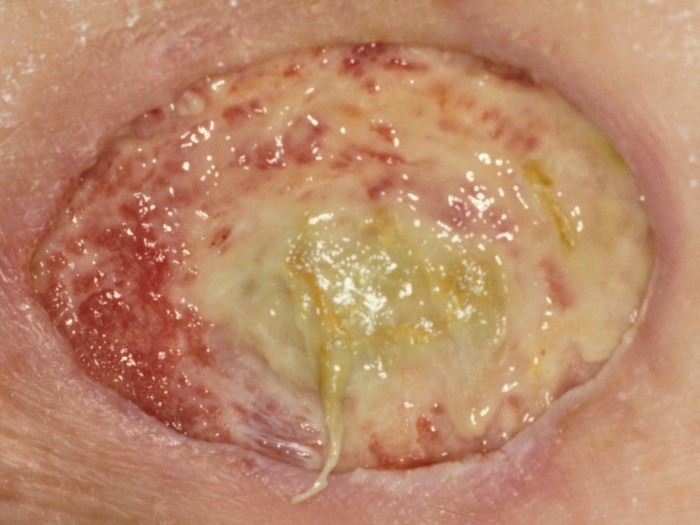
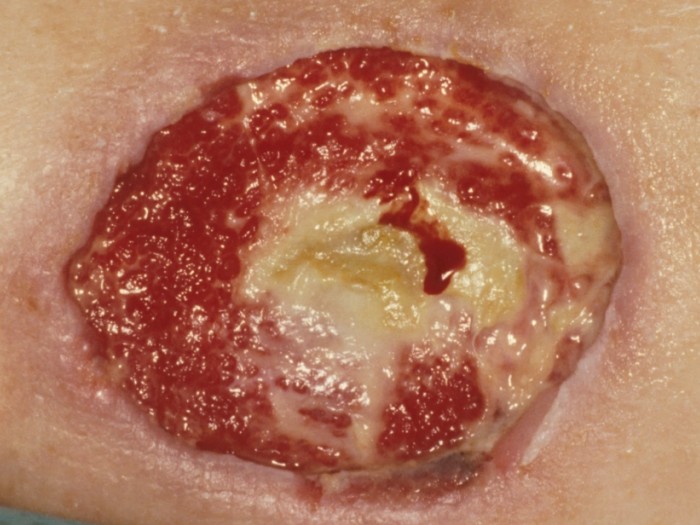
The first step is preparing the wound. The wound bed must be clean and well-perfused. A yellow wound or a dirty wound with dead tissue or bacteria is not a good breeding ground for skin grafts. They will not grow together but will fall off. Various wound products are used to clean wounds with dead tissue. The best product for cleaning wounds for skin grafting is a cleansing solution called EUSOL (EUSOL paraffin). EUSOL contains chlorine, which kills all bacteria, even those resistant to antibiotics. The disadvantage of chlorine is that it can cause pain or burning in some wounds. Alternatives to chlorine solution are physiological saline solution or other cleansing solutions. Sometimes antibiotics are also administered. Gauze pads soaked in the EUSOL solution are applied to the wound twice a day. By applying and removing the gauze pads, dead tissue is naturally loosened and mechanically removed. This process takes several days, depending on the initial situation. The body itself also helps out; inflammatory cells clear away dead tissue, and other cells form blood vessels and connective tissue. The wound changes from yellow to red. Once the wound is red enough, a transplant can be performed.
 |
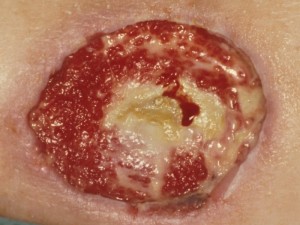 |
| Yellow wound |
Red wound (partial) |
The skin graft:
The procedure usually takes place in a well-lit treatment room. It is performed under local anesthesia. For a small wound, it takes a moment; for a larger one, it takes longer.
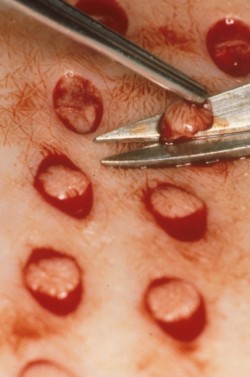
A small area of skin is selected from the thigh, large enough to receive several 4 mm diameter circles. The number of circles is estimated. Generally, one circle is needed per square centimeter of wound, so approximately 4 for a 2 x 2 cm wound and approximately 25 for a 5 x 5 cm wound.
The skin area is marked with a marker or adhesive tape and then numbed with lidocaine anesthetic. These injections are somewhat painful, but most patients find them minor. The most common reaction to this procedure afterward is: "Was that all?"
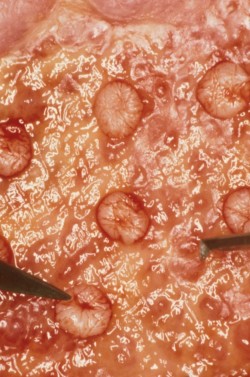
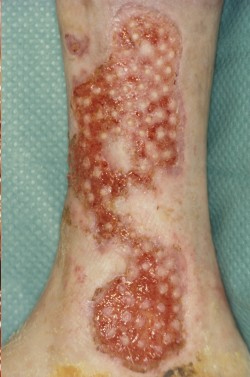
Circles of 4 mm diameter are removed from the anesthetized area. Circular holes are punched out with a kind of apple corer (English: punch). That's why it's called a punch graft. These rounds are removed with scissors and tweezers and placed loosely on the wound in a regular pattern. During the procedure, you must keep your leg still and avoid any sudden movements. A fatty gauze is then applied, followed by a layer of gauze, followed by a bandage and a protective bandage. This must remain in place for five days. The area from which the rounds were removed is thoroughly cleaned and then bandaged with a sterile dressing. This dressing should remain in place for as long as possible (it will fall off naturally once the wounds have healed).
After the transplant,
the rounds of skin are placed loosely on the wound, held in place by the bandage. Therefore, walking is not permitted after the procedure. Bed rest is required for at least four to five days. Strict bed rest, including no going to the toilet, is unsustainable for almost no one, so it is permitted. However, try to keep getting out of bed to an absolute minimum. If you are not taking anticoagulation, you will receive anti-thrombosis injections once a day during the bed rest period.
Unpacking
After the 4-5 days, the bandage is removed, starting with the top layers. Then, the bottom layers are thoroughly moistened. This is left to soak in for fifteen minutes. Then, the bandage is completely removed. After 5 days, the transplanted skin circles will have grown to the underlying layer. Some are not attached and remain stuck to the bandage. These have not survived; it's okay if a few fall off. When unwrapped after 5 days, a wound may look dirty, sometimes pus-filled and foul-smelling, and the skin biopsies may look pale, as if they won't survive. However, don't judge too hastily; after a few days, they will often be a nice pink color again. After unwrapping, a new layer of gauze is placed on the transplanted wound, and moist gauze is placed over this. The gauze is changed once a day, the moist gauze three times a day. This continues until the wound has (almost) healed, after which it is bandaged dry (gauze + dry bandage). After unwrapping, bed rest is lifted. However, patients with an open leg who would develop fluid in their legs without support stockings should not get out of bed without a stocking or pressure bandage around them.QUESTIONS ABOUT THE PUNCH GRAFT SKIN TRANSPLANTDo the wounds on the thigh heal properly?
Yes, they always heal well: there are no wound healing problems high up on the leg.
What do the scars look like?
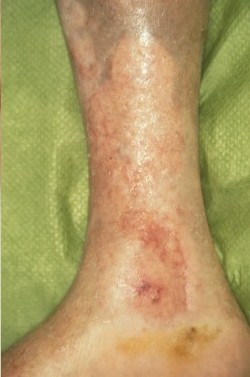
The scars heal nicely, the holes close up from the edges and become smaller. After 1-2 years, they are barely visible. No dents develop. Sometimes a slight color difference is visible.
Are there any complications?
Occasionally, postoperative bleeding or a wound infection at the donor site can occur. Otherwise, no problems are expected. The grafts may not take, or only take partially. This happens if the base wasn't red enough, if the dressing has shifted, or due to insufficient bed rest. Wound infection of the wound being transplanted can also occur. The risk of this can be reduced by using preventative antibiotics.
What is the difference with a split skin graft?
A split skin graft is removed with an electric knife, a kind of cheese slicer. This is usually done by a plastic surgeon. A flap of skin is cut away. This can be stretched if necessary by making holes in it (this is called a split skin mesh graft). The flap can also be removed under local anesthesia, but it is usually done under general anesthesia, partly because the flap is secured to the wound bed with staples. A split skin graft can also be used on an open leg. The only difference is that punch grafts are thicker. Punch grafts are full-thickness, meaning that not only the epidermis is transplanted, but also a large piece of dermis, containing intact hair follicles, sweat glands, and small vessels. This results in a much firmer end result than with the thin skin of a split skin graft. A thick and firm end result is especially important for an open leg (ulcus cruris venosum), because stockings must be tied around it again once it closes. For other types of wounds, this is less important, and a split skin graft can be used just as well. Split skin mesh grafts are used for very large wounds because inserting individual rounds would otherwise be very time-consuming.
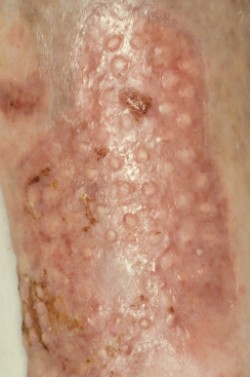
The punch graft method offers even more advantages: simple, easy to perform for any physician, fast, inexpensive, requires few materials, no waiting time, no anesthesia, and no operating room time.HOW LONG WILL IT TAKE TO CLOSED?The preparation time varies. Some wounds are clean in 1-2 days, others in 1-2 weeks. The bed rest period before the skin islets are attached to the wound is 4-5 days. It then takes another 5 days for the islets to begin growing. The skin grows at a maximum rate of 0.5-1 mm per day from the islets and from the wound edges. The total healing time depends on the number of islets attached compared to the size of the wound. On average, it takes another 5-10 days for the wound to close completely. This final period does not necessarily require hospitalization. If it is secure and appears to be growing, you may wait at home for further healing. However, a pressure bandage is required if it is a leg ulcer (venous leg ulcer). Other types of wounds do not require a pressure bandage.
 |
 |
 |
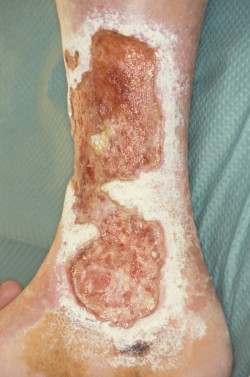
| Open leg (ulcus cruris venosum) |
4 mm punch biopsies of the femur |
Placing punch biopsies in the wound bed |
 |
 |
 |
| Skin regrowth after 10 days |
Situation after 3 weeks |
One and a half years after hospital admission |
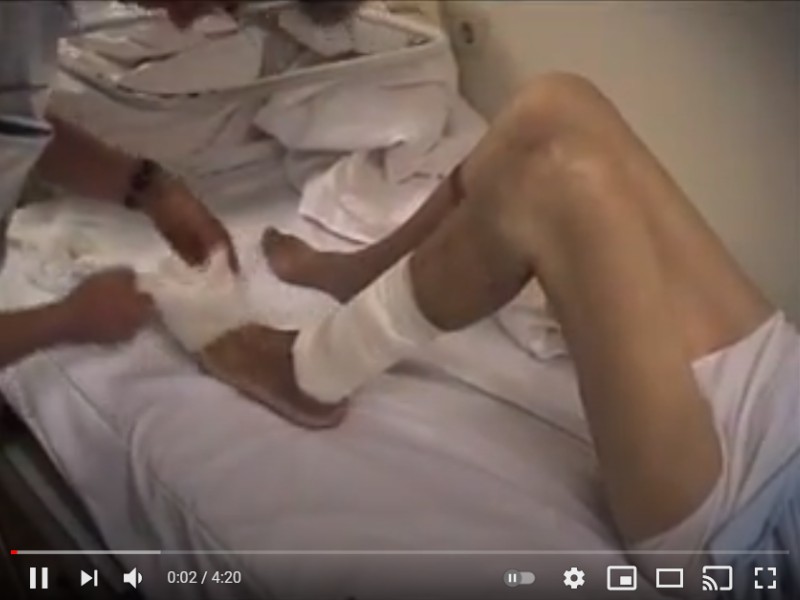
Video of the punch graft transplantation
|