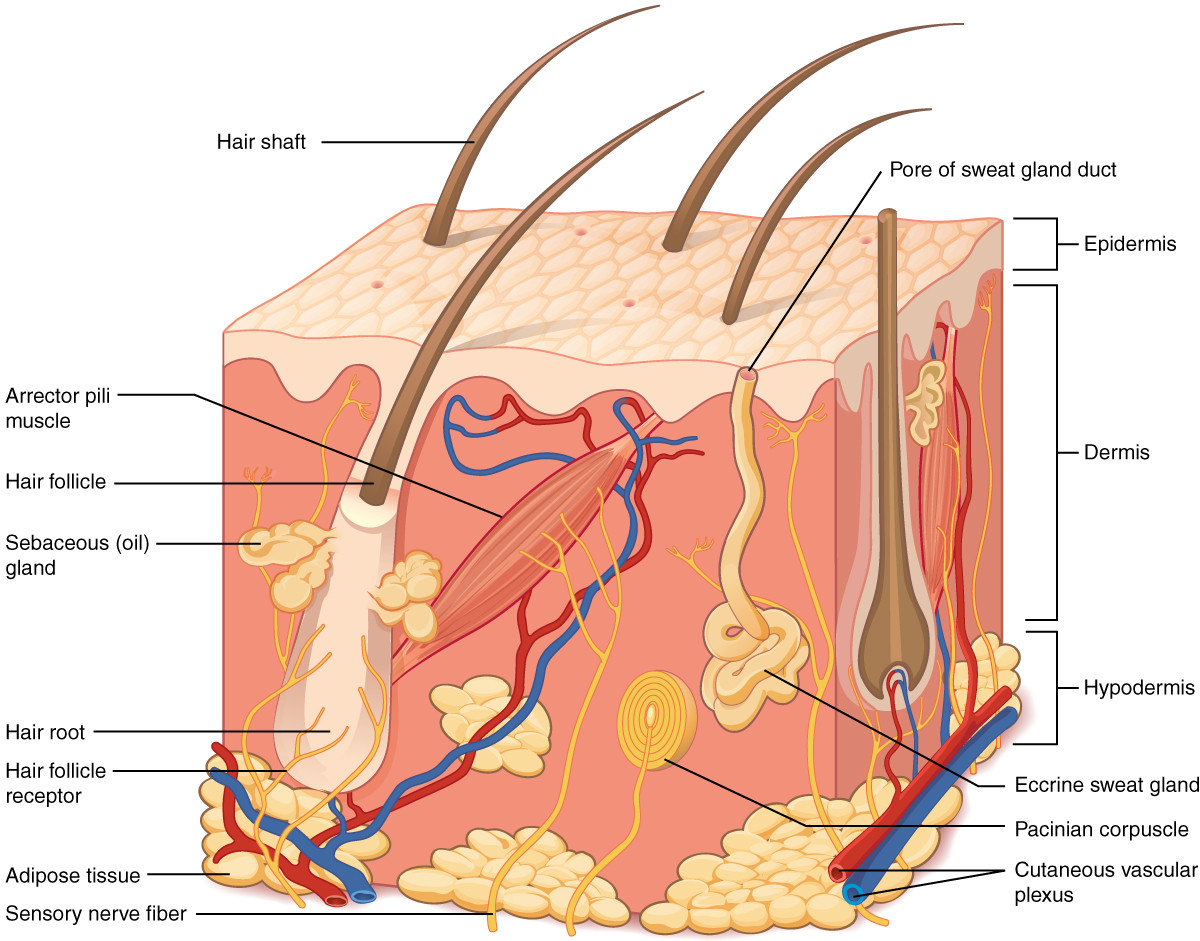
The skin is the covering that separates the individual from the outside world. This organ protects against all kinds of external influences. It consists of three parts. The upper (outer) portion is formed by the epidermis. Below this lies the dermis: the corium or dermis. These layers form the skin in the narrower sense. The lower portion is the subcutaneous connective tissue: the subcutis (connective tissue is tissue that serves to connect and support other tissues and organs). Below the subcutis is the fatty layer. The skin also contains skin appendages: sebaceous glands, sweat glands, hair roots, and nail beds, where nails are formed. These structures will be discussed one by one.THE EPIDERMISThe epidermis consists primarily of one type of cell: the keratinocyte. Keratinocytes are formed in the basal layer and gradually move upward from there. They gradually merge into a dead, keratinized cell layer, the stratum corneum, where the cells become increasingly loosely attached to one another. The connection between the individual epidermal cells is crucial for protecting the skin, including against dehydration. The epidermis is normally only a few tenths of a millimeter thick, with the stratum corneum being no more than a thin membrane. In areas with heavy calluses, such as the palms of the hands and the soles of the feet, the stratum corneum is extra thick.
Because the cells in the basal layer continuously divide and eventually flake off at the top, the epidermis renews itself approximately once a month. The ability of the basal layer to produce new cells allows the skin to heal relatively quickly after an injury. The division activity of the basal layer is determined by several factors. In young people, cell division occurs more rapidly than in older people. Surface flaking is usually not visible, except on the scalp in cases of dandruff and in certain skin diseases (such as psoriasis, see folder 10).
In addition to keratinocytes, the epidermis also contains melanocytes. Melanocytes are pigment cells located between the cells of the basal layer and produce pigment granules that are transferred to the keratinocytes via processes. The pigment in these pigment granules, melanin, largely determines skin color and protects us from sunlight. The more pigment granules, the darker the skin. The epidermis as a whole forms a natural barrier against chemical substances and physical influences such as acids, against dehydration, and against damage from sunlight. The skin also protects us from the penetration of bacteria, fungi, and viruses.THE DERMISThe dermis is a 1-3 mm thick layer of connective tissue. It consists primarily of connective tissue cells, connective tissue fibers, and a gel-like ground substance. The underside of the epidermis and the top of the dermis are not flat. The border has a strongly undulating pattern with indentations and protrusions, which interlock the two layers, anchoring the epidermis to the dermis. The protrusions of the dermis within the epidermis are full of tiny blood vessels (capillaries) and lymphatic vessels, which nourish the overlying epidermis and remove waste products. Further down in the dermis, a dense network of larger blood vessels and lymphatic vessels is present. Other nerve fibers supply the sebaceous and sweat glands, the muscles surrounding the hair, and the blood vessels. The blood vessels in the skin are responsible not only for nourishing (and supplying) the skin itself but also for regulating body temperature. Skin blood flow significantly determines the amount of heat released to the outside world. The fibers in the skin determine its elasticity and tensile strength. The older the skin, the less elastic and tensile strength it becomes. The dermis also contains numerous nerve endings that provide humans with the sense of touch, pain, and temperature.SUBCUTANEOUS CONNECTIVE TISSUE (SUBCUTIS)The subcutaneous connective tissue consists mainly of fat. It serves an important function as a heat-insulating layer, energy storage, and shock absorber.SEBACCO AND SWEAT GLANDSSebaceous glands are distributed throughout the skin, except on the palms of the hands and the soles of the feet. They are always located next to a hair follicle and empty into it. Sebum consists of a mixture of various fatty substances that keep the skin supple and protect it from drying out. On average, there are about a hundred sebaceous glands per square centimeter. On the center of the chest and back, on the face, and on the scalp, this number rises to almost a thousand. People with high sebum production often suffer from greasy hair.
Sweat glands are also found all over the body. There are two types of sweat glands. The so-called eccrine sweat glands are found throughout the body and play an important role in regulating body temperature. When emotional or nervous, the glands on the face and palms, in particular, secrete a large amount of sweat. The sweat glands in the armpits and around the genitals, the so-called apocrine sweat glands, have a different structure and function. In the animal kingdom, these play a vital role in species recognition and habitat demarcation. In humans, this function is no longer paramount, but the scent can be sexually arousing.
Skin anatomy. Source: OpenStax College, J. Gordon Betts, Peter Desaix, Eddie Johnson - Wikimedia (Creative Commons License 3.0 ).
HAIR AND NAILSHair and nails consist of dead horny material. A hair emerges from a follicle, which, together with a sebaceous gland, forms a hair follicle. With the exception of the lips, palms, and soles of the feet, hair follicles are found all over the body.
There are two types of hair: vellus hairs and terminal hairs. Vellus hairs are very fine, unpigmented downy hairs, approximately 2-3 mm long. Under the influence of sex hormones, vellus hairs change into thicker, pigmented terminal hairs in the armpits and pubic area during puberty. In men, terminal hair also develops on the face, torso, arms, and legs. We have typical male and female hair growth patterns, which develop under the influence of sex hormones.
Hair growth is cyclical. Each hair follicle has its own rhythm with three varying periods: a growth period (anagen phase), a transition phase (catagen phase), and a resting period (telogen phase), after which the hair falls out. The hair follicle then begins a new growth cycle. Unlike most mammals, human hair follicle cycles are not synchronized. Humans do not have a period when all hairs fall out simultaneously.
On the scalp, the lifespan of a hair is two to six years. On the rest of the body, the cycle is shorter. Of the 100,000 to 150,000 hairs on the human head, 85% are in the anagen phase, 14% in the telogen phase, and 1% in the catagen phase. This indicates that a loss of 50-100 hairs per day is normal.
Nails also consist of dead horny material. The nail grows from the nail bed. Between the skin the nail rests on, the nail plate, and the skin itself, there's a thin layer of skin that forms a good barrier with the outside world. Constantly pushing back the cuticle increases the risk of infection. Fingernails grow about 3 mm per month, while toenails grow only 0.5-1 mm per month and therefore take about a year or more to renew themselves.HOW DOES NEWBORN SKIN DIFFER FROM THAT OF AN ADULT?The skin of a newborn differs slightly from that of an older child and an adult. However, the differences are only apparent in premature babies. After the fourth week of life, a child's skin has fully matured. The thickness of a newborn's dermis is less than that of an adult. The epidermis and stratum corneum of a premature baby are considerably thinner than those of a baby born after a normal gestation of nine months. The subcutaneous connective tissue is not yet fully developed in a newborn and is significantly thinner than that of an adult. A very young child has a larger skin surface area relative to its weight than an adult. This is important for externally applied treatments. More substances can be absorbed into the body through the skin of young children. A baby can also cool down more quickly due to the larger skin surface area. |