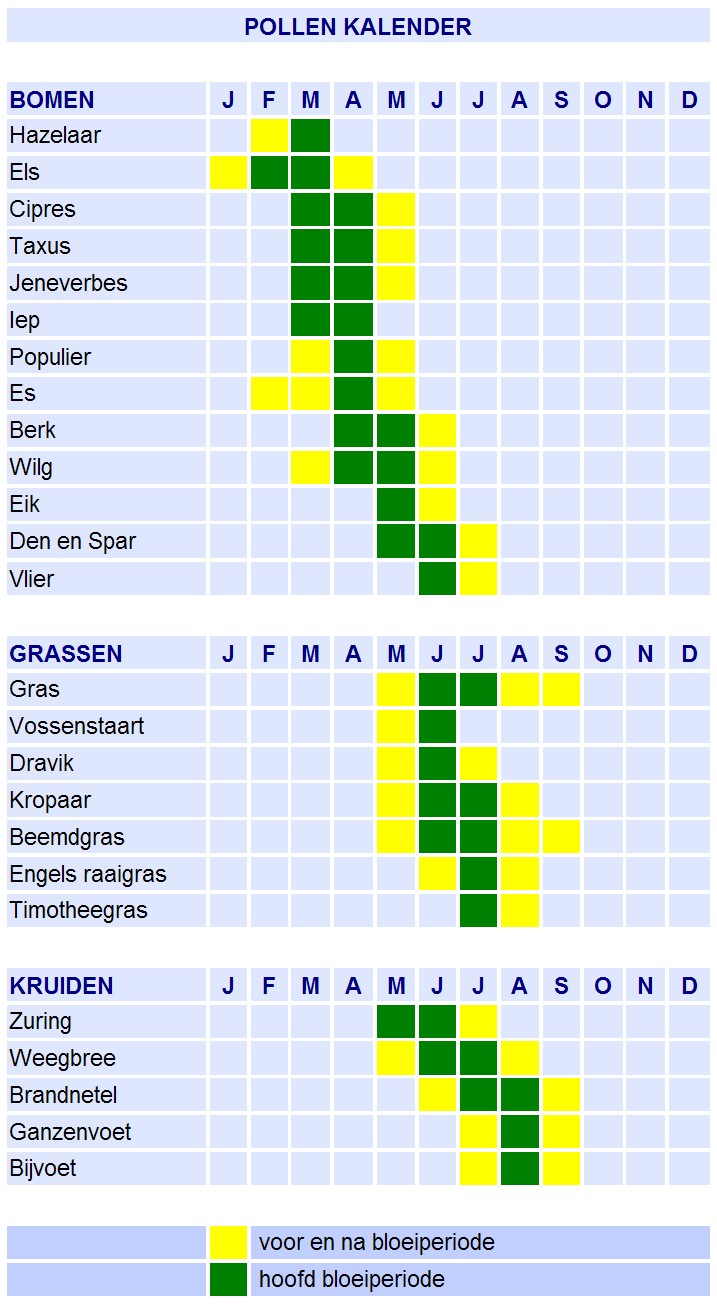
WHAT IS HAY FEVER?Hay fever( Pollinosis ), contrary to what the name suggests, has nothing to do with hay or fever. It involves an oversensitivity to pollen grains. Pollen from grasses, trees, and weeds can all cause symptoms. The seasonal variation in symptoms follows the flowering period:
Trees bloom early in the year: willows and hazelnuts in February-March, birches in April-May.
Weeds can cause symptoms from April to September.
The flowering period for grasses is usually between mid-May and mid-September.
Grass pollen is the main source of pollinosis in our region. Hay fever symptoms are most severe when the concentration of pollen grains in the air is highest. This occurs on warm and windy days. Grass pollen is extremely light and can therefore be easily carried by the wind over long distances. Therefore, grass pollen can also cause problems in places where one might not expect it (for example, in the city center).
COMPLAINTS
The complaints can be of various nature:
Nose:
Itching, pain, sneezing, runny nose (clear, later often coloured), congestion
Mouth, throat, ears:
Itching, pain and sometimes swelling of the mucous membranes with a feeling of pressure
Lungs:
Coughing, wheezing (asthma and/or bronchitis) accompanied by a feeling of tightness
Eyes:
Itching, pain and burning sensation, tearing, redness of the whites of the eyes, swelling of the conjunctiva and eyelids and sometimes irritation
Skin:
Itching, redness and swelling (hives), development and worsening of a skin rash
General:
Fatigue, headache, listlessness
The best way to prevent hypersensitivity symptoms is to avoid all contact with the responsible substances (these are called "allergens"). This is not easy and in some cases it is even impossible.
TREATMENTA proven hypersensitivity to pollen grains can be treated in several ways:
- Medication.
- Specific hyposensitization.
This involves a series of subcutaneous injections of allergen extract, which reduces the hypersensitivity to pollen grains over several years. The treatment activates the body's immune system by injecting small amounts of allergen. Antibodies are produced, resulting in fewer or no symptoms during the pollen formation period.
- A combination of medication and specific hyposensitization is also possible.
The treatment to be followed is individualized from patient to patient and should be discussed with the attending physician.ADVICEDuring the pollen formation period, contact with pollen grains should be avoided as much as possible.
On dry, sunny, and windy days, it's best to stay indoors as much as possible and keep doors and windows closed (even at night). Grasses and branches from trees and shrubs to which you are sensitive should definitely not be brought into the house. A walk in the wild is definitely not recommended. Traveling is best on rainy days, or by plane or boat. When traveling by car, keep the windows and roof closed. When choosing a vacation, it's best to choose places with low pollen counts (coastal, beach, seaside, large lakes, or mountainous areas). You can also choose a location where there is no flowering season at the time of your stay, or choose a different time of year (e.g., winter) to take your vacation. When choosing a profession or hobby, one should consider any potential sensitivity to certain substances and avoid areas where frequent contact with pollen is possible.
During the pollen-producing period, several rules of conduct should be followed:
- Maintain a regular lifestyle with a healthy diet and good sleep (=good resistance).
- Open windows only in rainy weather and on the side of the house facing away from the wind.
- Avoid contact with non-specific stimuli (temperature fluctuations, cooling, drafts, chemicals such as chlorine and ammonia, perfumes, tobacco smoke, etc.) as much as possible. |