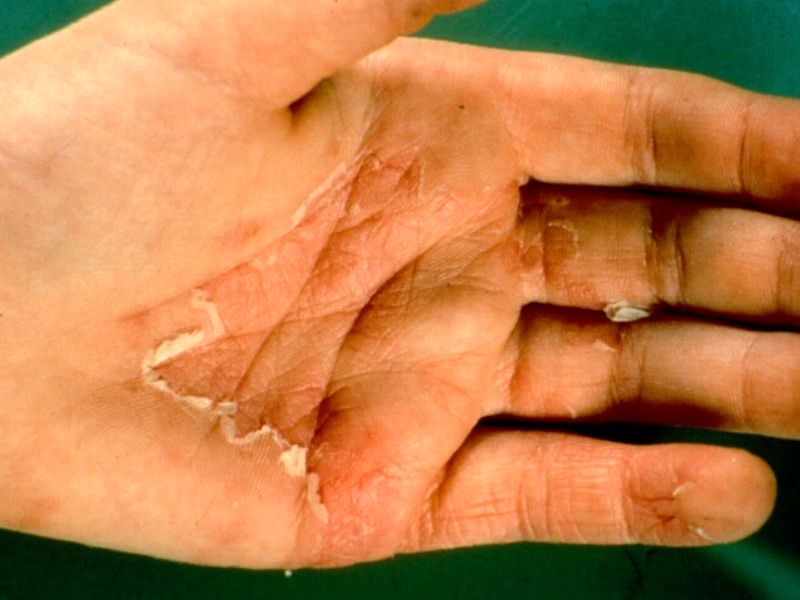
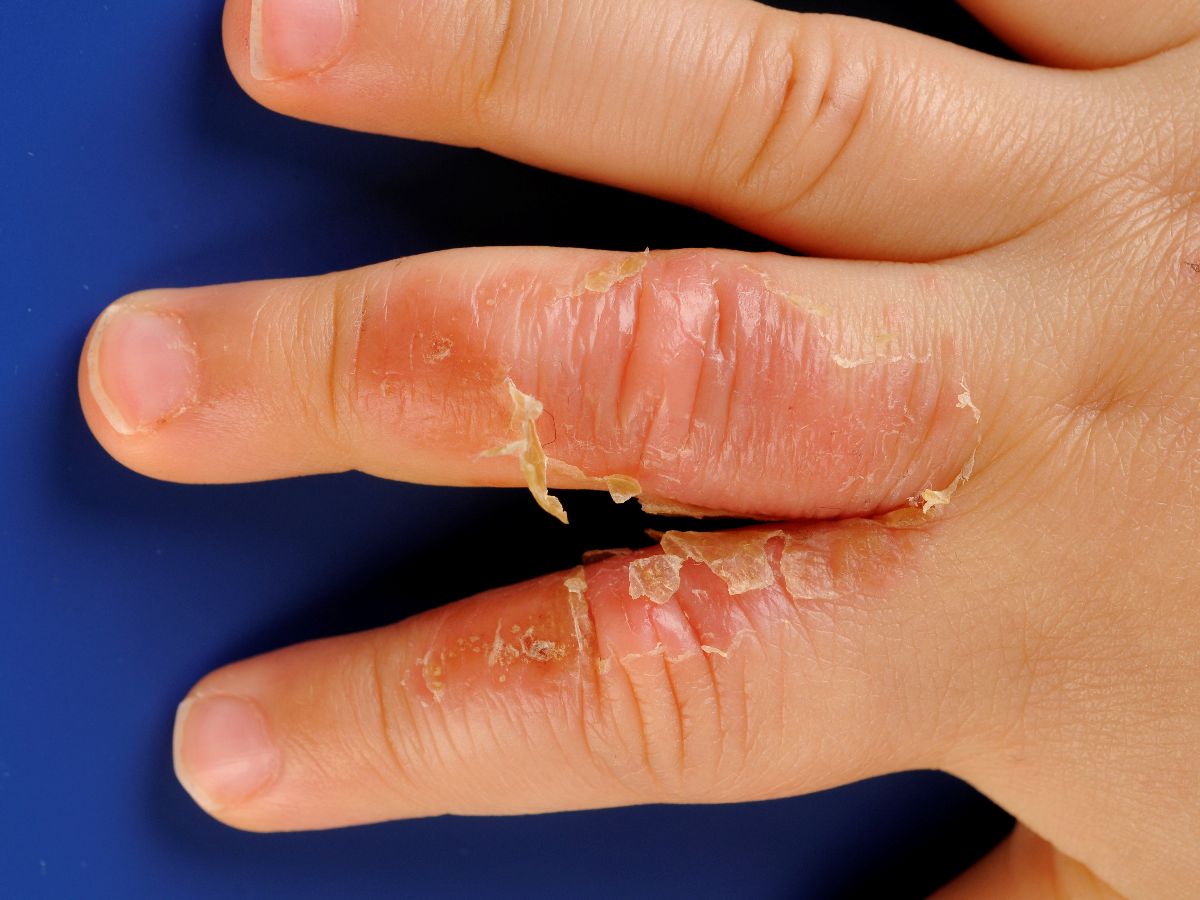
WHAT IS TINEA MANUUM?Tinea manuumis the medical term for a fungal infection of the hand . Tinea manuum often accompanies athlete's foot. Scratching fungal-infected feet can also infect the hand. A fungal infection of the hand can also be contracted through contact with animals (dogs, cats, livestock) or with soil (gardening, farming).
 |
 |
| tinea manuum |
tinea manuum |
WHAT DOES TINEA MANUUM (FUNGAL INFECTION OF THE HAND) LOOK LIKE?There are several types of fungal infection:
1. The most common form affects one hand. The palm has thickened, flaky skin, with calluses and sometimes some redness. The lines and folds of the hand are noticeably white due to the flaking.
2. Fungal infection can also appear as a ring-shaped spot on the back of the hand. This is called ringworm.
3. The third form of fungal infection develops as an itchy spot with bumps and blisters or pustules, and flaky edges.HOW DO YOU GET HAND FUNGUS?Athlete's foot (tinea manuum) is an infection caused by fungal species such as Trichophyton rubrum , Trichophyton mentagrophytes , Epidermophyton floccosum , M. canis , T. verrucosum , or M. gypseum . It can be contracted through contact with a person who has a fungal infection, or via towels or clothing. It can also be contracted through contact with animals (dogs, cats, livestock, rodents) or with soil.WHO CAN GET HAND FUNGUS?Athlete's foot can develop in people with athlete's foot through self-contamination. It also occurs in certain professions where hands frequently come into contact with water, such as in the hospitality industry or healthcare. It also occurs in livestock farmers and veterinarians, and in people who frequently come into contact with soil or gardening tools (e.g., gardening, or farming).HOW IS THE DIAGNOSIS MADE?The diagnosis is made by scraping off some scales from the hand and examining them under a microscope. Samples can also be submitted for fungal culture. Tinea manuum can sometimes closely resemble chronic hand eczema.HOW IS TINEA MANUUM TREATED?Tinea manuum is usually treated with an antifungal cream or ointment. This should be applied twice daily for four weeks. Antifungal creams are usually no longer covered by health insurance, but they are also inexpensive and available over the counter at pharmacies or drugstores.
If topical antifungal creams are insufficient, tinea manuum can also be treated with antifungal tablets. Various tablets can be prescribed, such as terbinafine, itraconazole, fluconazole, and griseofulvin.WHAT CAN YOU STILL DO YOURSELF?If the fungus was contracted through frequent contact with water, see if it's possible to change your washing habits. Avoid harsh soaps or solvents that dry out the skin and disrupt the skin barrier. Use a hand cream or lotion. Dry your hands thoroughly before putting on gloves. Avoid contact with animals and wear clean protective gloves when working with soil. |