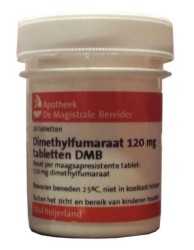
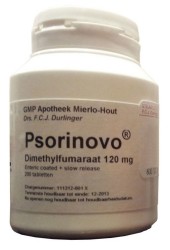
FUMARIC ACID FOR THE TREATMENT OF PSORIASISIn consultation with your dermatologist, you have decided to use fumaric acid (dimethyl fumarate) to treat psoriasis. Fumaric acid is an organic acid, a substance that occurs naturally in human cells. Research has shown that fumaric acid is an effective treatment for psoriasis. Little is known about fumaric acid's precise mechanism of action, but the results are positive. The Dutch psoriasis guidelines recommend fumaric acid as a first-choice tablet for the treatment of psoriasis.
Fumaric acid is a simple and inexpensive substance. The drug is prepared by various pharmacists and wholesalers in the Netherlands. Fumaric acid has been used in the Netherlands for psoriasis since 1981. However, for many years, fumaric acid was not officially registered as a medication for psoriasis. This was because there was no large pharmaceutical industry behind it that could carry out the costly registration procedure. Fumaric acid has now been registered for psoriasis by the company Allmirall, under the name Skilarence. This drug is 10 times more expensive than the fumaric acid produced by pharmacists, but the unique aspect of the Dutch healthcare system is that some insurers do reimburse the expensive drug because it is registered, while the cheaper pharmacy preparations are not. As a result, treatment with fumaric acid can cost thousands of euros per year and is even more expensive than treatment with a biological.AVAILABLE FUMARIC ACID TABLETS IN THE NETHERLANDSThe following tablets are available:
- Skilarence (dimethyl fumarate) tablet 30 mg
- Skilarence (dimethyl fumarate) tablet 120 mg
-
Dimethyl fumarate tablet 30 mg - Dimethyl fumarate tablet 120 mg
- Dimethyl fumarate tablet 240 mg
- Fumarate 105 mg tablet (30 mg dimethyl fumarate + 75 mg monoethyl fumarate)
- Fumarate 215 mg tablet (120 mg dimethyl fumarate + 95 mg monoethyl fumarate)
- Dimethyl fumarate Psorinovo tablets 30 mg
- Dimethyl fumarate Psorinovo tablets 120 mg
- Dimethyl fumarate Psorinovo tablets 240 mg
All tablets have an enteric-coated coating that prevents premature dissolution in the stomach. The 105 mg fumaric acid tablets contain 30 mg DMF (dimethyl fumarate) and 75 mg MEF (calcium monoethyl fumarate). DMF is the main ingredient in this tablet, making the 105 mg tablet comparable to a 30 mg tablet. Psorinovo is a delayed-release, enteric-coated tablet.
Because pharmacy-prepared fumaric acid is not registered, there are sometimes reimbursement issues. Most health insurers reimburse fumaric acid as standard, provided it is prescribed by a dermatologist and for psoriasis. Some require a dermatologist's statement. Health insurers are obligated to reimburse it. A patient who is not reimbursed can file a complaint with the disputes committee, and the outcome is always successful. This applies to both the magistral preparations and the slightly more expensive Psorinovo tablets. Skilarence is registered and is reimbursed as usual.HOW SHOULD I TAKE FUMARIC ACID TABLETS?The tablets should be swallowed whole, without chewing or breaking them in half, preferably immediately after a meal. The tablets are protected by a special enteric coating, which prevents them from passing through the stomach undamaged and disintegrating only in the intestines. This significantly prevents stomach upsets. If this coating is no longer intact, stomach upsets may occur.DOSAGE OF FUMARIC ACID TABLETSThe dose of dimethyl fumarate is gradually increased from 30 mg per day to 240 mg three times a day. The build-up schedule below is usually used for this. This gradual increase prevents side effects (particularly gastrointestinal complaints). Once you have reached the dose of 240 mg three times a day after 9 weeks, continue with this until your psoriasis improves. If your psoriasis is well controlled, the dose of dimethyl fumarate is gradually reduced to the lowest effective maintenance dose. This is usually between 240 and 360 mg per day, but some patients remain free of psoriasis on a very low maintenance dose (30 or 60 mg per day).
| Week |
morning |
afternoon |
evening |
| Week 1 |
|
|
30 mg |
| Week 2 |
30 mg |
|
30 mg |
| Week 3 |
30 mg |
30 mg |
30 mg |
| Week 4 |
|
|
120 mg |
| Week 5 |
120 mg |
|
120 mg |
| Week 6 |
120 mg |
120 mg |
120 mg |
| Week 7 |
120 mg |
120 mg |
240 mg |
| Week 8 |
240 mg |
120 mg |
240 mg |
| Week 9 |
240 mg |
240 mg |
240 mg |
If the tablets are well tolerated, the dosage can sometimes be increased more quickly, for example, adding one tablet every half week instead of every full week. However, never do this on your own initiative. Your dermatologist will determine the fumarate dosage schedule.
The maximum dose is therefore reached in week 9 and is 6 120 mg fumarate tablets per day or 3 240 mg fumarate tablets per day. This maximum dosage remains until almost all psoriasis patches have disappeared. If the maximum dosage does not show any improvement after 12 weeks, the medication is not effective, and fumarate therapy is stopped. This can be done without a tapering schedule. If good results are achieved and almost all psoriasis has disappeared, the dosage can be tapered: one 120 mg fumarate tablet is given less each week (see tapering schedule: reverse the schedule as mentioned above).WHICH PATIENTS ARE ELIGIBLE FOR FUMARIC ACID?Fumaric acid is prescribed for patients with moderate to severe psoriasis, with or without joint pain, who are unresponsive to topical agents such as corticosteroid ointments, calcipotriol, tar or dithranol therapy, or light therapy. Besides fumaric acid, other tablets are also available for the treatment of severe psoriasis, such as methotrexate tablets, Neotigason (acitretin), Neoral (cyclosporine), and Otezla (apremilast).WHICH PATIENTS SHOULD NOT USE FUMARIC ACID?The following patients may not use fumurates:
• patients under 17 years of age
• patients with cardiovascular disease, high blood pressure, kidney and liver disease, serious gastrointestinal complaints and blood or lymphatic cancer, pregnant women and women who are breastfeeding (see the pregnancy section).WHAT ARE THE SIDE EFFECTS OF FUMARIC ACID?Short-term side effectsThe most common short-term side effects of fumaric acid are:
• hot flashes (50% of all patients)
• fatigue (20%)
• diarrhea (15%) and abdominal cramps (15%).
However, these complaints are usually well tolerated and are rarely a reason to stop therapy. Furthermore, fumaric acid can affect the kidneys, liver, and blood in particular. In 65% of patients, a decrease in the number of blood cells occurs, and in approximately 35% there is a decrease in the number of white blood cells. Liver enzymes also increase in approximately 40% of patients, but this increase usually normalizes over time.Other side effects that occur to a much lesser extent are:• esophageal pain
• stomach pain and/or stomach ulcer
• vomiting/nausea/general feeling unwell
• kidney problems
• increased cholesterol
• feeling feverish
• itching, dizziness
• weight gain
• edema (fluid retention) in the legsLong-term side effectsThe side effects listed above have been described to varying degrees in people treated with fumaric acid for up to three years. For even longer-term fumaric acid treatment, it is unknown whether there are side effects other than those described above, and whether or not these are serious. Currently, based on the experiences of people who have used fumaric acid for years, there are no indications that there is a serious long-term health risk. However, this cannot be completely ruled out.PREGNANCYFumaric acid therapy may damage the fetus. Therefore, women are advised to prevent pregnancy through adequate contraception. When using the pill (contraceptive method), additional precautions should be taken if vomiting or diarrhea occur as a side effect during the initial phase of fumaric acid therapy.FUMARIC ACID FOR JOINT COMPLAINTSJoint complaints in psoriasis may also respond well to fumaric acid therapy.HOW EFFECTIVE IS FUMARIC ACID?The effectiveness of fumarates has not always been studied consistently. Therefore, it is difficult to compare studies on effectiveness and to provide precise figures for the efficacy of fumarates. However, on average, one in four people (24%) experiences complete disappearance of their psoriasis after 16 weeks of fumarate treatment. Significant improvement occurs in 50-70% of psoriasis patients, provided the medication is well tolerated.ARE CONTROLS REQUIRED WHEN USING FUMARIC ACID?When using fumaric acid, it's common to have blood tests after 1, 2, and 3 months, then every 3 months, and twice a year after 1 year. Anemia and low white blood cell counts, liver function, kidney function, and cholesterol are checked. |