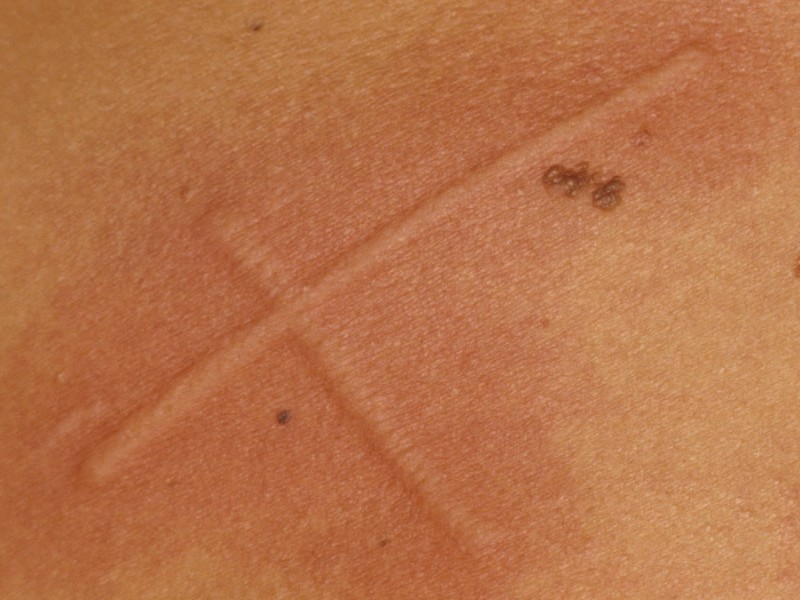
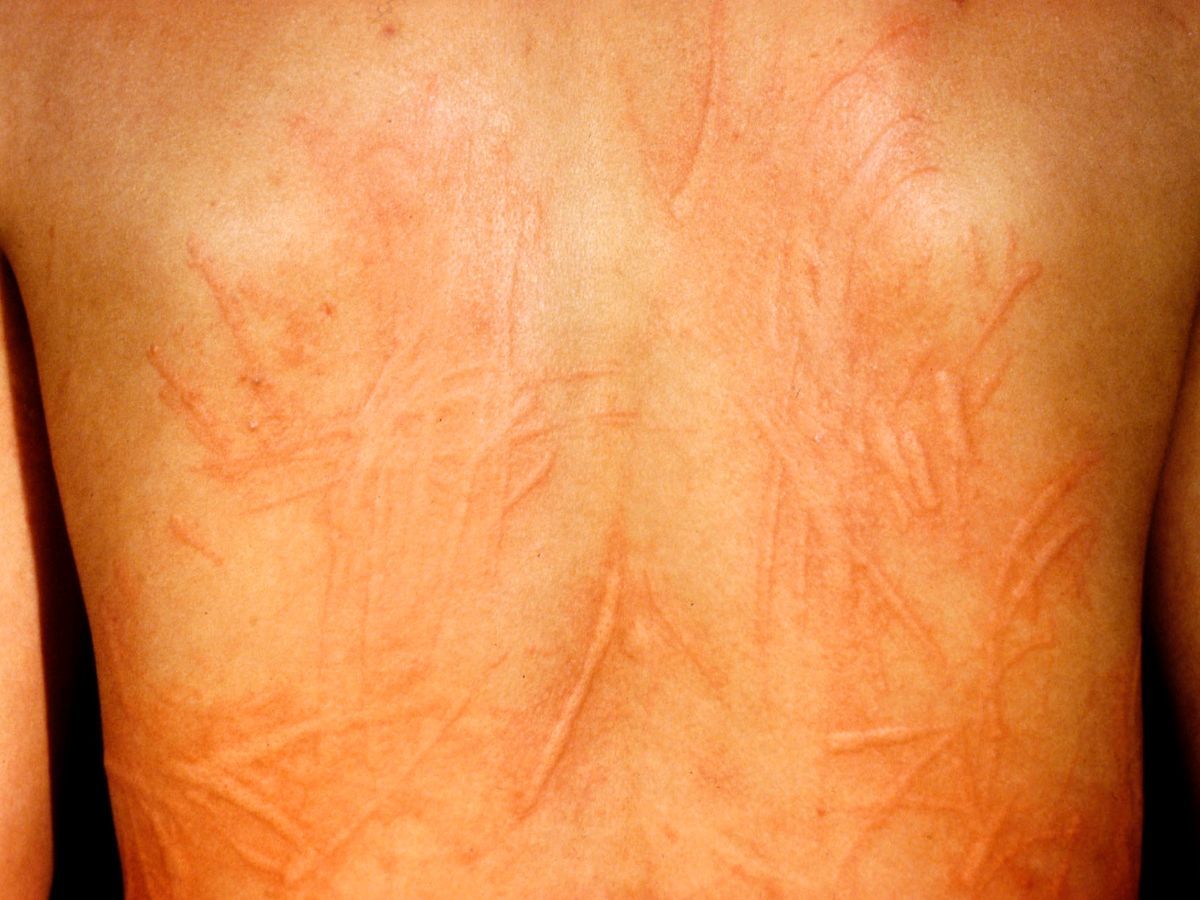
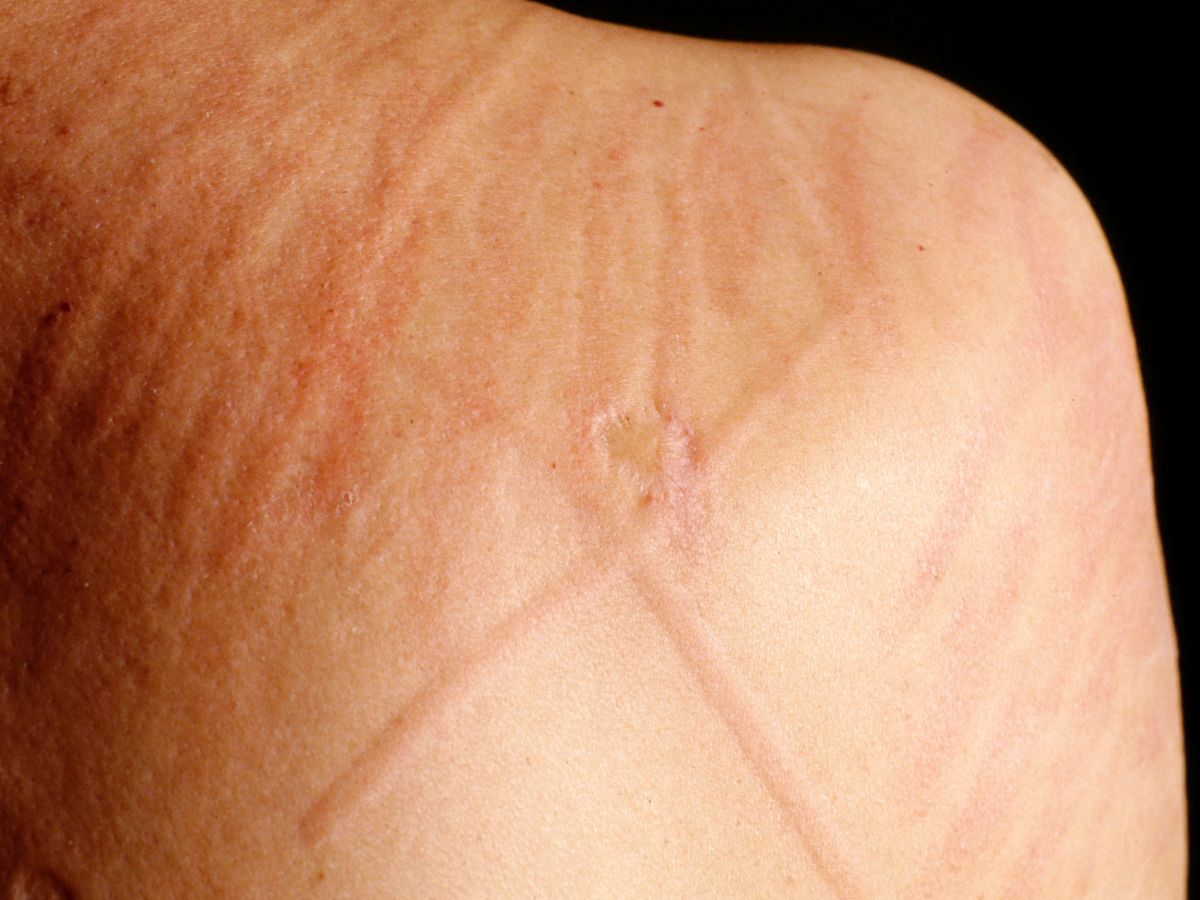
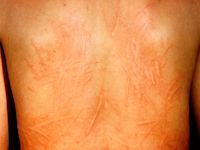
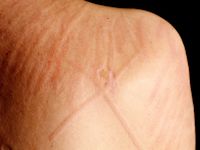
WHAT IS DERMOGRAPHISM?Dermatographism is the name for the phenomenon where a raised, itchy stripe appears after rubbing or scratching the skin. This is a variant of hives. The medical term is urticaria factitia. A minor mechanical stimulus, such as scratching or drawing a stripe across the skin with the back of a ballpoint pen, is enough to cause this.
 |
 |
 |
| dermography |
dermography |
dermography |
HOW IS THE DIAGNOSIS MADE?By firmly stroking the skin with the back of a ballpoint pen or a special test pen, on the inside of the forearm or on the back. This causes an itchy raised area to appear within 10 minutes, which fades after 30 minutes to 3 hours. A red color develops around this line. The redness disappears before the swelling.
The normal appearance in someone without dermographism is a light red, non-raised line at the scratch site that fades quickly, often within 5 minutes.
There is also a delayed form of dermographism, where the lines develop after 30 minutes to 9 hours and can last 12 to 24 hours.WHAT IS THE CAUSE OF DERMOGRAPHISM?The cause is unknown, and it's unclear what can cause dermographism to suddenly appear. It's common, affecting approximately 1.5-5% of the general population. It's more common in atopic people (those with a predisposition to hay fever, atopic eczema, or asthma). People who are perfectly healthy can develop dermographism overnight. Sometimes a precipitating factor can be identified, such as a cold or flu a few weeks prior to the onset, or medication use. But in most patients, the cause remains completely unclear.
The mechanism is known. The skin contains mast cells. These are cells involved in allergic reactions. Mast cells contain large amounts of the substance histamine. When released, histamine causes severe itching and swelling. This is the same substance found in nettles. Normally, histamine is only released from mast cells during an allergic reaction. Somehow, the mast cells in patients with dermatographism are also sensitive to pressure: a light, firm stroke releases histamine from the mast cells. Afterward, the same reaction cannot be elicited again in the same skin area for about three hours, because the mast cells are depleted.WHAT IS THE PROGNOSIS?Dermatographism can resolve on its own, but this can sometimes take several months to years. It's an annoying condition, but it's not dangerous and doesn't indicate an underlying disease.WHAT IS THE TREATMENT?Dermatitis can be treated with medications that block the substance histamine: antihistamines. These antihistamines must be taken daily to prevent itching and swelling. Antihistamines are effective and safe, even when used long-term. They are also used long-term by patients with hay fever. It is important to use one of the modern ones that do not have drowsiness as a side effect.
Examples of antihistamines for dermatitis:
- Xyzal (levocetirizine) 1 tablet of 5 mg once a day
- Zyrtec (cetirizine) 1 tablet of 10 mg once a day
- Claritin (loratadine) 1 tablet of 10 mg once a day
- Aerius (desloratadine) 1 tablet of 5 mg once a day
It is also important not to scratch if an itch starts, because then the itch will get completely out of hand and only get worse. Also, be careful when drying after showering (don't rub, but pat), and don't wear tight clothing.
Sometimes there's another reason for itching, such as dry skin or eczema. This should be treated as best as possible to prevent itching followed by scratching.
Exposure to sunlight makes the skin less sensitive. Therefore, light therapy (a broad-spectrum UVB light box) is sometimes tried in patients for whom antihistamines are ineffective or insufficient. |