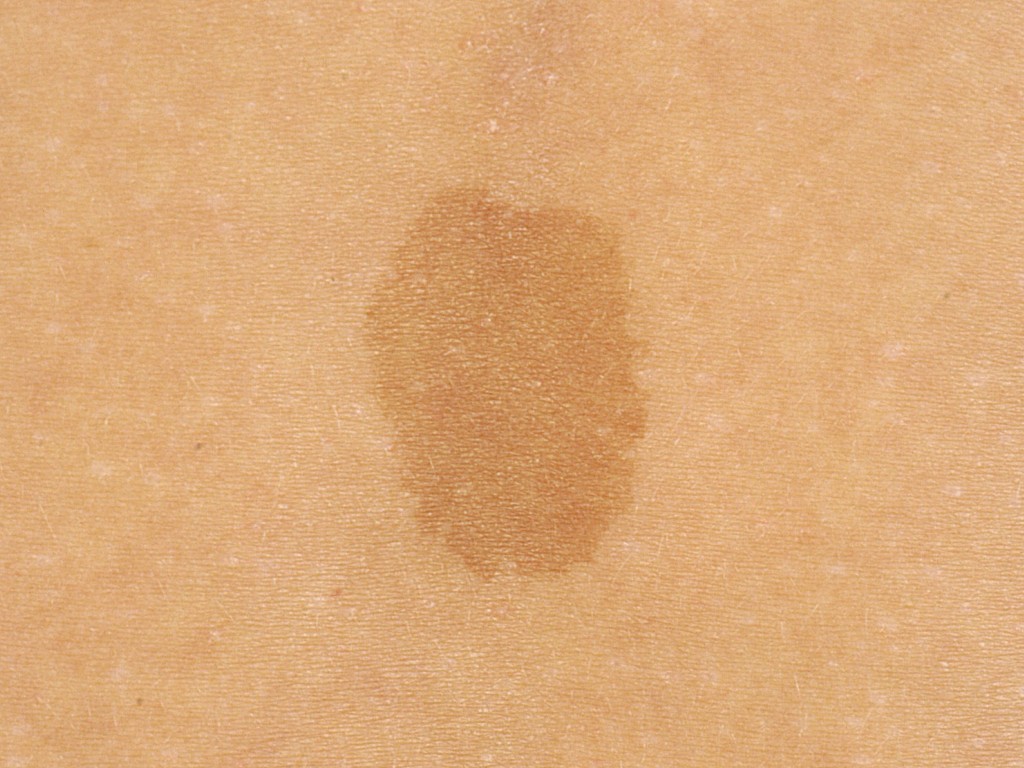
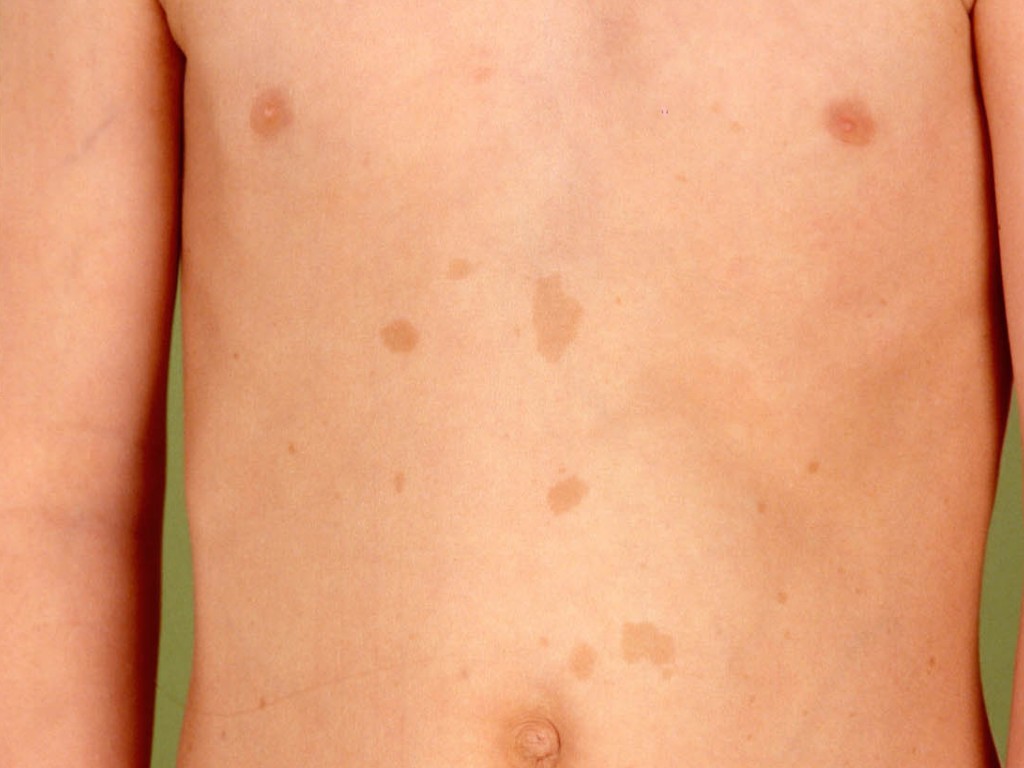
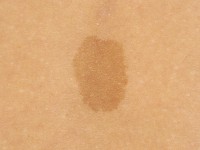
WHAT ARE CAFÉ AU LAIT STAINS?Café au lait spots are evenly colored light brown pigment spots.
Café au lait is French for "coffee with milk," and that's precisely the color of the average café au lait spot.
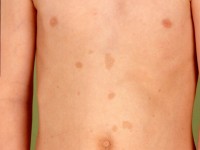
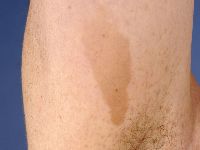
Café-au-lait spots can be present from birth, but because they are initially small and light in color, they are difficult to see. Around the age of two, they darken somewhat and become more visible. They are benign and grow as the child grows. Café-au-lait spots are usually oval in shape and range in diameter from 0.5 cm to several centimeters.
 |
 |
 |
| café au lait stain |
café au lait stains |
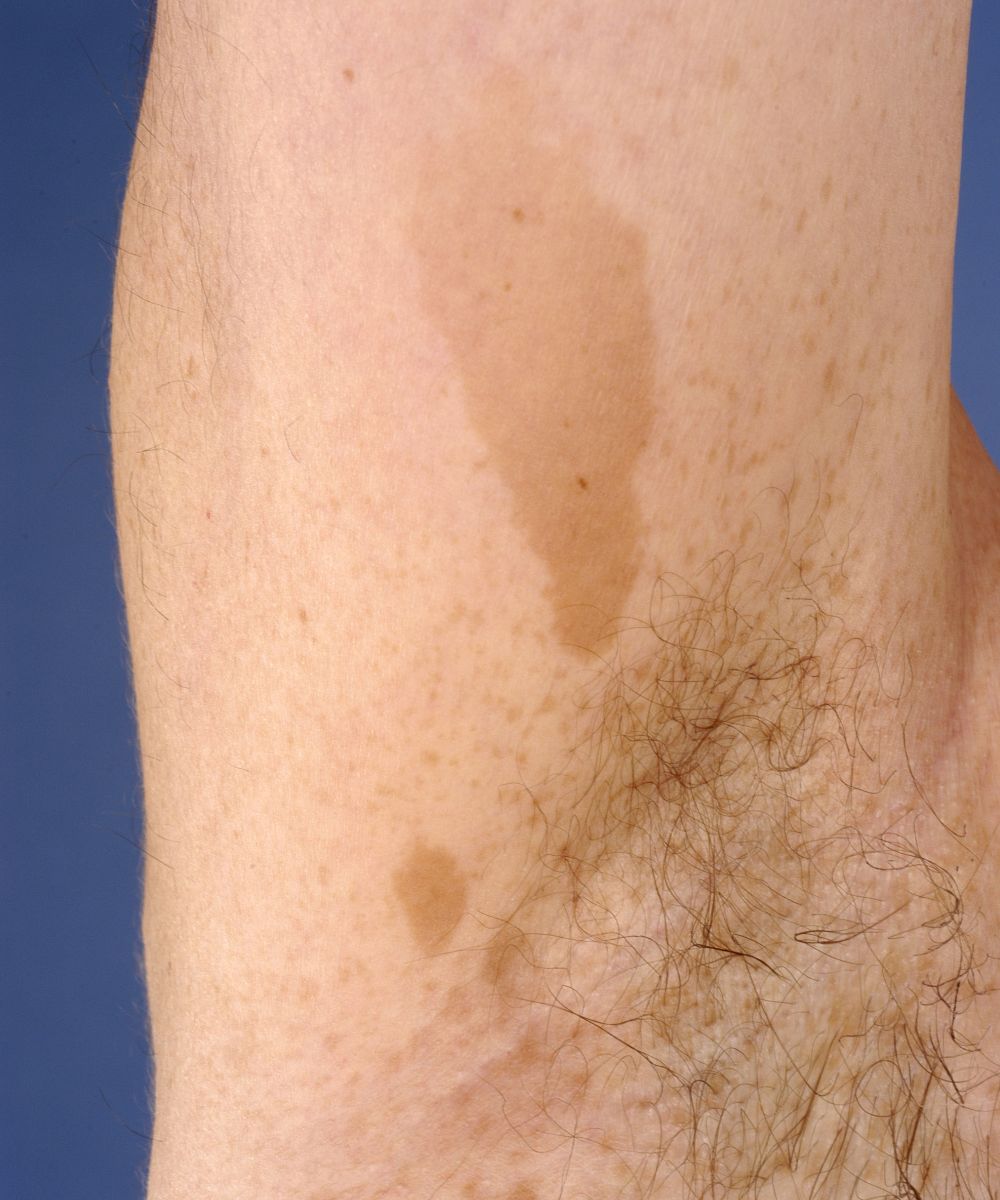
café au lait stain |
HOW DOES IT COME ABOUT?Pigment cells (melanocytes) that produce pigment are found throughout the skin. Due to a tissue defect, the pigment cells in a café au lait spot produce much more pigment than those in the surrounding skin.HOW OFTEN DOES IT HAPPEN?Café au lait spots are common: 0.3-0.5% of children have one café au lait spot at birth, and in children with darker skin, the number can reach 15-18%. In childhood, this number increases to approximately 13% for fair skin and 27% for pigmented skin.HOW IS THE DIAGNOSIS MADE?Café au lait spots are so characteristic that the diagnosis is based on the clinical picture.
Additional testing, such as blood tests or a skin test, is not necessary.WHAT IS THE RELATIONSHIP WITH NEUROFIBRAMATOSIS?Most children have only one café-au-lait spot; some children have several. If there are many café-au-lait spots (6 or more, and larger than 0.5 cm in diameter), a syndrome such as neurofibromatosis (von Recklinghausen's disease) may be present.
Patients with neurofibromatosis often have café-au-lait spots. Approximately 95% of the population have them, and in approximately 80% of cases, they appear within the first year of life. Neurofibromatosis affects approximately 1 in 3,000 to 4,000 people (0.03%).
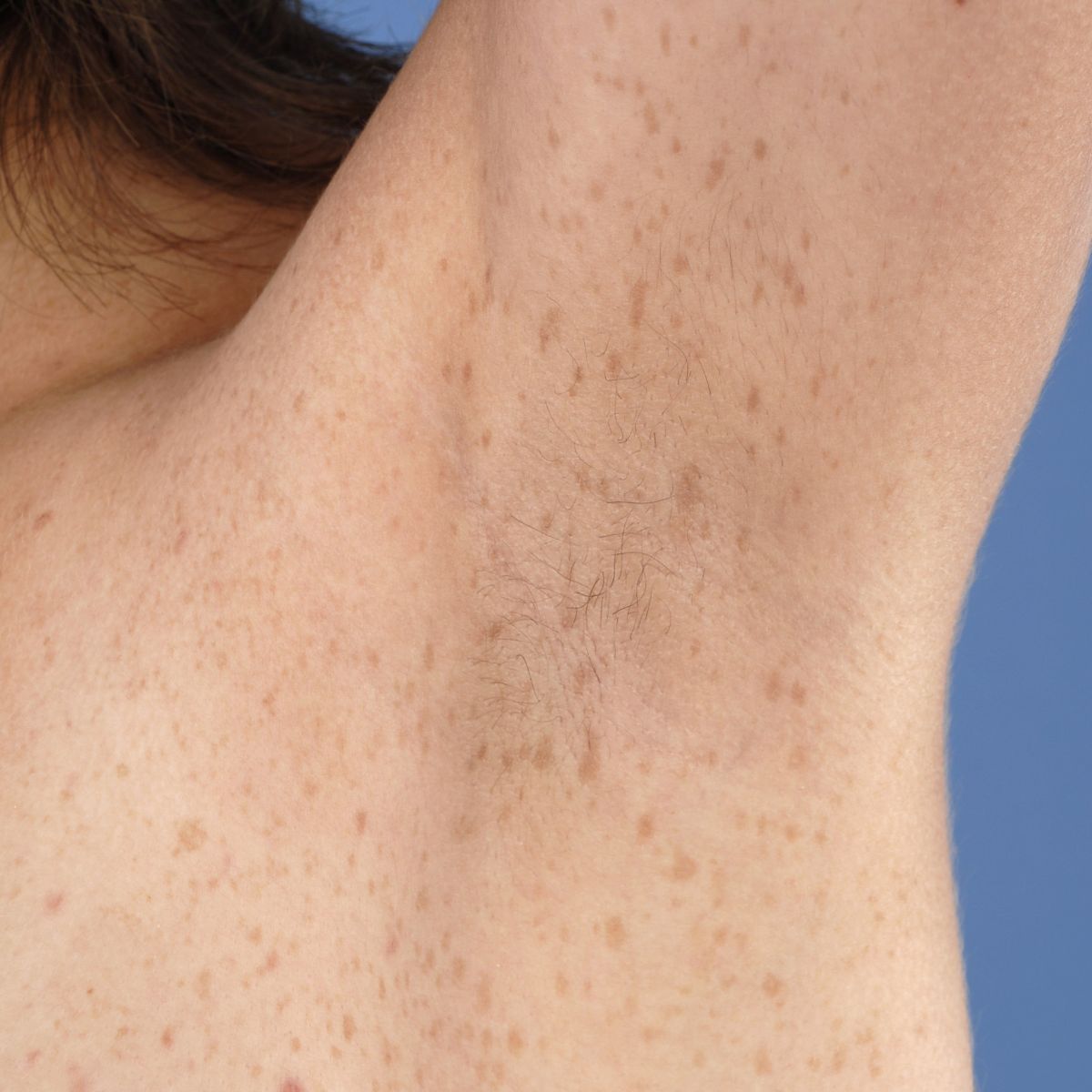
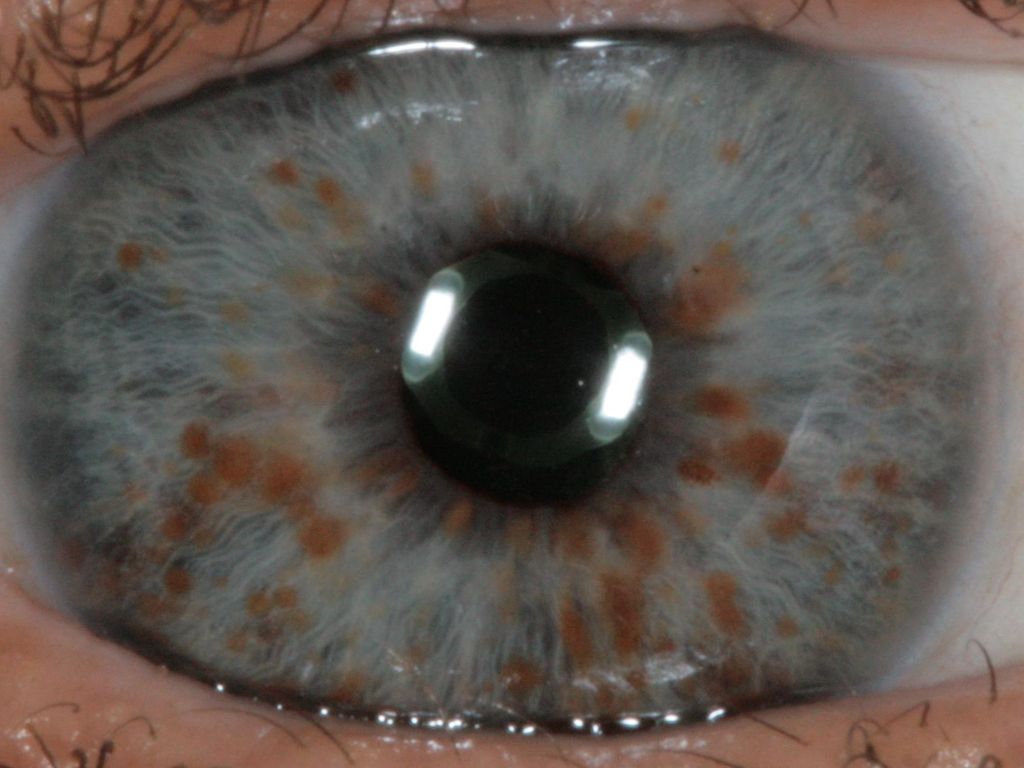
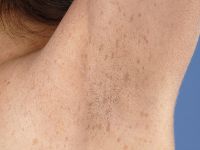
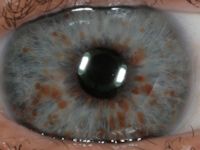
Having 6 or more café-au-lait spots is not sufficient to diagnose neurofibromatosis. Other characteristics must also be present, such as freckles in the armpits or groin ( called axillary freckling ), or spots on the iris of the eyes ( called Lisch nodules ).
 |
 |
| axillary freckling |
Lisch nodules |
Photo right: Dimitrios Malamos - Wikimedia (Creative Commons License 4.0 ).
To determine whether neurofibromatosis or another syndrome is present, children with café au lait spots should be referred to a dermatologist (and sometimes also to an ophthalmologist) for evaluation. If there are indications of neurofibromatosis, a genetic specialist (clinical geneticist) will also be consulted.WHEN DOES NEUROFIBROMATOSIS OCCUR?To diagnose neurofibromatosis, 2 or more of the following features must be present:
| - |
6 or more café au lait spots (> 5 mm in diameter before puberty, > 15 mm after puberty) |
| - |
2 or more neurofibromas or 1 plexiform neurofibroma (neurofibromas are soft swellings, spherical or pedunculated, usually skin-colored) |
| - |
axillary freckling (small, freckle-like pigment spots in the armpits or groin) |
| - |
a benign tumor in the optic nerve (nervus opticus) |
| - |
2 or more Lisch nodules (yellow-brown spots on the iris) |
| - |
bone abnormalities |
| - |
someone in the first-degree family (father, mother, brother, sister) who has neurofibromatosis. |
WHAT IS THE TREATMENT?Café au lait spots are rarely cosmetically disturbing, but if they are, they can be treated with laser. Pigment lasers are used for this purpose. One example is the ruby laser (Q-switched ruby laser). The effectiveness of laser treatment is not very good. Sometimes it's not possible to lighten the spot sufficiently to achieve a good cosmetic effect. It's also possible that the spot returns over time. Occasionally, the spot can even become darker after laser treatment. Generally, the treatment is successful in about a third of cases, in another third the spot returns, and in another third the spot becomes worse.
Therefore, it's important to have a test spot treated before treating the entire spot to assess the effects. The cost of the treatment is sometimes reimbursed, depending on the terms of your health insurance.
Another option is to camouflage the spots. Special camouflage creams are available in all skin tones and can be ordered through a beautician.
Doing absolutely nothing and accepting that they are there is probably the best advice.WHAT IS THE PROGNOSIS?Café au lait spots don't disappear on their own, but they also don't get any bigger. They grow with the child and remain that way. They can darken somewhat until about the age of two. They are benign, cannot become malignant, and do not cause any symptoms.
There's no need to fear the development of neurofibromatosis, because the figures mentioned above (café au lait spots: 13% of children; neurofibromatosis: 0.03%) show that most children with one or more café au lait spots do not develop neurofibromatosis.
If a diagnosis of neurofibromatosis is made, it's often shocking for the parents (and the person concerned). This is because the diagnosis conjures up disturbing images of people covered in tumors ( the Elephant Man ). However, this is incorrect. Neurofibromatosis is a hereditary condition with enormous variability. This means that people with this hereditary condition sometimes have few or no symptoms, and sometimes very many. Most people have few abnormalities, but it's precisely the exceptions with numerous abnormalities that receive all the media attention. Therefore, searching randomly for images on the internet is unwise. There are plenty of websites, including those of patient associations, where one can find good and reliable information and connect with others in the same situation.
Neurofibromatosis is hereditary. It's autosomal dominant, meaning that if you are predisposed (if you have the gene), there's a 50% chance your children will also develop it. Furthermore, it can also occur in a child whose parents don't have the gene at all and where it doesn't run in the family. In that case, it's a newly occurring mutation (spontaneous mutation). That child's children then also have a 50% chance of developing it. It's now possible to determine whether someone has the neurofibromatosis gene (NF1 gene) through blood tests.
Most patients diagnosed with neurofibromatosis eventually also work with a clinical geneticist. He can explain exactly what to expect and the heredity of this condition. |