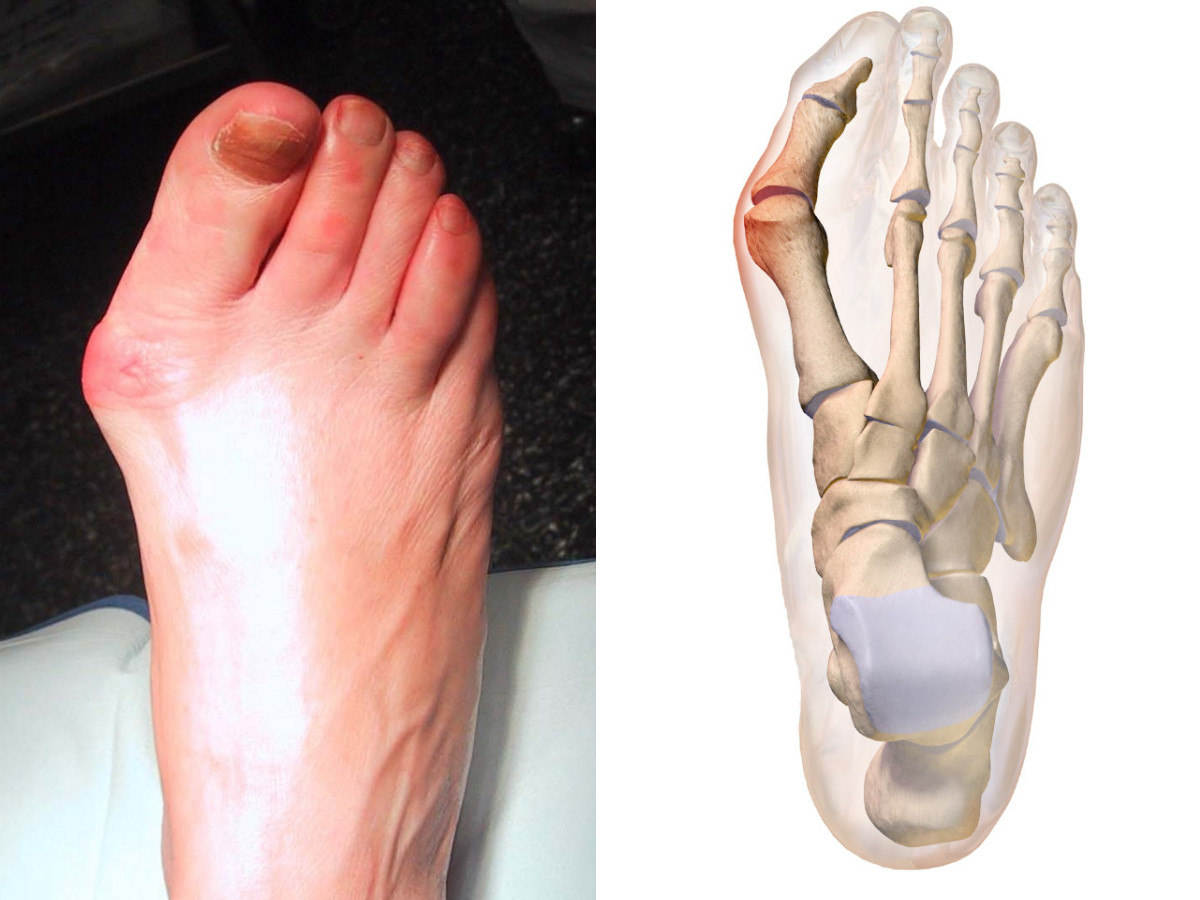
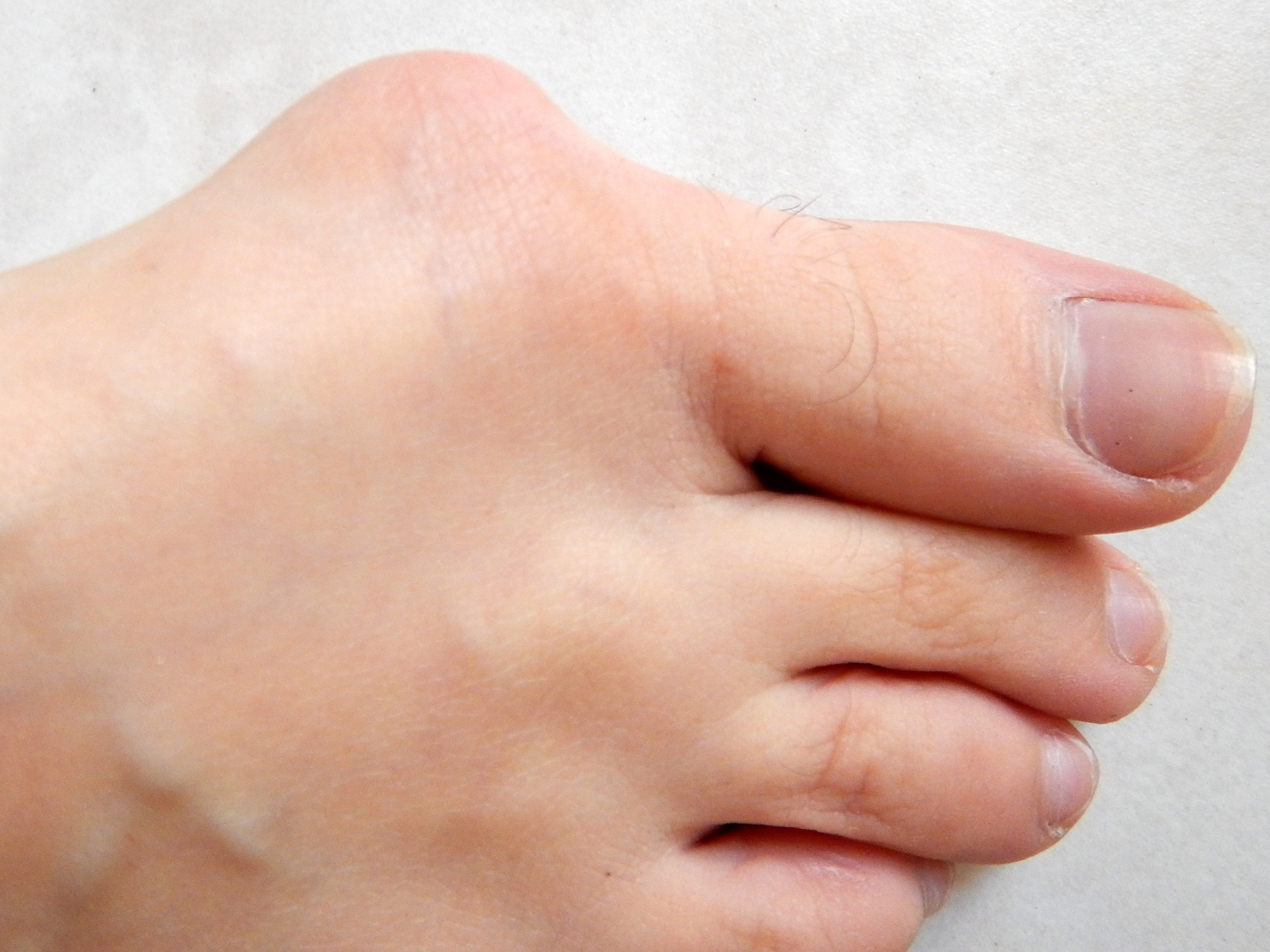
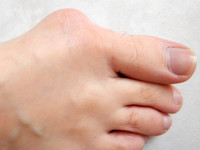
WHAT IS A BUNION?A bunion is a painful, red, and inflamed swelling on the side of the big toe. It's caused by pressure from shoes that are too tight. This is especially common with deformities of the big toe (hammer toe), such as when the big toe is turned inward (hallux valgus) and the joint protrudes significantly outward. A bursa sits above the joint at the site of the swelling. This bursa is a sac filled with a slimy fluid that lubricates the joint. With a bunion, the constant pressure irritates everything: the skin, the bursa, the joint, and sometimes the underlying bone.
 |
 |
| bunion |
bunion |
Photos: Cyberprout, BruceBlaus, and Lamiot - Wikimedia (Creative Commons License 1.0 / 3.0 / 4.0 ).
WHAT IS THE CAUSE?The main cause is wearing shoes that are too narrow. This causes the big toe joint to become pinched and irritated. This can lead to chronic swelling of the pinched tissue, resulting in a bunion and sometimes a permanent curvature of the toe. Heels that are too high are also disastrous: they cause the foot to slide forward.
Some people naturally have a wide forefoot, which increases their risk of developing this condition.
In older people, a curvature of the big toe can occur due to wear and tear in the joint. This wear and tear causes the bones of the joint to widen, protrude, and thus cause chronic pressure and irritation.WHAT ARE THE COMPLAINTS?A bunion can occur on one or both feet. The main symptom is pain in the protruding bone. This makes wearing shoes unbearable. The skin becomes red, sometimes warm, and sores may develop. Sometimes the entire joint can become inflamed.HOW IS THE DIAGNOSIS MADE?Simply examining the foot is sufficient. The only conditions that might even remotely resemble it are a corn and gout. An X-ray is often also taken to determine whether there is wear and tear in the joint and how severe any bone misalignments are.HOW IS IT TREATED?For mild cases with minimal symptoms, wearing wider shoes without (high) heels is sometimes sufficient. If this doesn't help, surgery by an orthopedic surgeon may be considered.HOW DOES THE OPERATION WORK?Depending on which procedure is necessary to resolve your complaint, we will choose either an outpatient procedure or an inpatient procedure.
The surgery can be performed under general anesthesia or with a spinal anesthetic, where only both legs are numbed. The anesthesiologist will discuss with you which anesthesia is best for you. If the procedure does not require extensive surgery, local anesthesia can also be used.
During the surgery, an incision is made on the inside of the foot, through which the bursa is first removed. The joint capsule is detached, and the protruding bone is removed. If there is incipient wear and tear, the joint is cleaned. Afterward, the joint capsule and skin are sutured.WHAT PREPARATION IS NECESSARY FOR THE OPERATION?At the outpatient clinic, your doctor will explain the planned surgery. You'll often receive a note so you can borrow elbow crutches from Home Care/Rijksvereniging (Dutch Red Cross) before your hospital stay. It's important that you bring your crutches with you when you arrive.WHAT IS THE AFTERTREATMENT?Immediately after surgery, you will receive a bandage around your foot. It is important to keep your foot elevated for the first few days to minimize swelling of the toe and foot, and preferably use crutches.
It is recommended that you only support yourself on your heel for the first two weeks after surgery.
Your toe will remain sensitive for several weeks after the surgery. The scar on your foot can sometimes remain painful for several months. Wearing (tight) shoes is usually uncomfortable for the first few weeks.WHAT ARE THE POSSIBLE COMPLICATIONS OF THE SURGERY?Complications with this surgery are rare. Bleeding and/or wound infection may occur. Sometimes a nerve to the skin is damaged, causing numbness in the toe. This is usually temporary. |