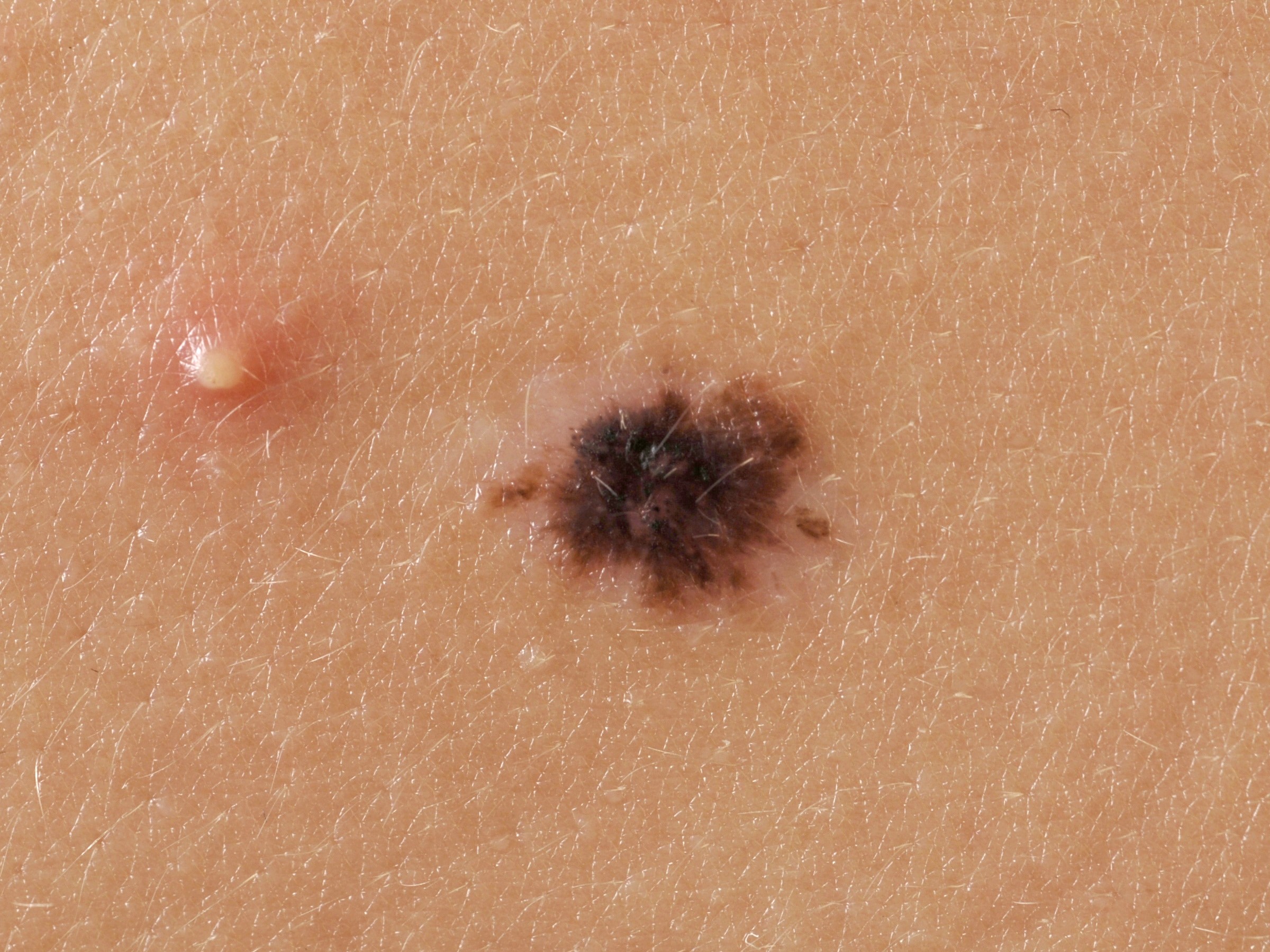
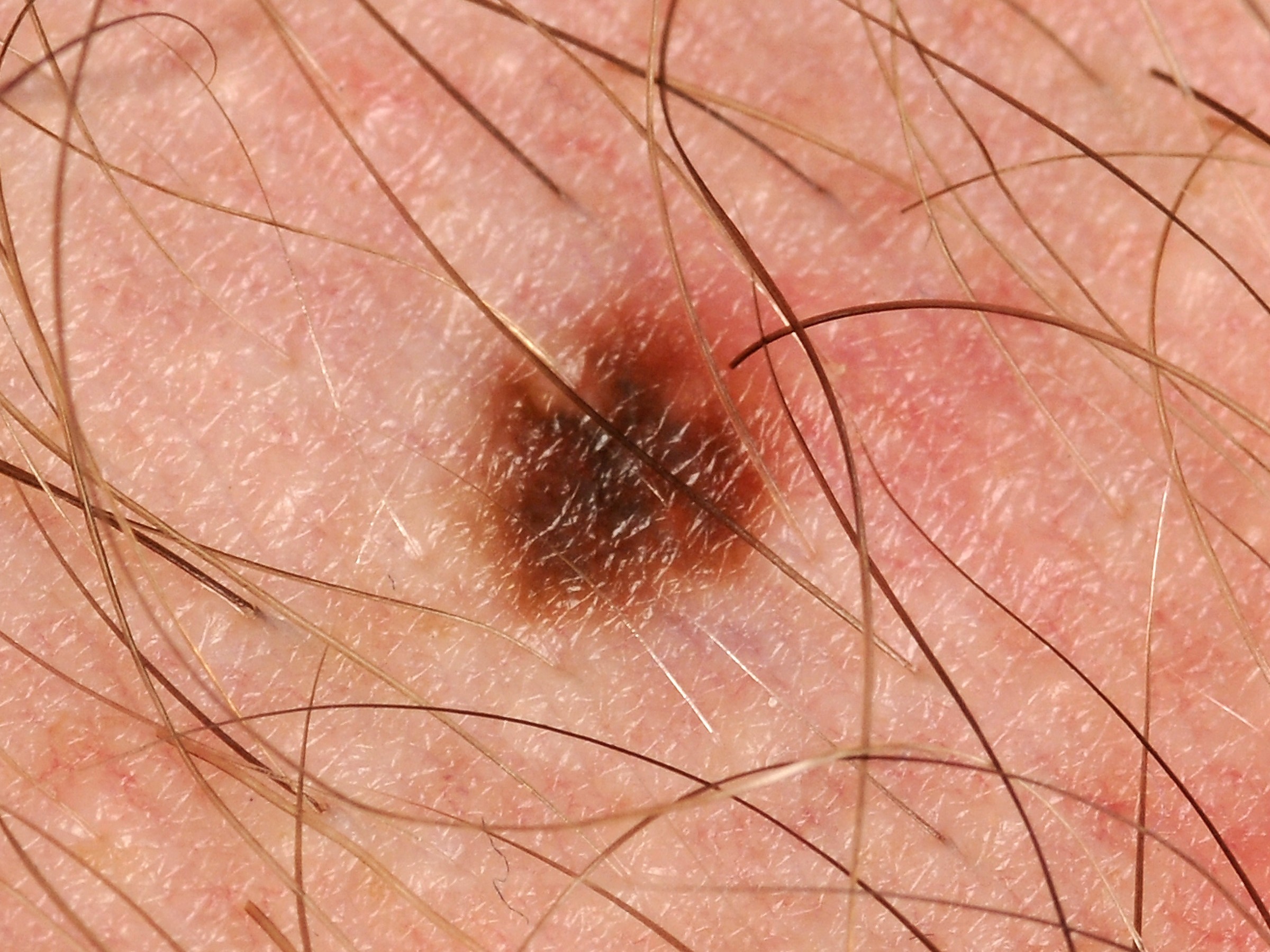
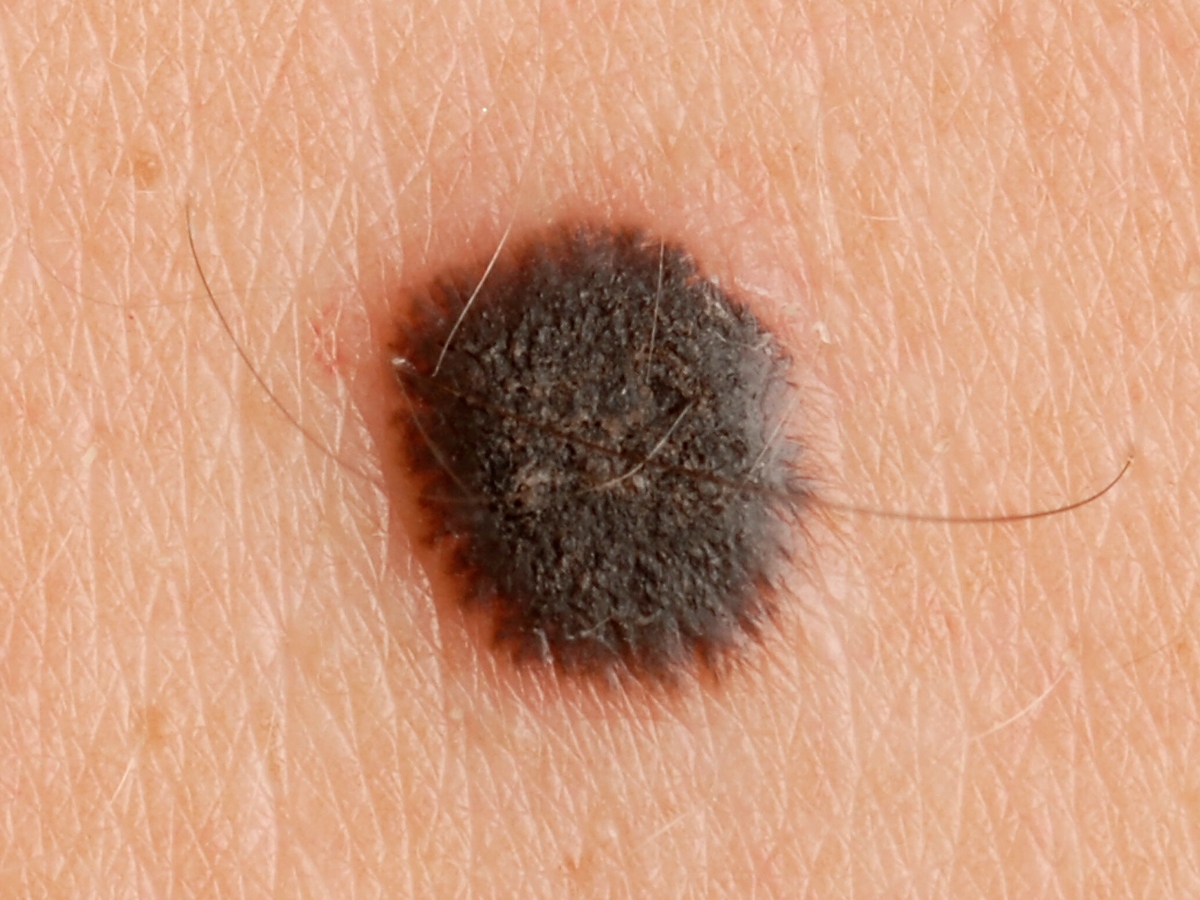
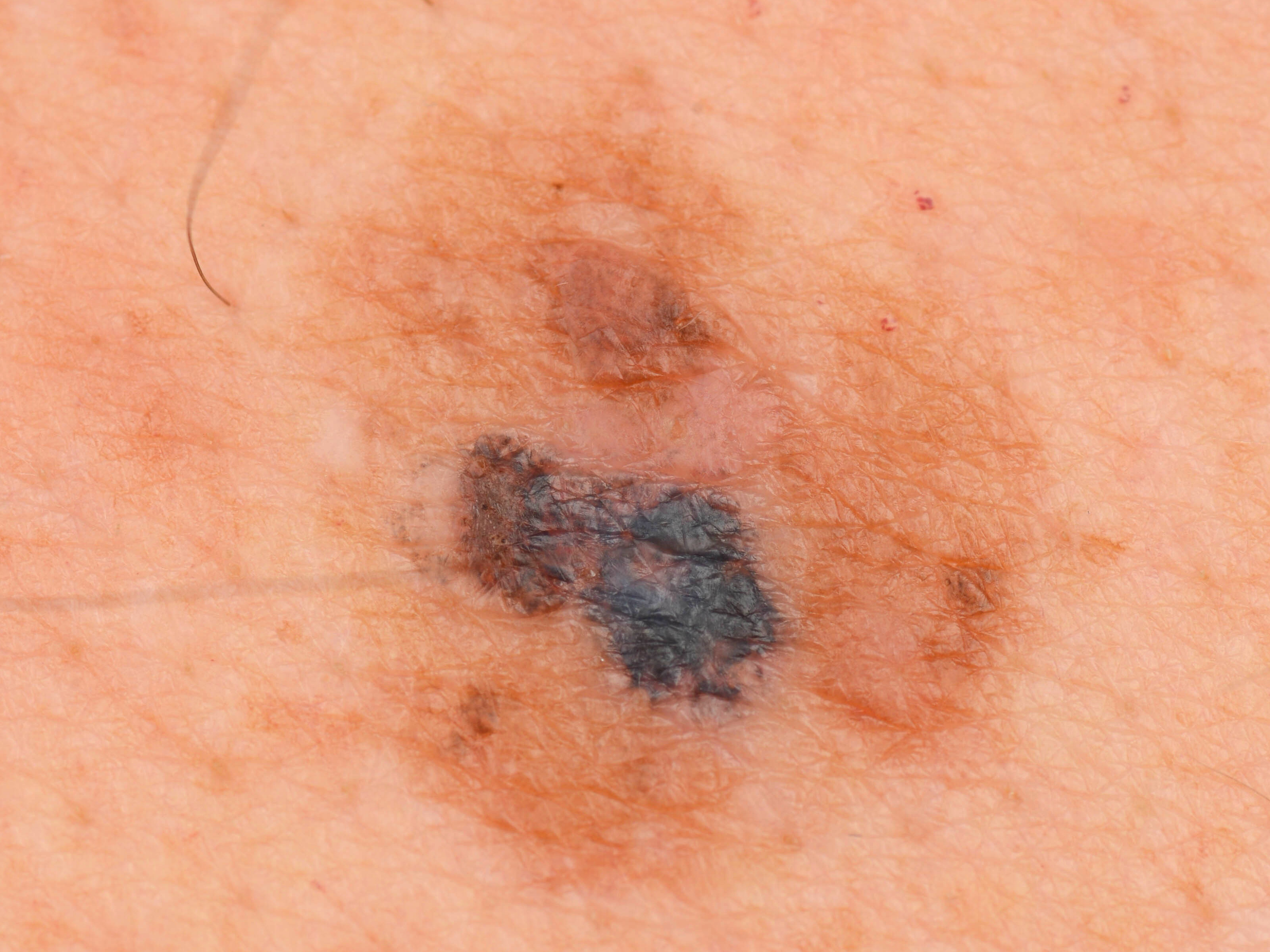
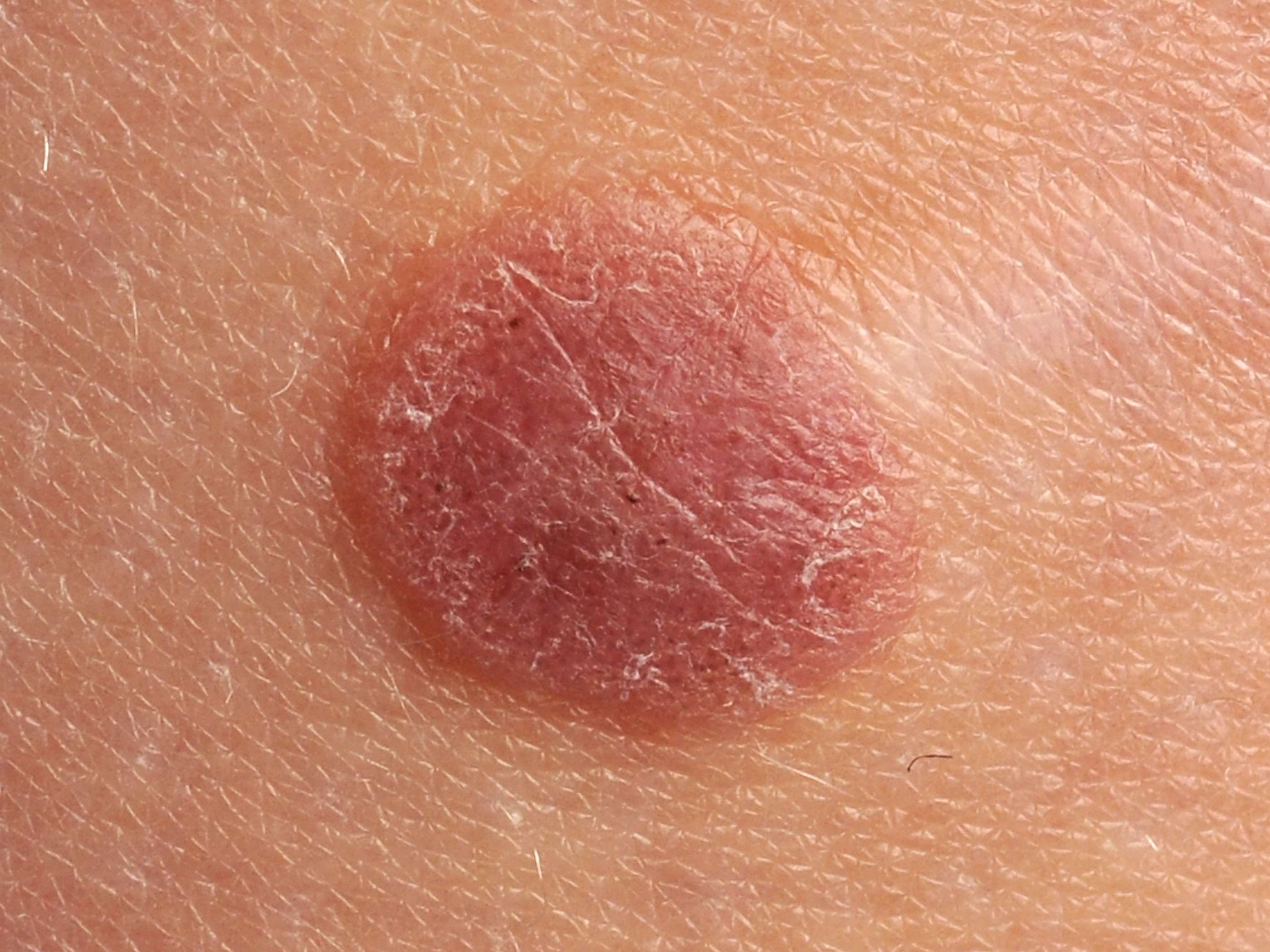
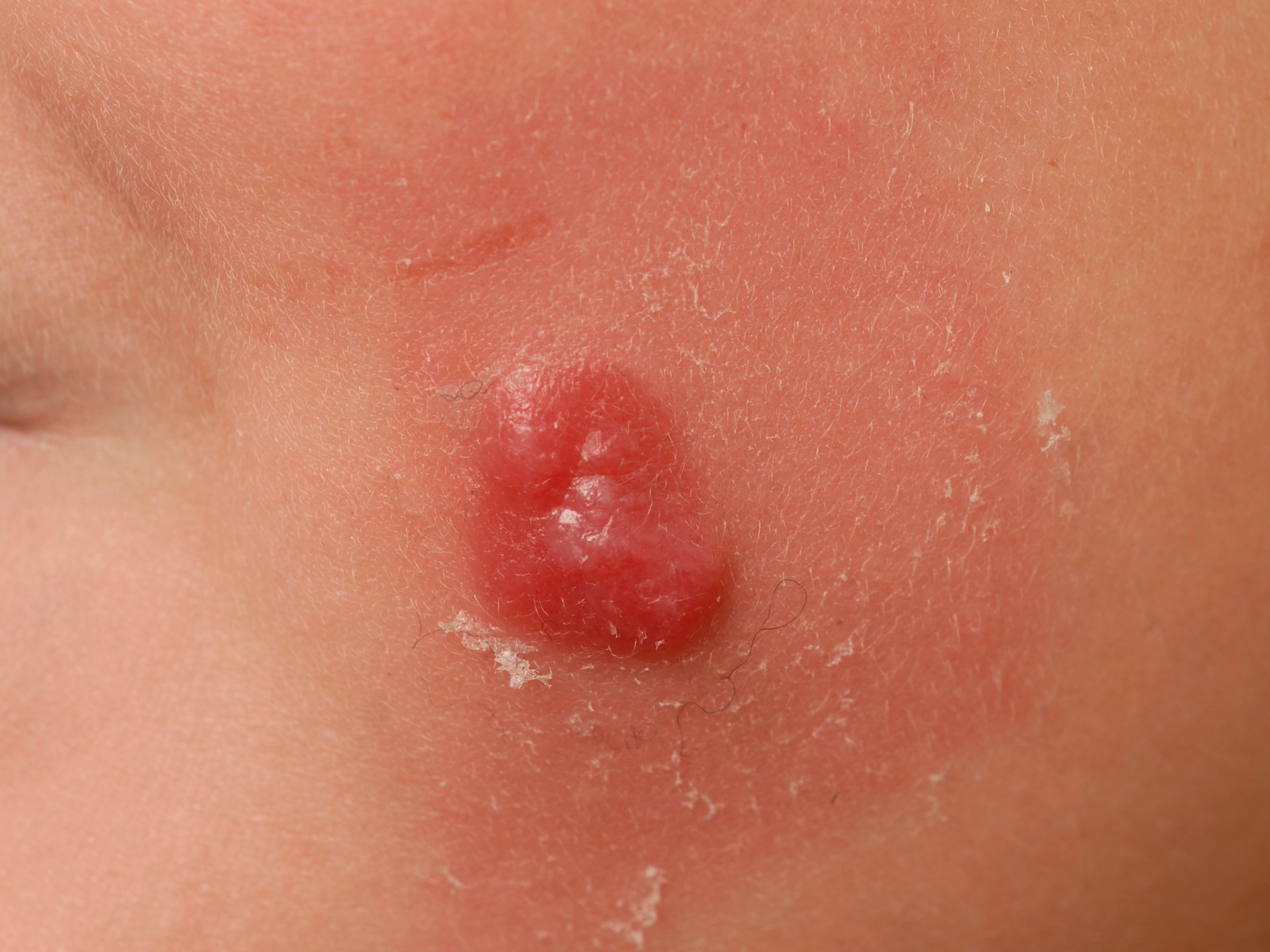
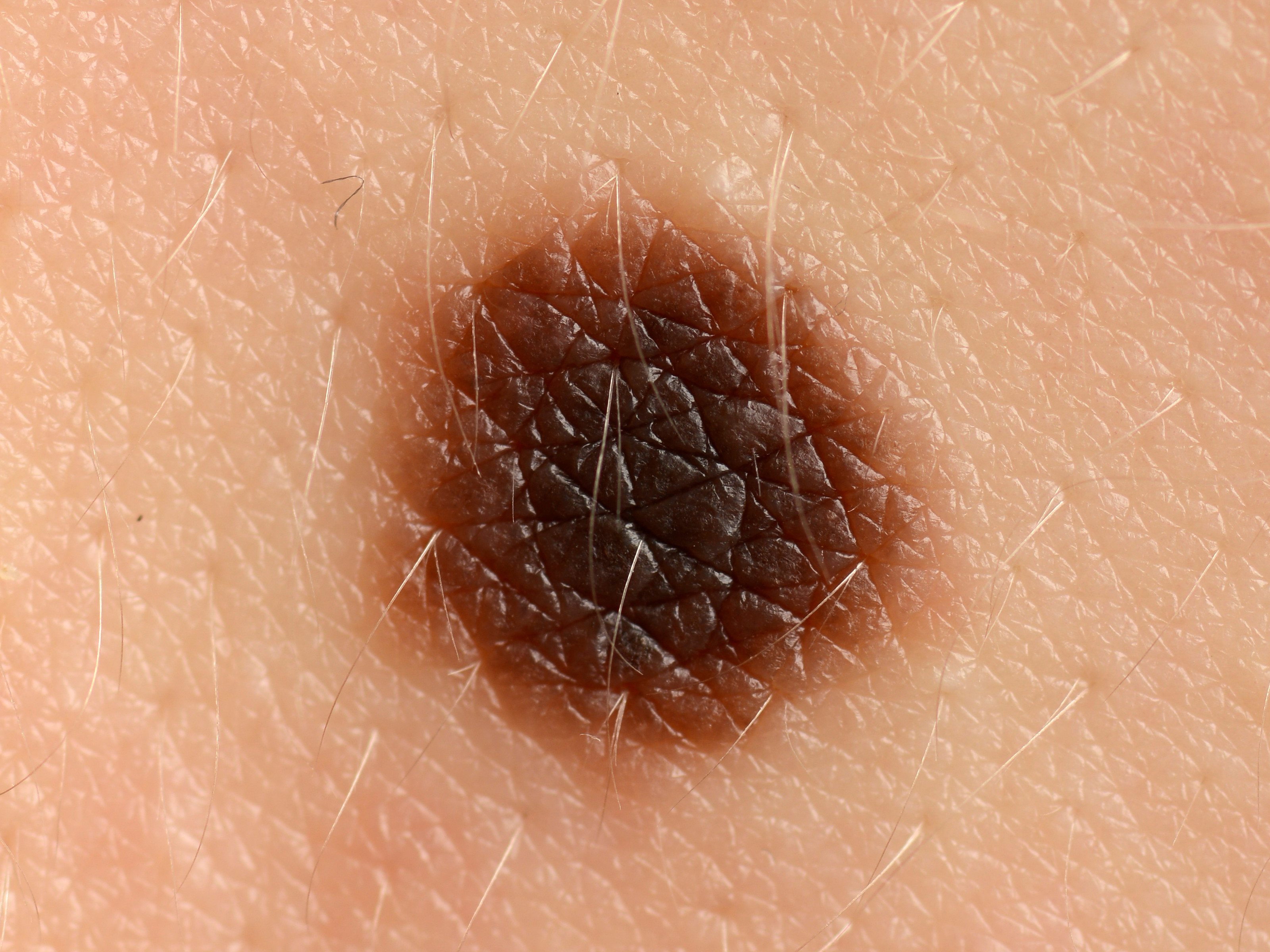
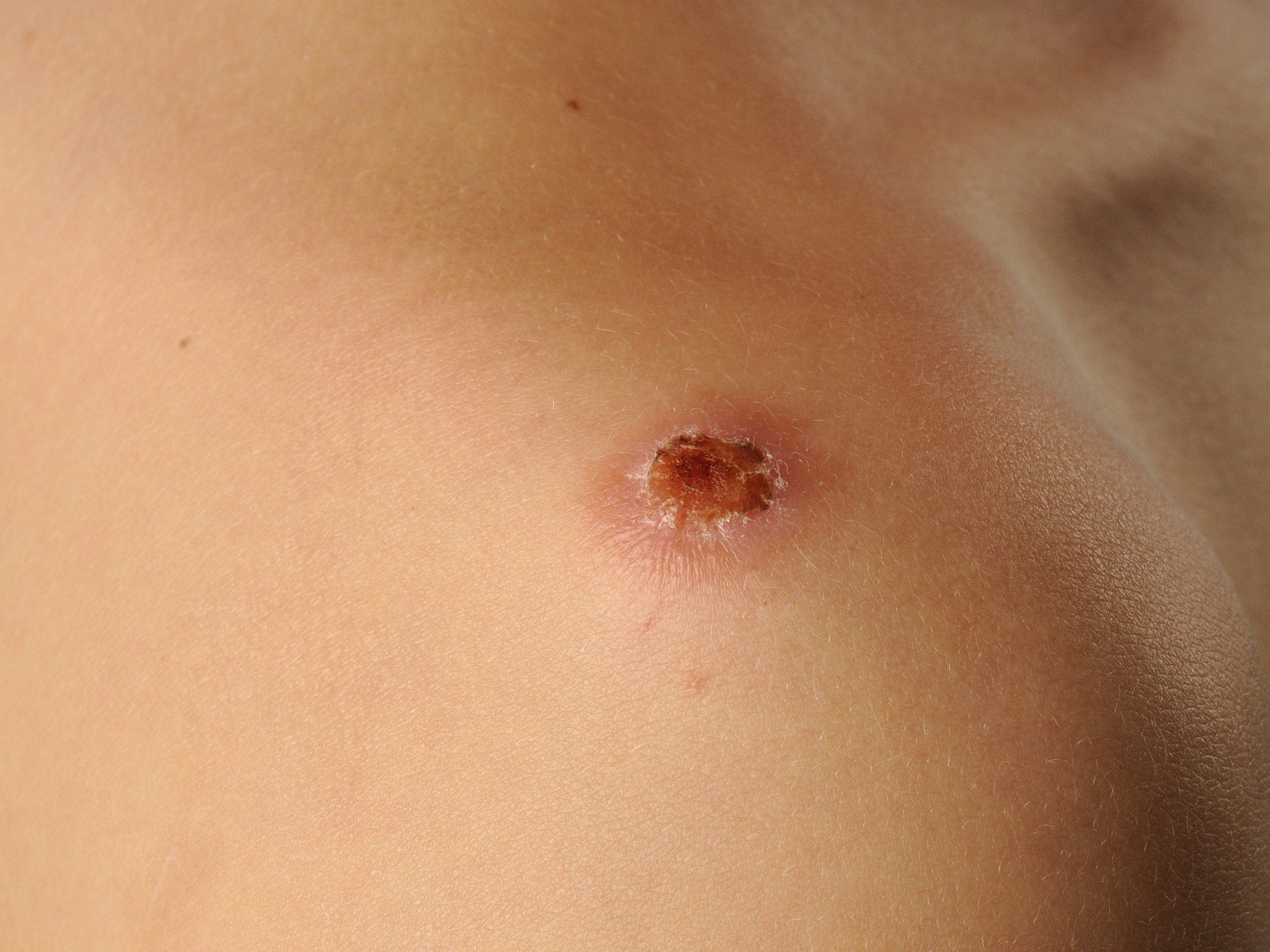
| BETWEEN MOLE AND MELANOMA: ATYPICAL MELANOCYTIC TUMORS |
 |
 ATYPICAL NEVUS / DYSPLASTIC NEVUS ATYPICAL NEVUS / DYSPLASTIC NEVUS
MELTUMP
SAMPUS
IAMPUS
AIMP
ATYPICAL SPITZOID TUMOR
STUMP
MELANOCYTOMA
Pigmented skin lesions can be
benign or
malignant. There are also
lesions that fall
somewhere in between, borderline cases where neither
the dermatologist nor the pathologist can say with
certainty whether it is a benign mole (nevus) or a
malignant melanoma. These borderline cases are also
referred to as atypical melanocytic lesions, but
there are many other names in use, which are
discussed in this brochure.
 |
 |
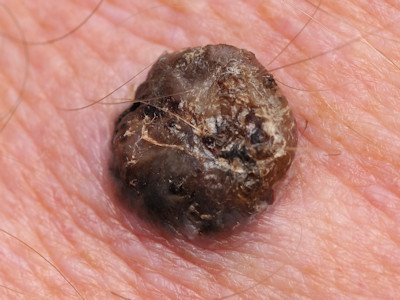 |
|
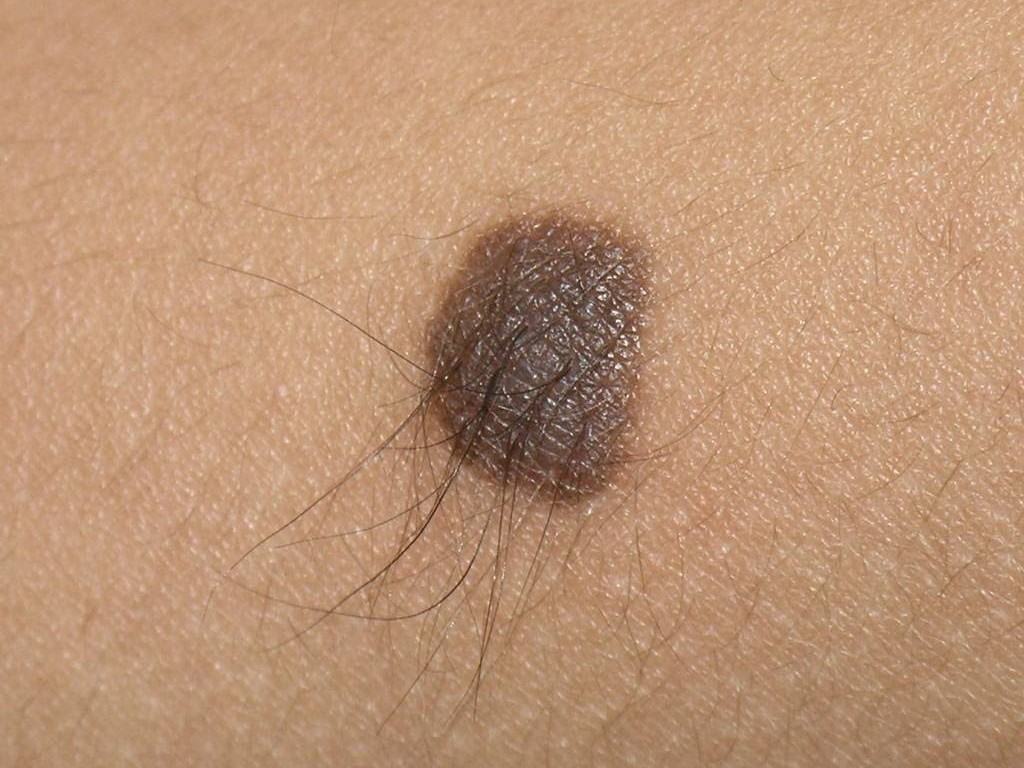
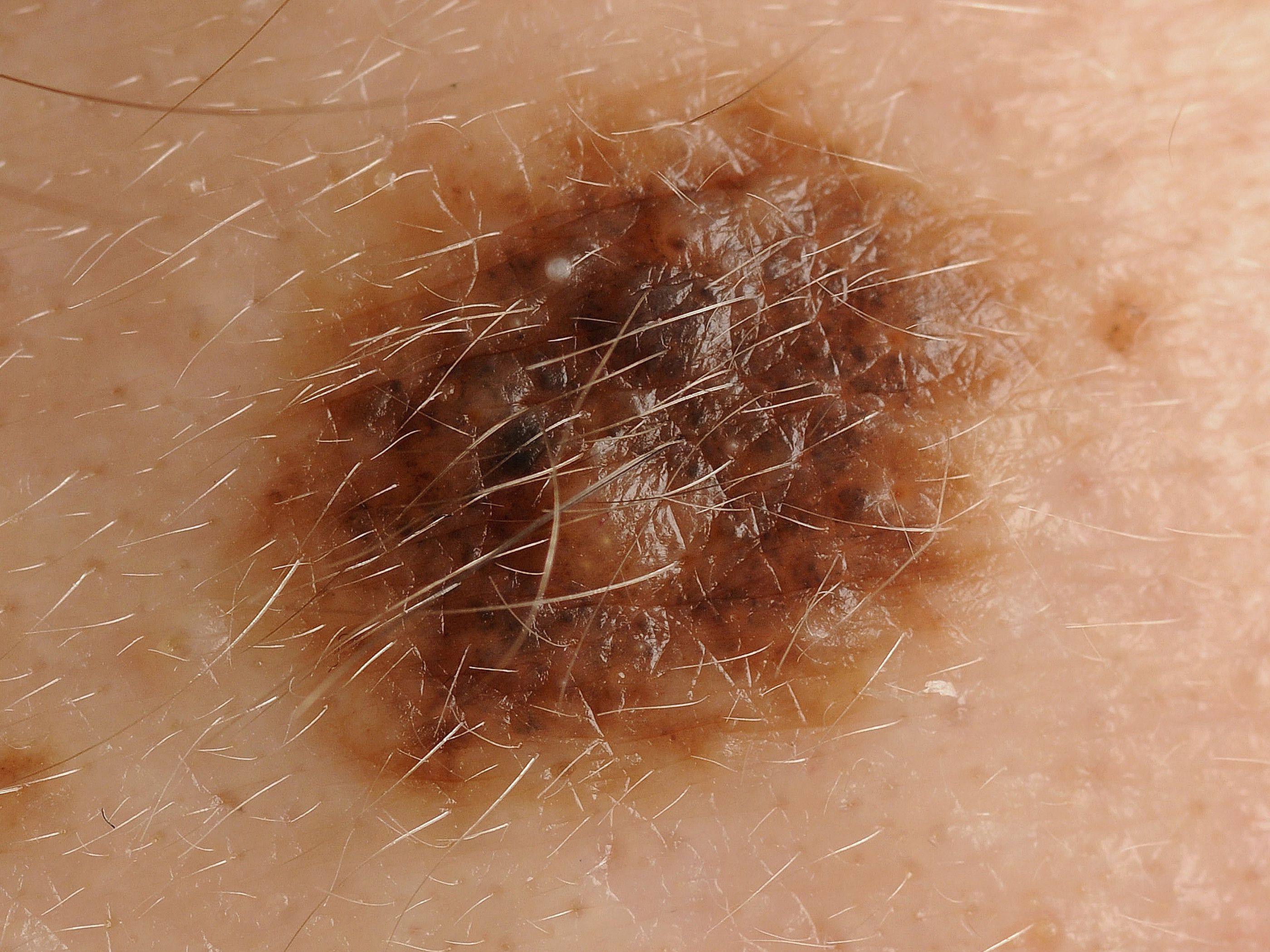
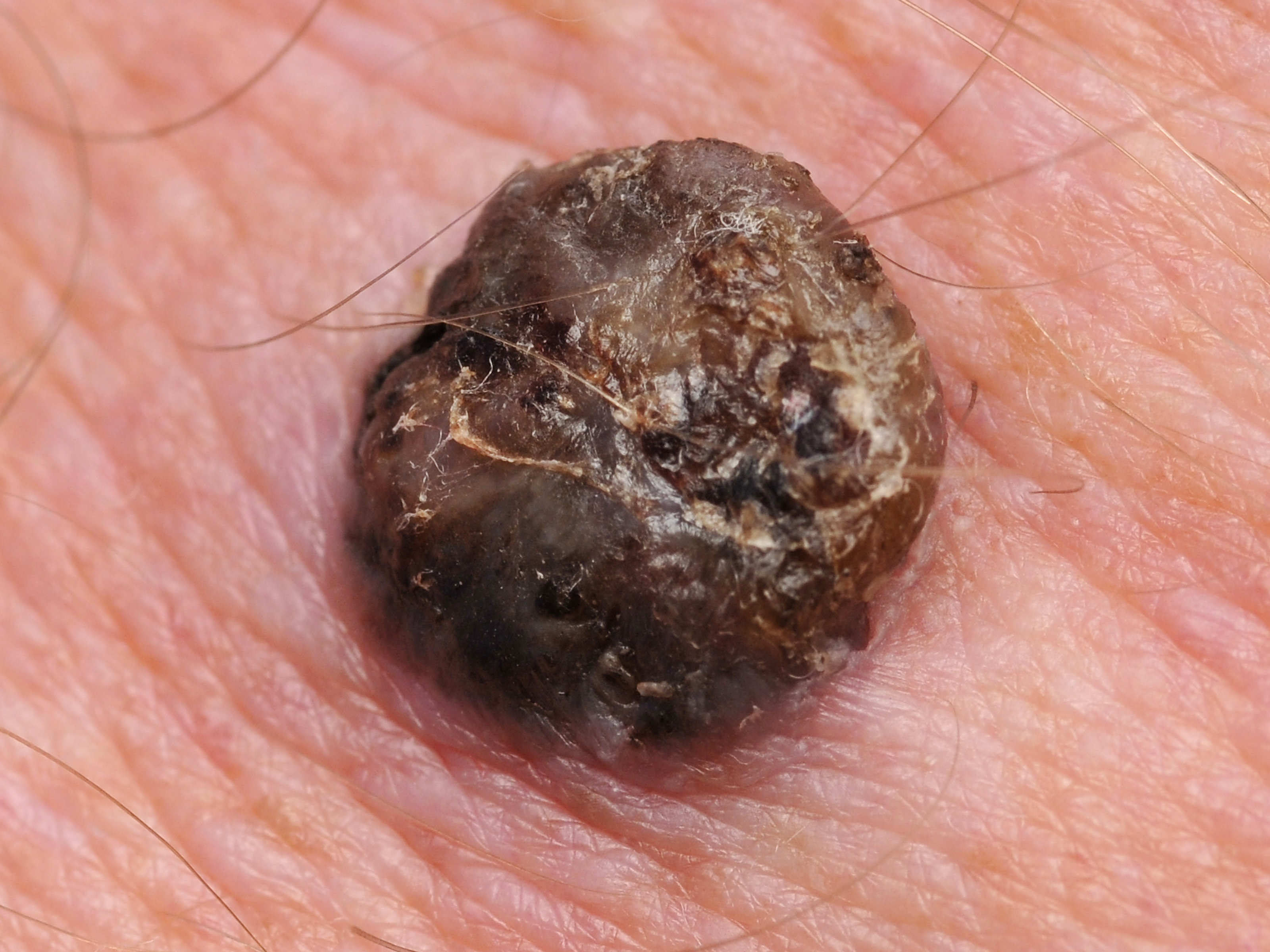
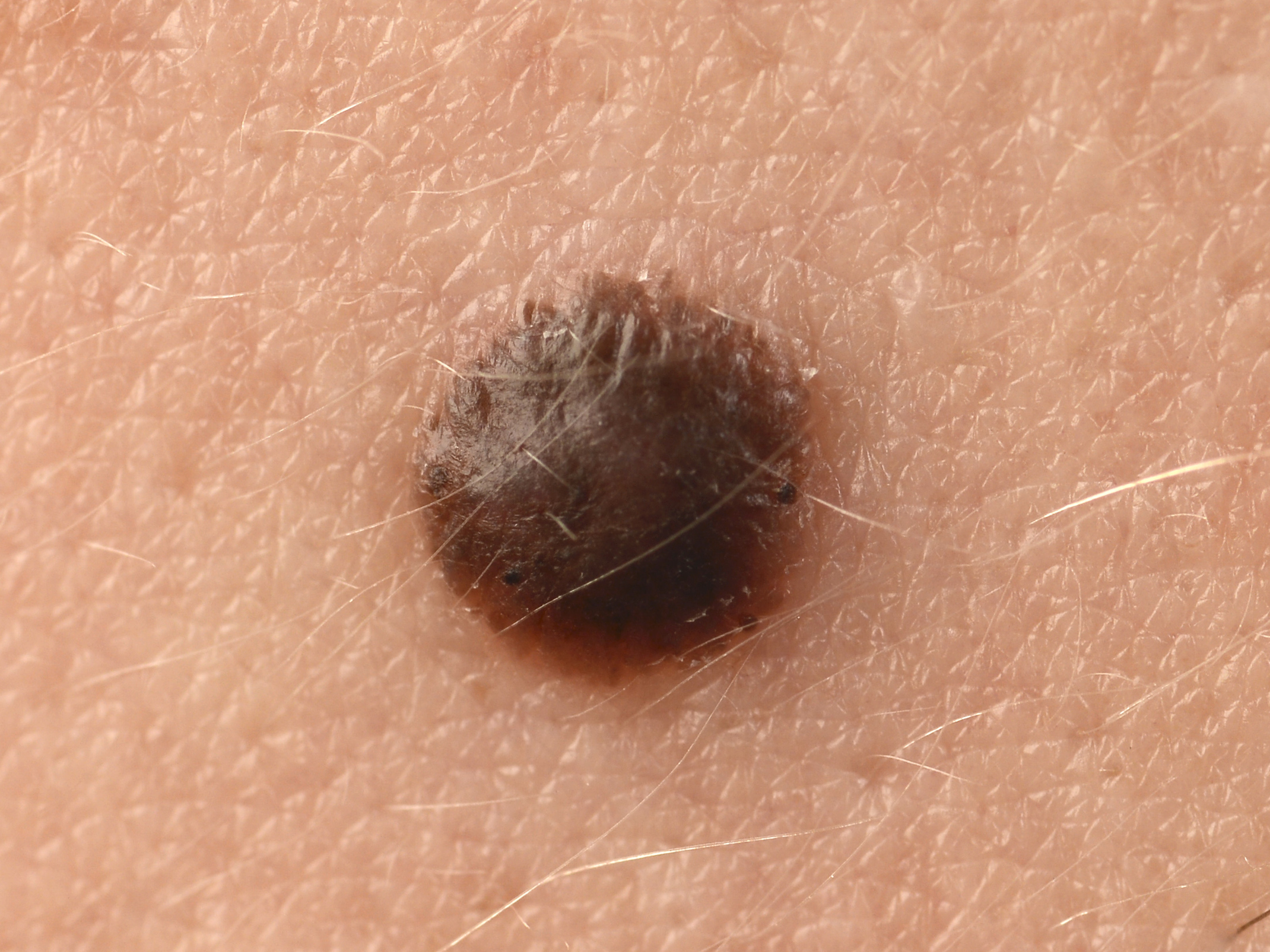
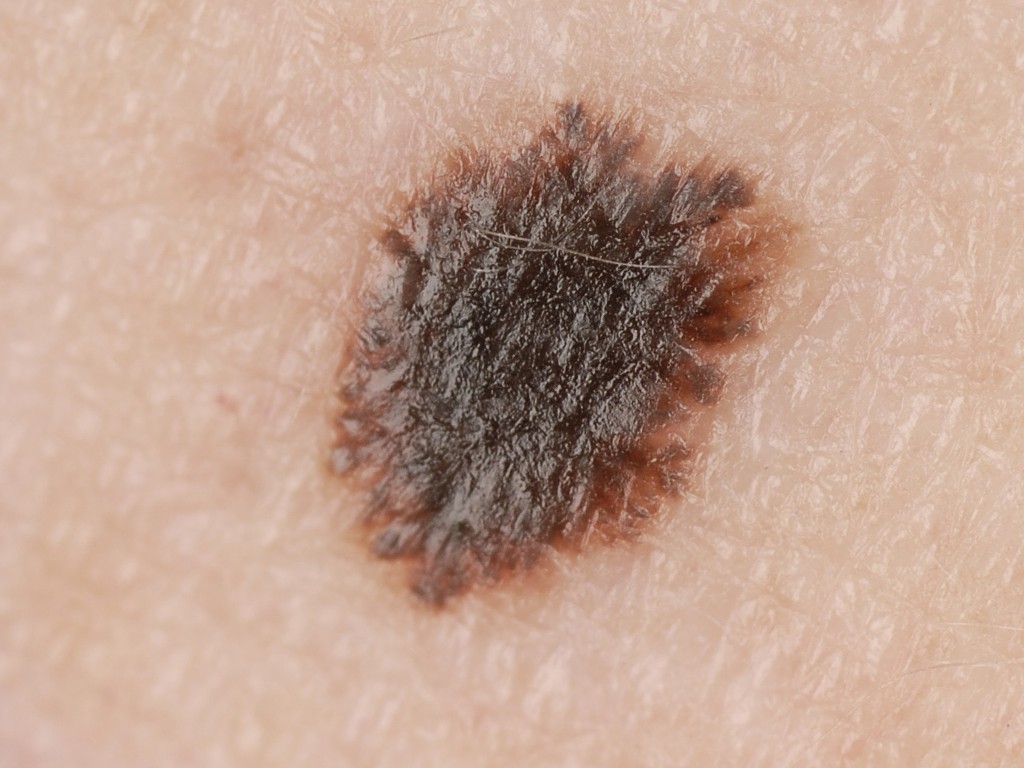
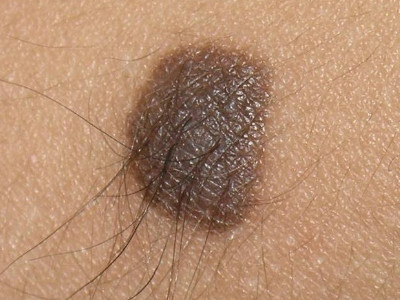
mole (nevus) |
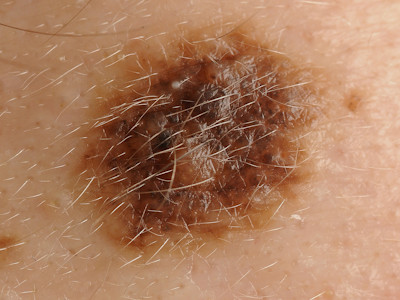
atypical
mole |
melanoma |
Usually, skin
abnormalities that look suspicious are removed in
their entirety (excision) and sent to the pathology
laboratory. The pathologist examines the tissue
under a microscope and makes a diagnosis (what it
is) and whether it is a malignant abnormality.
This
decision determines the further course of action. If
it is a benign mole, no further action is required.
If it is melanoma, the area must be operated on
again (re-excision), and
the area where it was located is then excised more
extensively, with a safety margin of usually 1 cm
around the scar. Sometimes the pathologist will say
that there are some malignant characteristics, but not
enough to make it melanoma, and the area has been
completely removed. In that case, no further action
is required. And sometimes the pathologist says that
the area, which has malignant characteristics but is
not melanoma, has not been completely removed. In
that case, it is usually recommended to operate
again to ensure that the abnormality has been
completely removed, but not with a margin of 1 cm
around it, but much smaller, for example a few
millimeters, or 5 mm.
The final advice given about
surgery and follow-up checks depends on the type of
tumor and the pathologist's assessment. This advice
is laid down in guidelines. There are Dutch,
European, and international guidelines, and they are
not all exactly the same. Guidelines also change
over the years, becoming more flexible or more
strict.
AYPICAL NAEVUS / DYSPLASTIC NAEVUS
A normal mole
is called a nevus (nevus naevocellularis). Moles
that are cause for concern can be assessed by a
dermatologist or general practitioner. The clinical
picture, or how it looks, determines whether the
mole is suspicious. The size, any growth, the color,
whether there are multiple colors or abnormal
shapes, and the symmetry are all taken into account.
The dermatologist will usually also use a
dermatoscope, a powerful magnifying glass with
special lighting.
The assessment may be that it is a
normal mole, with nothing unusual to be seen. In
that case, no action is required. The assessment may
also be that it does not appear to be a normal mole,
but an abnormal mole (medical term:
atypical nevus),
or perhaps a melanoma. In that case, the spot is
usually removed in its entirety and sent to the
pathologist.
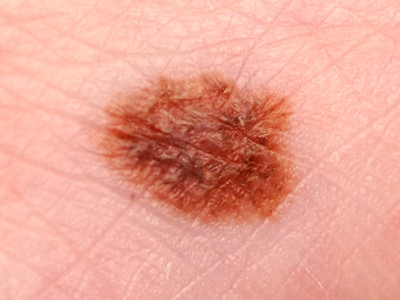 |
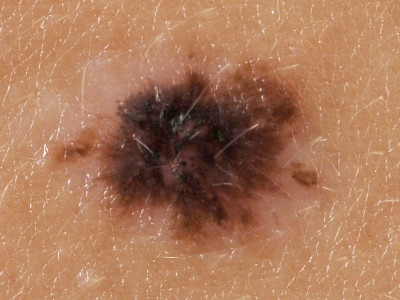 |
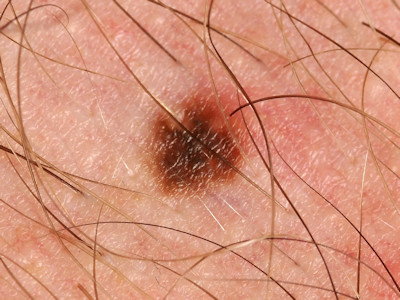 |
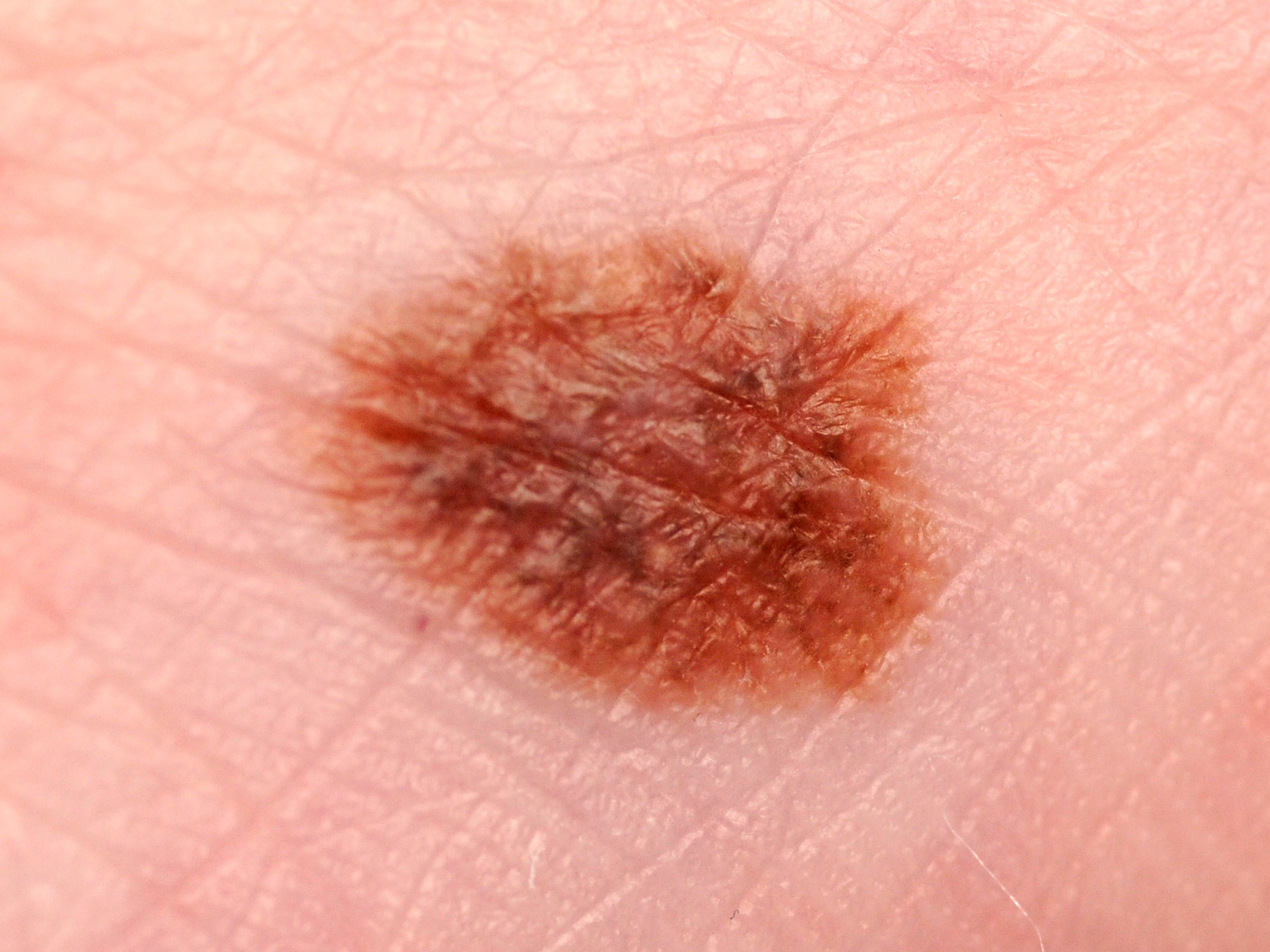
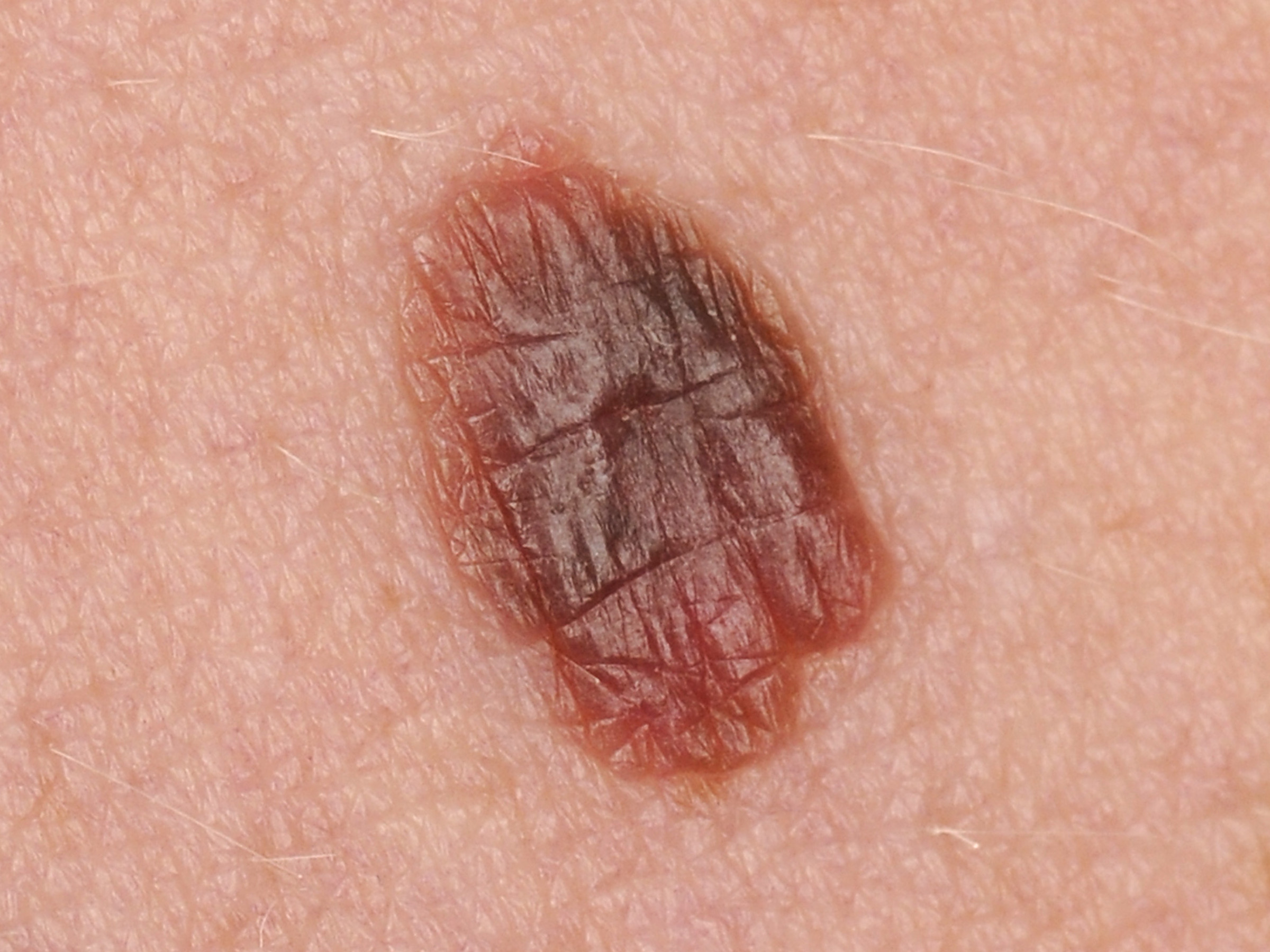
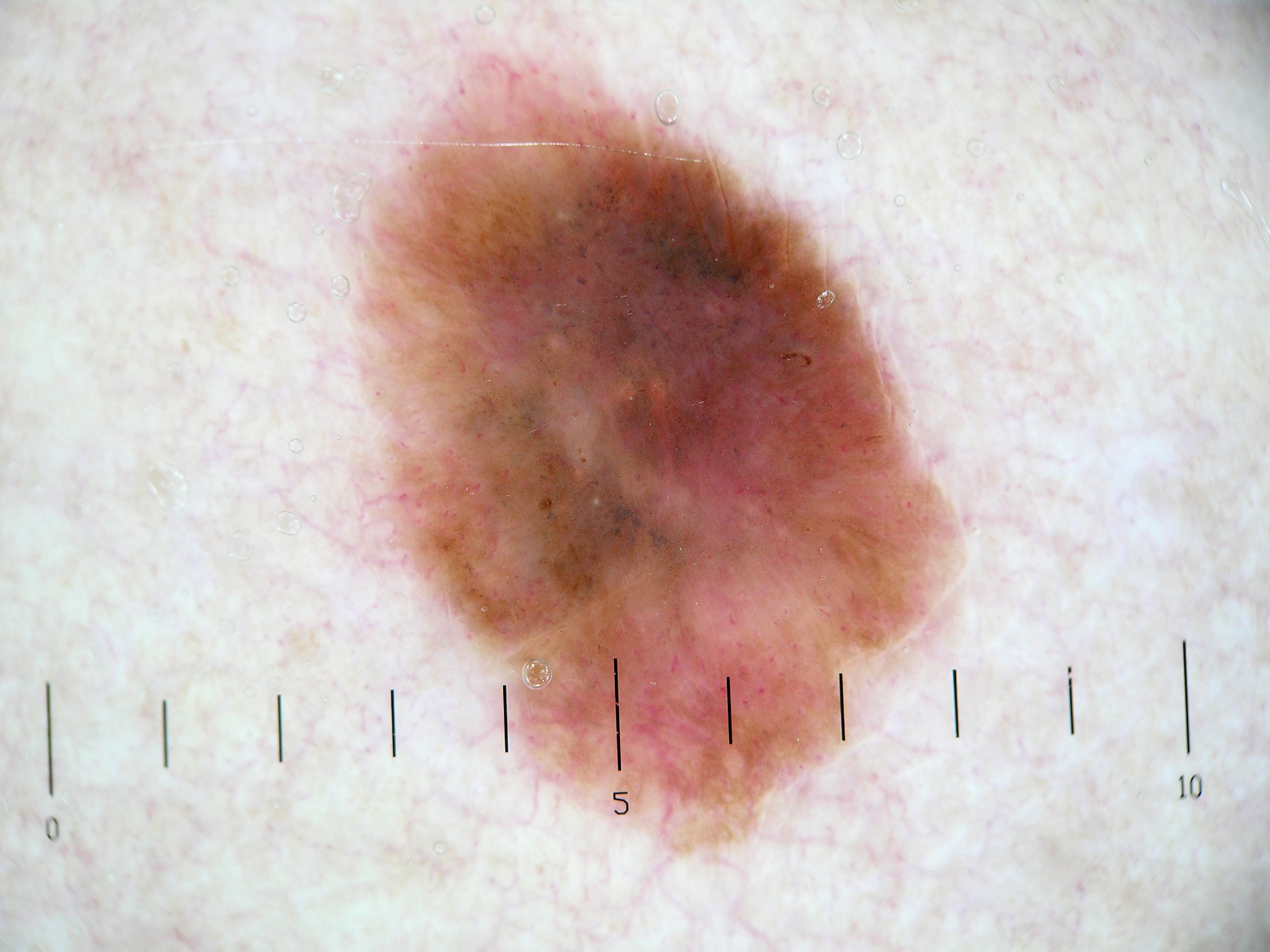
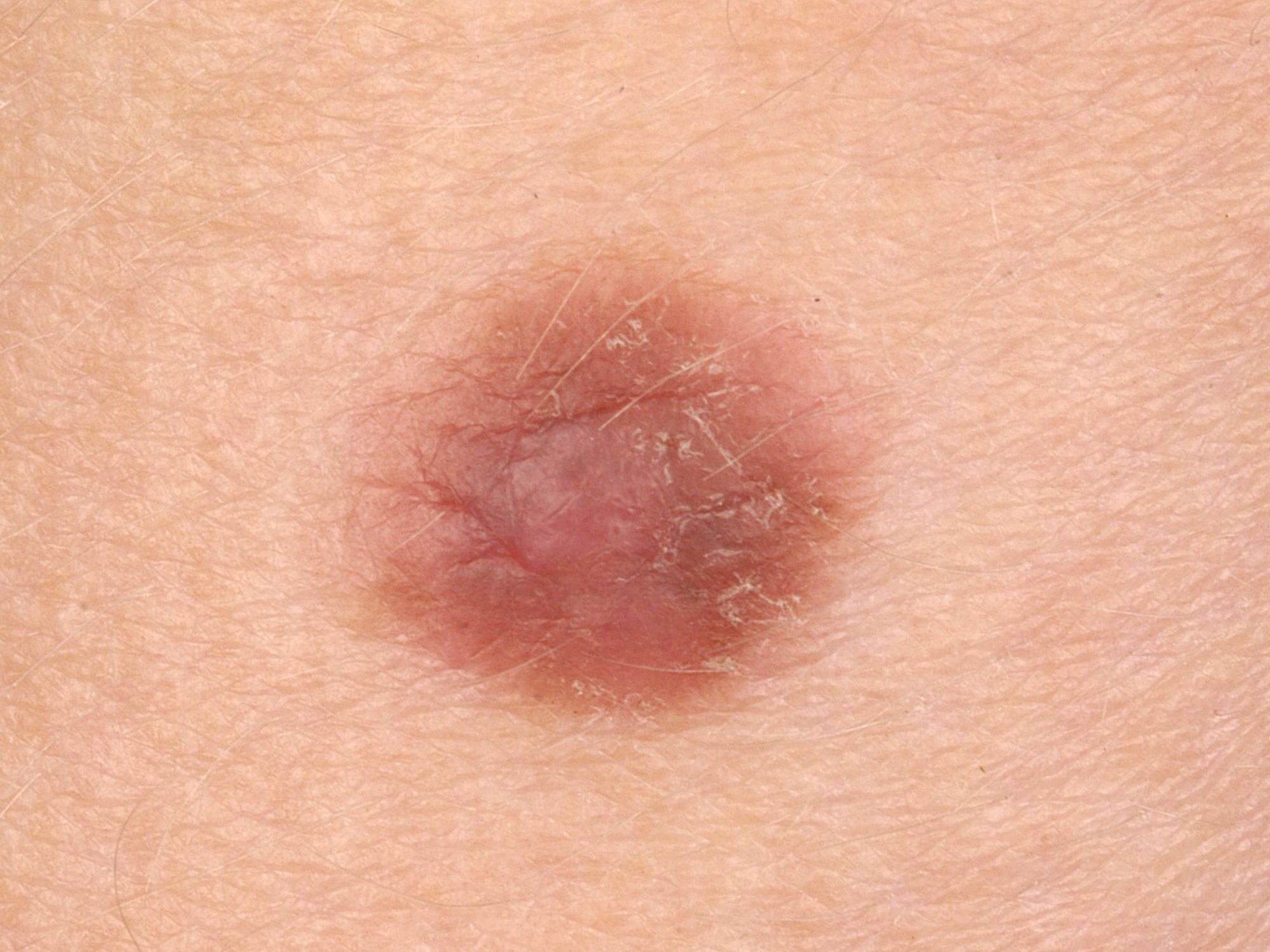
| atypical nevus |
atypical
nevus |
atypical
nevus |
The pathologist's assessment is sometimes
available after a few days, but it can also take
weeks, especially if it is difficult and a lot of
additional staining is required.
There are
then several possible outcomes:
| 1. |
|
It is a normal mole. |
| 2. |
|
It is a melanoma. |
| 3. |
|
It is a
dysplastic nevus: not a normal
mole, nor melanoma, but something in
between. There are some atypical
characteristics, unstable cells, but not
serious enough to call it melanoma. |
| 3a. |
|
The lesion has been
completely removed. |
| 3b. |
|
The lesion extends locally
to one of the edges or to the bottom, is not
completely removed. |
| 4. |
|
It is something completely
different. |
A dysplastic nevus (atypical
nevus) could eventually develop into
melanoma. That is why it is recommended that the
nevus be removed in its entirety. So if the
pathologist writes that the lesion extends to one of
the edges or to the bottom, then another operation
is needed, more extensive or deeper.
Some
people have a lot of atypical moles, which increases
their risk of developing melanoma. They often have
family members with many atypical moles or with one
or more melanomas. This may be a hereditary
condition called dysplastic nevus
syndrome. Other names for this
condition are FAMMM syndrome
(Familial Atypical Multiple Mole/Melanoma syndrome)
or familial melanoma. If
familial melanoma is suspected, DNA diagnostics can
be performed.
Instead of dysplastic nevus,
the pathologist may also make other diagnoses, such
as MELTUMP,
SAMPUS, IAMPUS,
AIMP, atypical
spitzoid tumor, STUMP,
or melanocytoma. The term
melanocytoma is relatively new. In 2018, the WHO
proposed using this term for all intermediate forms
between moles and melanoma. However, the other terms
are still in use as well.
MELTUMP
MELTUMP is an abbreviation
for melanocytic tumor of uncertain
malignant potential.
Melanocytic means that the
abnormality, like all other abnormalities discussed
in this brochure, is composed of pigment cells (melanocytes).
Tumor means lump or swelling. The term tumor does
not mean that it is malignant. There are benign
tumors and malignant tumors. Pigmented skin lesions
are not always a lump or swelling; they can also be
just a pigmented spot that is not raised.
Uncertain malignant potential
means that it could be a malignant tumor (a
melanoma). The pathologist is then unsure whether it
is benign or malignant.
WHAT IS
THE CAUSE OF A MELTUMP?
It is not
known why a MELTUMP develops. A MELTUMP can develop
anywhere on the skin. In principle, anyone can
develop a MELTUMP, but they are more commonly seen
in people with fair skin.
WHAT
DOES A MELTUMP LOOK LIKE?
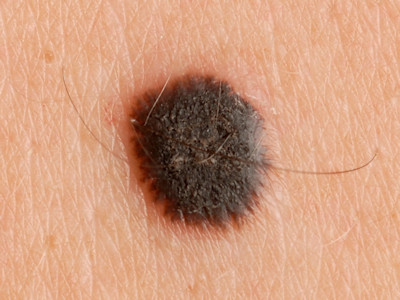
A MELTUMP
usually looks like a brown or black bump or spot. It
actually looks like a mole. The diagnosis of MELTUMP
can never be made based on how the spot looks. The
diagnosis can only be made retrospectively by the
pathologist, once the spot has been removed and sent
for pathological examination. Lesions will be
removed when there are reasons for this, such as
growth, color differences, asymmetry, signs of
unrest during examination with the dermatoscope, or
itching, pain, or bleeding.
 |
| MELTUMP |
HOW IS MELTUMP TREATED?
If the dermatologist thinks that a mole looks
suspicious, the spot is usually removed in its
entirety and sent to the pathologist.
If the
pathologist has diagnosed MELTUMP, the advice is to
excise the area more extensively, with a safety
margin of at least 5 mm around the scar, and if
possible (in areas where there is plenty of space,
not on the face) with a margin of 1 cm (as with
melanoma).
WHAT IS THE OUTLOOK
FOR MELTUMP?
Once a MELTUMP has been
completely removed, the treatment is complete.
Follow-up checks are not necessary for MELTUMP. It
is sufficient to check the skin yourself and, if new
or changed areas appear, to visit your GP or
dermatologist.
WHAT ELSE CAN YOU
DO YOURSELF?
Avoid sunburn. Check
your skin regularly and see your doctor if you
notice any new or suspicious spots.
SAMPUS AND IAMPUS
SAMPUS and
IAMPUS are actually exactly the
same as MELTUMP, the only difference being that the
lesions are not tumors (not raised or growing deep
into the skin), but grow superficially.
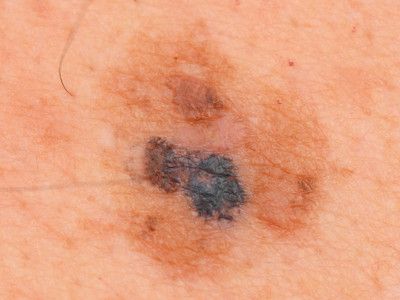
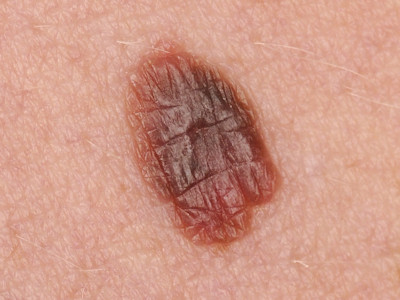
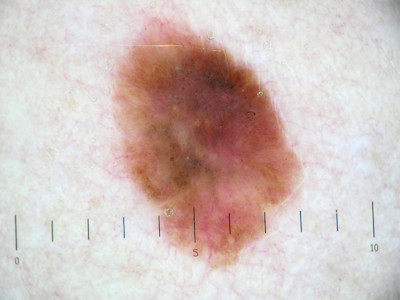
They usually look like slightly raised spots or
completely flat pigmented spots. These are also
diagnoses that can only be made retrospectively, by
the pathologist, after the tissue has been examined.
 |
 |
 |
| SAMPUS |
SAMPUS |
SAMPUS
(dermatoscopy) |
SAMPUS stands for
superficial atypical melanocytic
proliferation of uncertain significance.
IAMPUS stands for intraepidermal
atypical melanocytic proliferation of uncertain
significance.
Superficial means that the abnormality
continues to grow superficially and does not go deep
anywhere. Intraepidermal
means that the abnormality is even more superficial,
only in the upper layer of skin, the
epidermis. The layer underneath is
called the dermis. Between
the epidermis and the dermis is a very thin but
sturdy layer called the basement membrane. If tumor
cells remain in the epidermis (intraepidermal)
and do not penetrate that layer, this is good news
because there is no risk of growth into the deeper
layers or metastasis.
There is also a form of
melanoma that remains in the epidermis
(intraepidermal) and does not pass through the
basement membrane. This is called lentigo
maligna.
AIMP
AIMP stands for
atypical intraepidermal melanocytic
proliferation. This is a descriptive
term used only by pathologists. It means that there
is an increase in atypical (not entirely normal)
melanocytes in the epidermis.
STUMP
STUMP stands for Spitz
tumor of uncertain malignant potential.
To understand what a STUMP is, we first need to
explain what a Spitz tumor is. There are three
different types of Spitz tumors: a Spitz
nevus, an atypical Spitz
nevus, and a Spitz
melanoma.
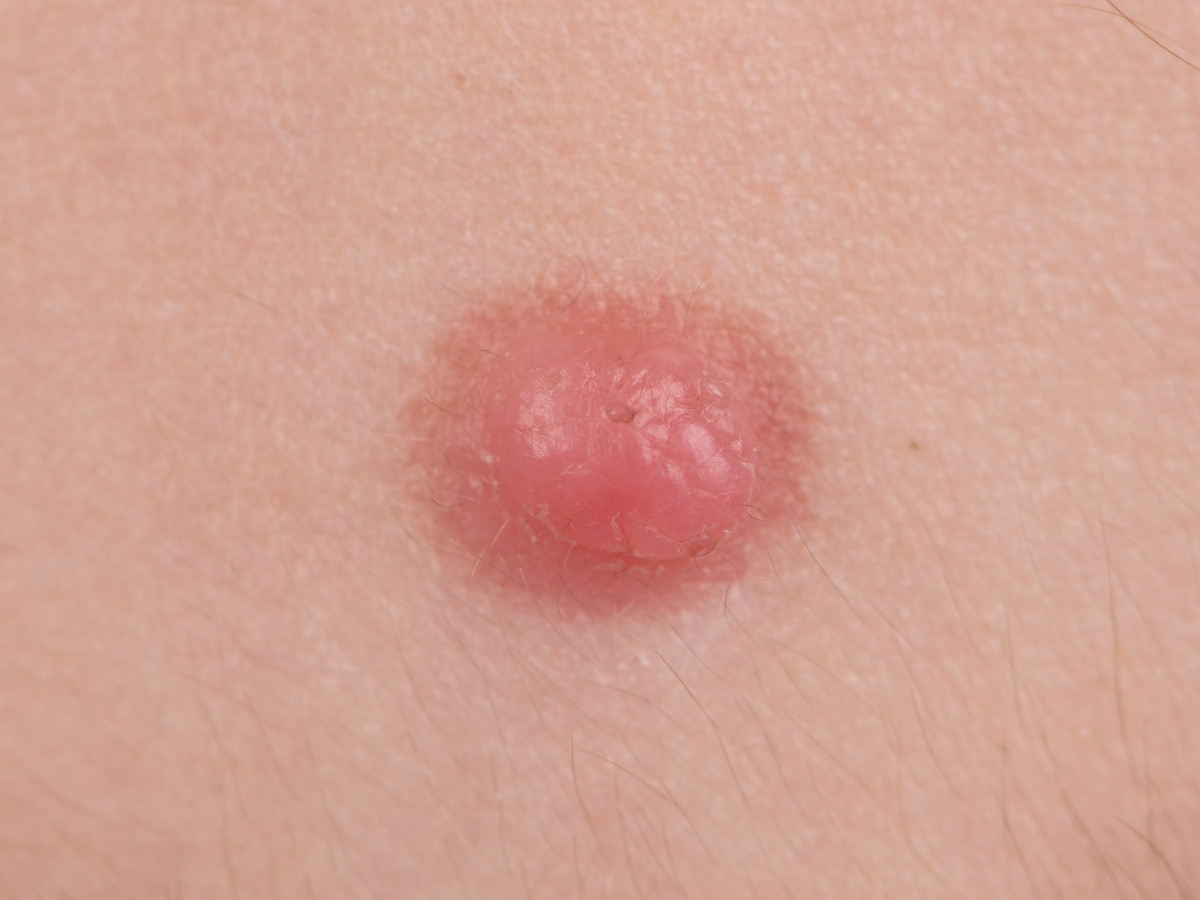
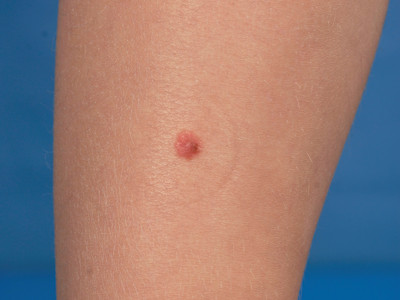
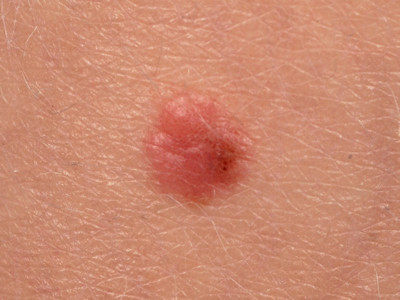
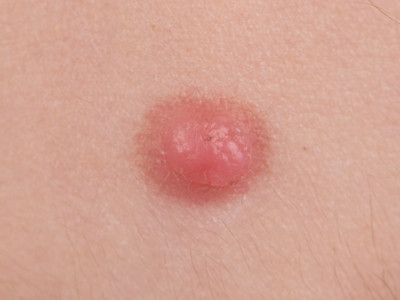
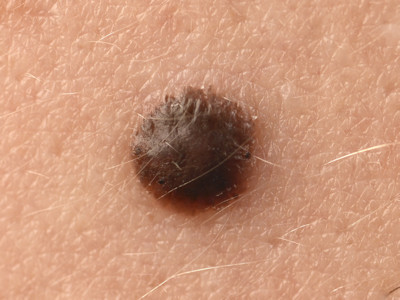
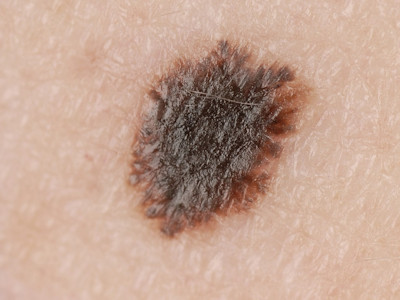
Spitz nevus
A Spitz nevus is a mole
composed of melanocytes
that have a distinctive elongated shape.
These are also called spindle cell melanocytes. The
name comes from the dermatologist Spitz, who first
described the mole. A Spitz nevus is a benign, rare
mole that occurs in children and young adults. A
Spitz nevus looks like a pink, red, or
reddish-brown, symmetrical, round bump measuring
approximately 5 mm. Spitz nevi are mainly found on
the face, neck, or legs. There is also a rare
variant in which several Spitz nevi are grouped
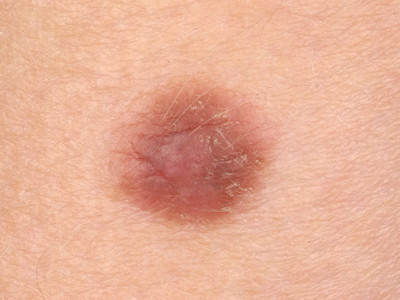
together in one area. There is also a variant that
is very dark brown to black in color and flat. This
is also known as a Reed's nevus.
The nevus of Reed is usually found on an arm or leg.
Its size can vary, up to a maximum of 1 cm in
diameter.
 |
 |
 |
|
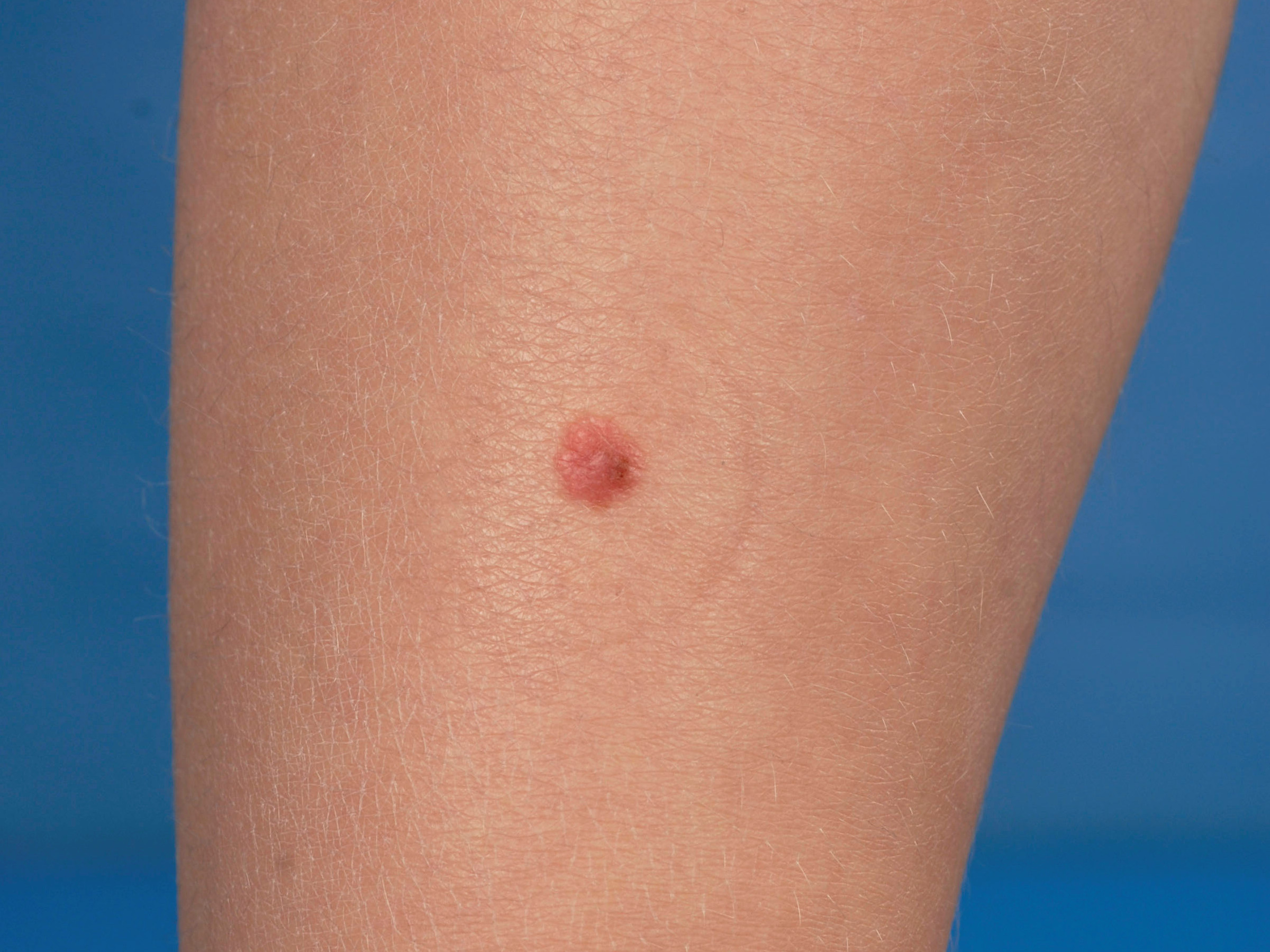
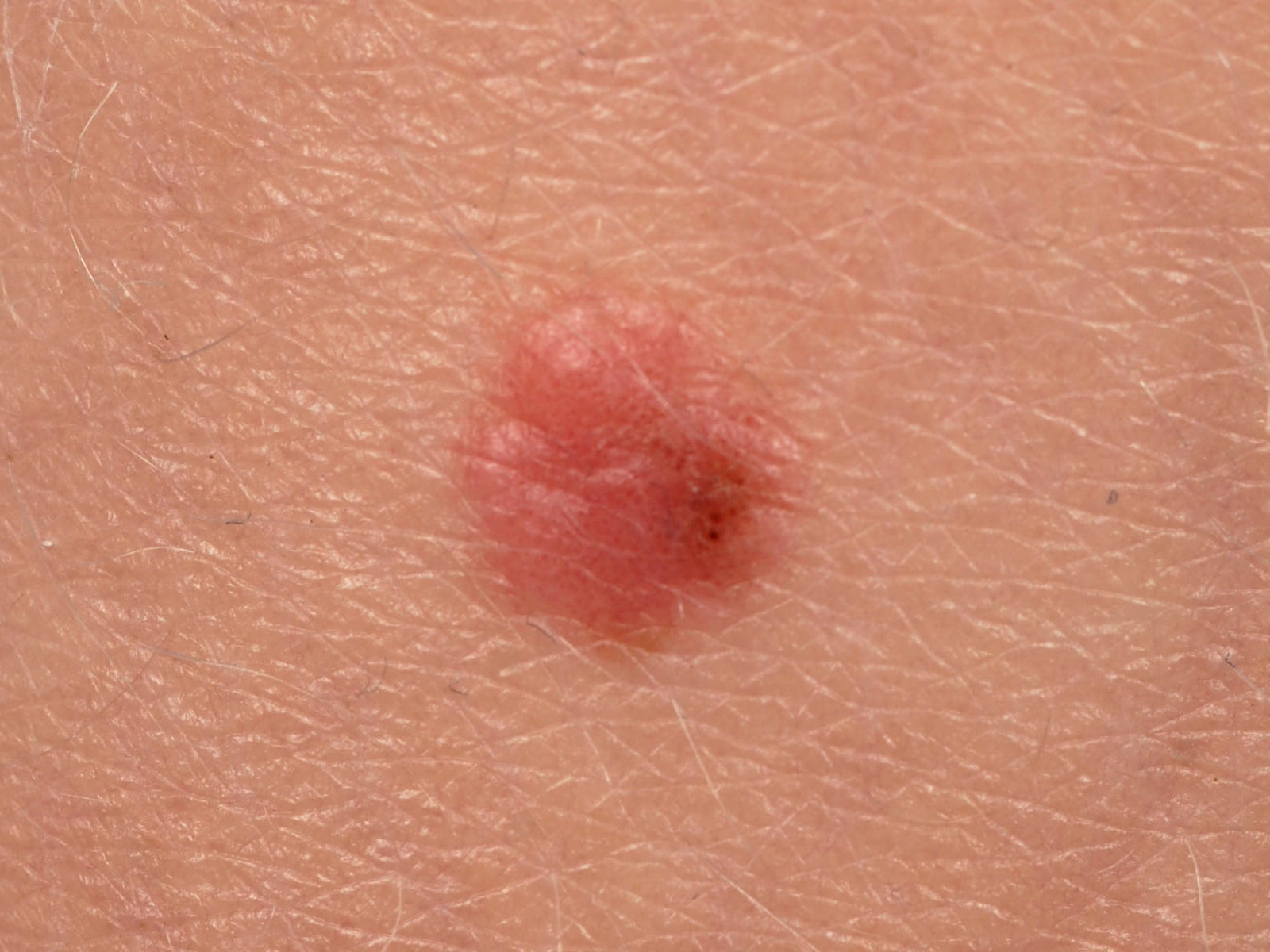
Spitz nevus |
Spitz nevus |
Spitz nevus |
 |
 |
 |
| Spitz
nevus |
Spitz
nevus |
Reed's nevus |
Atypical Spitz nevus
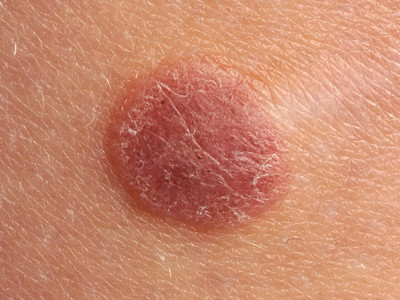
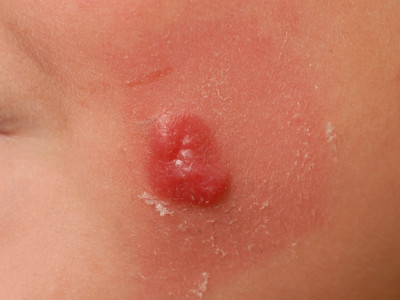
An
atypical Spitz nevus
(atypical Spitzoid tumor) is a mole composed of the
same elongated melanocytes, but the difference is
that these cells are atypical,
irregular. The melanocytes
exhibit characteristics that point toward malignant
behavior, but not enough to diagnose melanoma. The
pathologist can also distinguish between mildly
atypical and severely atypical.
 |
 |
|
atypical Spitz
naevus |
atypical Spitz
naevus |
If the diagnosis is atypical Spitz nevus, it
is usually recommended to remove the entire nevus,
if this has not already been done, with a safety
margin of a few millimeters to 5 mm.
Spitz melanoma / Spitzoid melanoma
A Spitz melanoma is also
made up of elongated spindle-shaped melanocytes, but
in this case, malignant cells
are clearly present. It is a variant of melanoma and
must also be treated as melanoma; the site must be
removed again with a safety margin of 1 cm around
the scar.
STUMP
A STUMP
(Spitz tumor of uncertain malignant
potential) is a tumor composed of
elongated melanocytes, in which the pathologist, as
with MELTUMP, cannot clearly distinguish between
benign and malignant. A STUMP could therefore be a
Spitz melanoma and must therefore be treated in the
same way as a melanoma. However, there is a
difference: extensive research has shown that with
STUMP, it is not necessary to maintain a large
safety margin of 1 cm; 5 mm is sufficient.
Research is currently being conducted to determine
whether re-excision of melanomas with a safety
margin of 1 cm, and sometimes even 2 cm, is really
necessary. It is possible that the guidelines will
change on this point.
MELANOCYTOMAS
In
2018, the WHO proposed melanocytoma
as a new term for skin lesions that fall between
benign moles and malignant melanoma. This term is
not yet widely accepted. The old terms are still in
use. However, it is possible that in the future, the
term melanocytoma will be used instead of atypical
or dysplastic nevus. The WHO also distinguishes
between melanocytomas with few atypical features (low-grade
melanocytoma) and melanocytomas with
many atypical features (high-grade
melanocytoma). For low-grade
melanocytoma, the recommendation is to excise the
lesions with a margin of a few millimeters (1-3 mm).
For high-grade melanocytoma, the recommendation is
to excise the lesions with a margin of at least 5 mm
(5-10 mm).
Spitz melanocytoma
The term melanocytoma is also increasingly used for
Spitz tumors. The current
term for abnormalities that fall between a
benign Spitz nevus and a
malignant Spitz melanoma is
atypical Spitz nevus or
atypical Spitzoid tumor. The WHO proposes replacing
this term with Spitz melanocytoma,
which can be further subdivided into
low-grade Spitz melanocytoma and
high-grade Spitz melanocytoma.
This new classification also has new
consequences. What has not changed is the policy
that suspicious pigmented skin lesions must always
first be removed in their entirety with a narrow
margin of 2 mm and sent to the pathology lab. If the
result is Spitz nevus, no further action is
required, as this is a benign mole. If the result is
low-grade Spitz melanocytoma, no further action is
required, as the 2 mm margin is sufficient. If the
result is high-grade Spitz melanocytoma, the
recommendation is to excise the area again with a
margin of at least 5 mm (5-10 mm).
Other melanocytomas
There are other
types of melanocytomas, such as
pigmented epithelioid melanocytoma,
deep penetrating melanocytoma,
and BAP1-inactivated melanocytoma,
but these are all very rare.
|