Peutz-Jeghers syndrome
Peutz-Jeghers syndrome
(periorificial lentiginosis, pigment spot polyposis) is a rare, hereditary disorder characterized by
mucocutaneous pigmentation,
gastrointestinal polyposis, and an
increased risk of cancer. It
is caused by mutations in the LKB1 gene (STK11), a tumor
suppressor gene on chromosome 19. Hamartomas develop at
a young age and lead to abdominal pain, anemia, or acute
bowel obstruction. Patients have an increased risk of
developing cancer in both the gastrointestinal tract and
other organs and should be regularly screened for this
using endoscopic examination and MRI. The mutation can
be detected by DNA diagnostics.
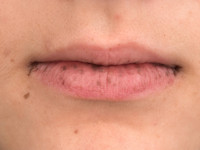 |
| Peutz-Jeghers syndrome |
For more information see
Peutz-Jeghers syndrome.
|

|


