| FACIAL
PARALYSIS
(FACIAL PALSY) |
 |
 INTRODUCTION INTRODUCTION
The purpose of this brochure is to provide you with information about facial paralysis and the
associated symptoms. This condition is also known as facial nerve palsy.
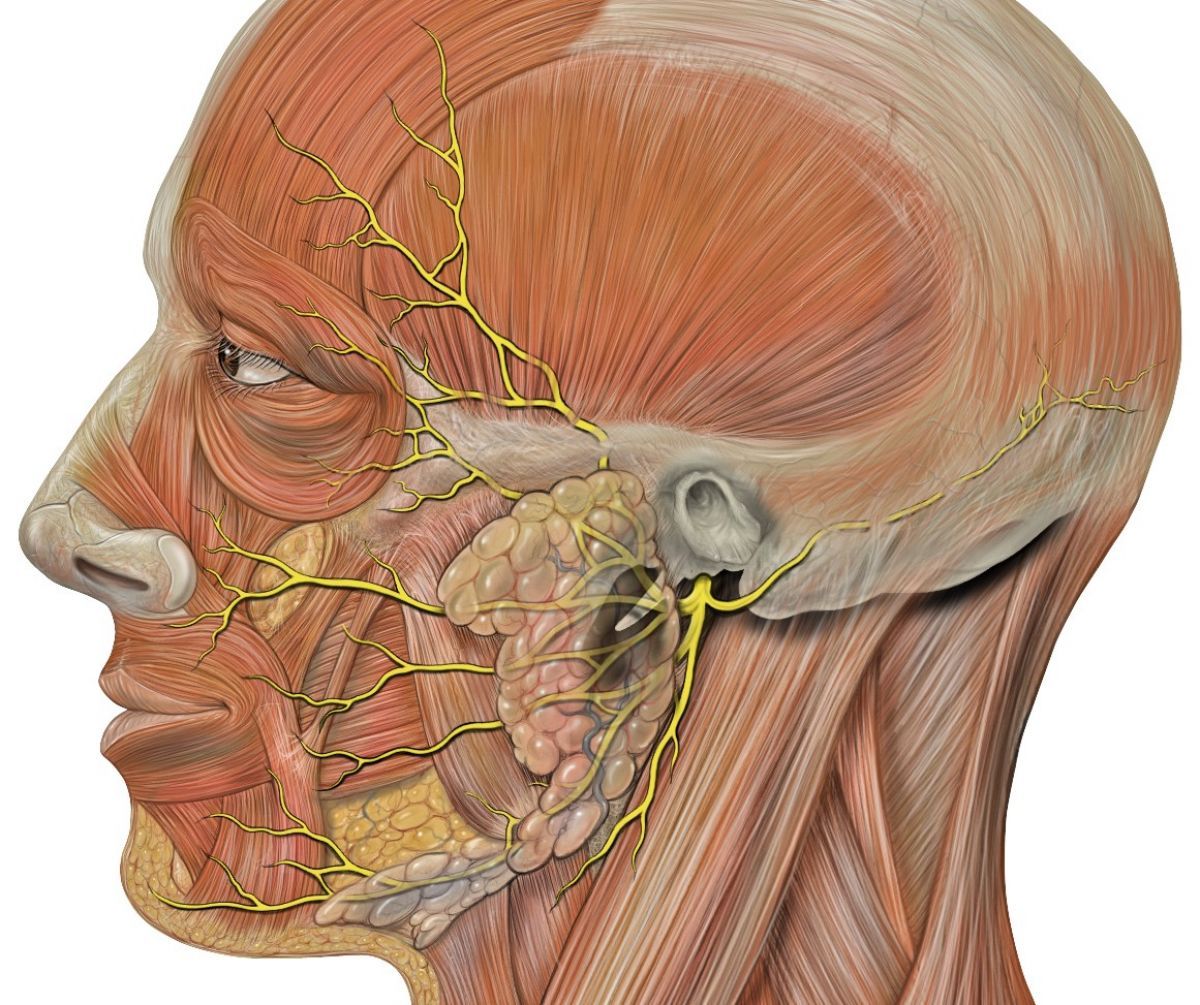
Nervus facialis. Illustratie: Patrick J. Lynch - Wikimedia
(Creative Commons License
2.5).
THE FACIAL NERVE
Both sides of your face have a facial nerve. This nerve controls facial expressions (mimicry). It also
controls the closing of your eyes and mouth. The facial nerve originates in the brain and runs through
a narrow, bony canal (tunnel) in the skull. It first passes the inner ear, then a middle ear bone (the
stapes), and finally emerges in the parotid gland, which is located in front of the ear. In this salivary
gland, the nerve splits into several branches that go to the muscles of the face. A small branch of this
nerve goes to the tongue and controls taste.
The facial nerve is vulnerable compared to other nerves. This is probably due to the narrow and long
bony canal through which the nerve runs. If, for any reason, the nerve is damaged inside the skull, it
will function less effectively. The affected side of your face no longer moves properly. You have
paralysis on this side. Sometimes, pain sensations (in the ear) can also occur.
THE SYMPTOMS OF PARALYSIS
When the facial nerve (almost always on one side) malfunctions, the muscles on that side of the face
stop working. This is called facial paralysis. The result is a crooked face. The corner of the mouth
droops, the crease between the nose and the corner of the mouth disappears, and the eye is wider
than on the healthy side. It is impossible to close the eye and when attempting to do so, the white of
the eye becomes visible. This is caused by the eyeball turning upwards. This is a normal phenomenon
that is not usually seen because the eyelid covers it. The cheek is limp and because the mouth hangs
down slightly, talking and swallowing are difficult. Sometimes saliva runs out of the mouth.
Paralysis can be complete or incomplete. In the case of incomplete paralysis, the facial muscles are
mobile to a limited extent. Incomplete paralysis can still develop into complete paralysis within a few
days.
CAUSES
The medical history and ENT examination may reveal the cause. If necessary, a hearing test can be
performed, followed by laboratory tests and a scan (CT or MRI).
Causes of facial paralysis may include:
| - |
|
Ear infection. |
| - |
|
Skull injury or injury
after surgery, for example to the ear or
salivary gland. |
| - |
|
The shingles virus (herpes
zoster oticus). This causes blisters,
similar to chickenpox, to appear on ear and
surrounding area. The paralysis is often
painful and is sometimes accompanied by
hearing loss and balance disorders. |
| - |
|
A tumor pressing on the
nerve. In this case, the paralysis often
occurs very gradually. |
| - |
|
Tick-borne disease (Lyme
disease). In approximately 50% of cases, we
refer to this as Bell's palsy. |
BELL'S PALSY
Bell's palsy, named after the English surgeon Sir Charles Bell (1774-1842), can generally be considered
a mild condition. The paralysis is most likely caused by the herpes simplex virus, type 1. This virus,
which also causes the well-known "cold sore", is thought to lie dormant in nerve tissue and becomes
active again after exposure to drafts, large temperature differences, intense emotions, etc. This causes inflammation of the facial nerve. It swells and is probably pinched in the bony canal.
PROGNOSIS OF FACIAL PARALYSIS
Bell's palsy often heals spontaneously and completely within 6 to 8 weeks without treatment.
However, age plays a major role in this: in 85-90% of cases in people under the age of 30, in 76% of
cases in people aged 30 to 45, in 61% of cases in people aged 45 to 60, and in only 37% of cases in
people over the age of 60. Incomplete paralysis usually heals on its own without any problems.
If healing takes longer, full recovery is unlikely. This is also more likely if the facial nerve is damaged
due to nerve degeneration in cases of complete paralysis. The degree of nerve degeneration can be
determined using an electrical nerve test, in which the nerve is electrically stimulated through the
skin. Regular checks for possible nerve damage by an orthopedic surgeon are recommended,
especially in the early stages of paralysis.
RESIDUAL SYMPTOMS
After facial paralysis with nerve degeneration, bothersome symptoms may persist. Due to reduced
muscle strength, the eye and mouth may not close completely. The affected side may move
abnormally when speaking, eating, and whistling. Furthermore, the affected side may feel tight and
the eye may water during eating ("crocodile tears").
Recovery will not continue beyond one year after the onset of paralysis.
Over the years, the paralysis may become less visible as the skin ages and sags. The end result is often
acceptable.
TREATMENT
Rest
In the case of Bell's palsy, spontaneous recovery will be awaited as long as the function is not or not
completely lost. Rest must be observed for a few weeks to promote the natural healing process as
much as possible.
Eye problems
To prevent eye problems, it is recommended that the affected eye be treated with eye ointment or
covered with a watch glass bandage during the night. This prevents drying out. If necessary,
protective eye drops can be used during the day.
Medication
In cases of severe paralysis, it may be advisable to start a course of prednisone, possibly in
combination with an anti-herpes virus medication, preferably within one week. Prednisone, which is
also produced by the body in the adrenal cortex, has the ability to reduce the effects of inflammation.
Additional examination
If there is no recovery after 3 months, the diagnosis of "Bell's palsy" must be reviewed. Additional
tests (including scans) are then necessary.
Mime therapy
In cases of incomplete recovery due to nerve damage, the annoying residual symptoms (facial
asymmetry, reduced function, and abnormal movement) can be suppressed as much as possible
through specific exercise therapy ("mime therapy"). This treatment aims to achieve better control
over the disturbed facial expression. Through exercise, a conscious connection is made between body
language, emotions, and facial expression. The exercises focus on relaxation, breath control, and
learning to move the mimic muscles on the healthy and affected sides together.
Psychosocial support
Psychosocial counseling is necessary for a number of patients.
Plastic surgery
Plastic surgery is only indicated if the eye is at risk (this rarely happens).
Other treatments
Scientific research has shown that surgically drilling open the nerve canal to relieve pressure on the
nerve has no effect. Electrotherapy is not useful and may actually increase muscle tightness
(contracture).
In cases other than Bell's palsy, treatment of the cause of the paralysis will be necessary: treatment of ear infections, treatment of tumors, antiviral medication (in case of shingles), nerve reconstruction after nerve damage, or antibiotics (in case of tick-borne disease).
|