|
EFUDIX CRÈME (FLUOROURACIL) |
 |
 WHAT IS EFUDIX CREAM AND HOW DOES IT WORK? WHAT IS EFUDIX CREAM AND HOW DOES IT WORK?
Efudix cream contains
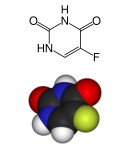
5-fluorouracil, a
cytostatic (cell growth inhibitor) that damages rapidly dividing cells but not slowly dividing cells. This unique property makes Efudix cream suitable for the local treatment of
superficial forms of skin cancer. Other skin conditions in which cell division is accelerated or abnormal, such as the skin condition
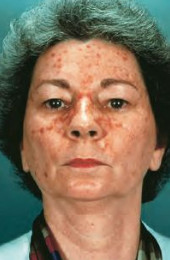
actinic keratosis (a keratinization disorder), can also be treated with it. If there is a large area of skin with small areas of actinic keratosis all over it, for example,
on the scalp, the entire area can be treated. The cream then selectively damages only the areas with accelerated cell division. These areas
will become red, while normal skin is spared.
 |
|
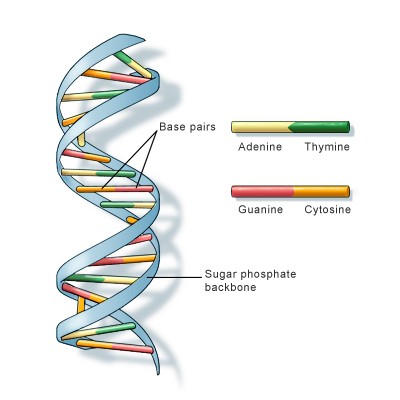
5-Fluorouracil is a fluorinated pyrimidine and belongs to the group of antimetabolites (cytostatics). It inhibits cell growth. Fluorouracil inhibits the production of thymidine in cells. Thymidine is one of the building blocks of DNA, and a deficiency prevents cells from dividing properly. As a result, fluorouracil primarily targets rapidly dividing cells, such as cancer cells and their precursors. |
|
 |
PRODUCT INFORMATION
Efudix cream contains 5% (50 mg/g) 5-fluorouracil in
an oil-in-water emulsion base and is available in 40 g tubes.
Do not store above 25ºC.
Do not refrigerate or freeze.
Shelf life: 3 months after opening the tube.
Close the tube tightly after use.
As with all medicines: never throw away any leftover Efudix in the regular garbage bin, but in the special waste bin for small chemical waste or hand the leftover medicine in at your pharmacy.
WHAT CAN BE TREATED WITH EFUDIX?
| - |
|
actinic keratoses (other
names: keratosis actinica, solar keratosis,
senile keratoses) |
| - |
|
actinic keratosis on the
lip (actinic cheilitis) |
| - |
|
porokeratosis actinica (a
sun-induced skin disorder) |
| - |
|
superficial forms of basal
cell carcinoma |
| - |
|
superficial forms of
squamous cell carcinoma (Bowen's disease) |
| - |
|
genital warts (condylomas) |
| - |
|
common warts (verruca
vulgaris) and plantar warts (verruca
plantaris) |
INSTRUCTIONS FOR USE
| - |
|
Apply a thin layer of
Efudix cream to the area to be treated. You
can do this with your hands. Wash your hands
thoroughly with soap and water after
applying the cream. For hygiene reasons, it
is also advisable to wash your hands
thoroughly before applying the cream. |
| - |
|
Research has shown that
5-fluorouracil, the active ingredient in
Efudix, can be detected in surface water.
Apparently, that's how often it's used. This
is bad for the environment because
5-fluorouracil is a cytostatic (cell
growth-inhibiting agent). You can reduce
this by wiping away as much excess cream as
possible with a cleansing wipe, tissue, or
piece of toilet paper and disposing of it in
the waste bin. |
| - |
|
Your doctor will tell you
how often and how long to apply Efudix
cream. This is usually twice a day for 3-4
weeks. |
| - |
|
Efudix should not come into
contact with mucous membranes or the eyes.
Use caution when applying it to areas around
the eyes and mouth. When used for genital
warts, it may be applied to mucous
membranes, provided a doctor's prescription
is given. |
| - |
|
Do not use other skin
products such as creams, lotions, cosmetics,
or medications at the same time, unless
advised by your doctor. During the healing
phase, disinfectant creams such as Fucidin
cream are sometimes prescribed. |
| - |
|
Unless prescribed by a
doctor, the treated areas should not be
covered with bandages, gauze or plasters. |
| - |
|
Avoid sunlight and other UV
light (sunbeds). Depending on the area being
treated, it's advisable to wear a hat or
long-sleeved clothing. |
WHAT HAPPENS WHEN I APPLY EFUDIX?
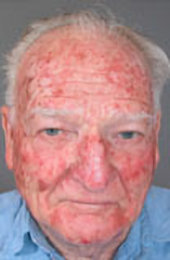
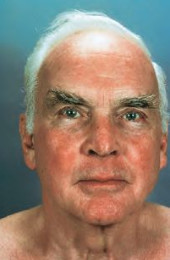
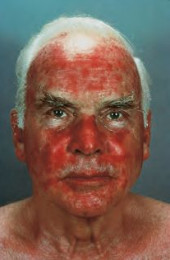
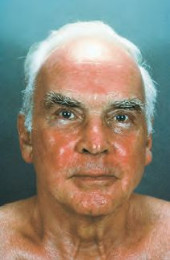
Initially, nothing seems to be happening. Over time, the areas where rapidly dividing cells are located become damaged. The cells die. First, you'll see redness, then blisters, abrasions, then deeper wounds and even ulcers. Afterwards, after you stop using the product, the skin begins to heal as healthy skin cells grow in from the edges and
from the depth. So, first it gets worse, then it gets better. The skin will
be healed within 1 to 2 weeks.
Don't be alarmed or
worried if your skin starts to break. This is a sign that Efudix is working. The redness, crusting, and peeling of the skin are caused by the death of the abnormal cells and are completely normal during Efudix treatment. Do not stop treatment for this reason. Most patients find that the end result is worth the temporary discomfort. However, if any of these symptoms become severe, contact your doctor. It's possible that unaffected areas of your skin will also become red and inflamed. This is because Efudix also treats very small lesions that are not yet visible to the naked eye.
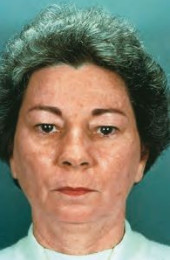
You should be prepared to walk around with red spots and sores for several weeks (2-4 weeks). Therefore, plan your treatment carefully. Don't do it during a
period when you have many social obligations or are going on vacation. Schedule it during a quiet period. Below you can see how severe the condition can look during treatment:
 |
 |
 |
|
before treatment |
during treatment |
after treatment |
 |
 |
 |
|
before treatment |
during treatment |
after treatment |
 |
 |
 |
|
before treatment |
during treatment |
after treatment |
HOW OFTEN SHOULD I APPLY IT AND HOW LONG SHOULD I CONTINUE?
It varies. It's common to apply it once or twice a day for 3-4 weeks. Your dermatologist will tell you how often and for how long. The most effective treatment is twice a day for 4 weeks. Not everyone reacts the same way to the cream, so you can decide to continue for a little longer if nothing happens or to stop
earlier if severe reactions occur. It also depends on the condition it's being applied to.
Actinic keratosis:
Apply twice a day for 3 weeks. After that, it should look like the pictures above (middle photo). If not: continue for another week, for a total of 4 weeks. Then stop, and once the skin has completely healed, make another appointment with the dermatologist to assess the results.
Basal cell carcinoma and Bowen's disease:
Apply twice a day for 4 weeks. Sometimes it is recommended to apply an occlusive dressing to improve penetration; in that case, it only needs to be applied once a day. After 4 weeks, the area should look like a large abrasion or ulcer. If so, you can stop. If the skin hasn't broken after 4 weeks of application, continue for another 1 or 2 weeks.
Genital warts (condylomas):
For external warts, apply the cream twice a day for two consecutive days a week.
For internal warts (in the vagina or anus):
apply using an applicator once or twice a week (depending on your doctor's advice). The surrounding healthy mucous membrane can be protected with Vaseline. The applicator will be prescribed separately.
For the treatment of genital warts, you should use Efudix for at least 6 weeks, after which you should schedule a follow-up appointment to assess whether treatment should be continued longer.
Other conditions:
Depending on your doctor's prescription.
Efudix should only be used under medical supervision.
What is the maximum area I can treat?
You
can not treat more than 500 square cm of skin per day. This corresponds to an area of approximately 23 x 23 cm. If a larger area needs to be treated, it should be done in two phases. For example, first treat one half of the
chest for three weeks, then treat the other half for three weeks. A 40 g tube of Efudix is more than enough for a three-week treatment.
SIDE EFFECTS
Side effects only occur where the cream has been applied. Side effects include itching, burning, pain, tenderness, redness, flaking, and swelling of the skin. Superficial wounds may also develop. If any of these symptoms become severe, contact your doctor. An allergic reaction sometimes occurs.
WILL EFUDIX ALSO ENTER MY BODY?
No, if you adhere to the maximum surface area mentioned above, no traces of Efudix will be found in your blood or tissues. This means that your body will not suffer any damage from it.
PREGNANCY AND BREASTFEEDING
Although no traces of the substance can be found in the blood with local treatment with Efudix, you should not use Efudix if you are pregnant. During pregnancy, any exposure to harmful substances, no matter how small, must be avoided.
WHEN SHOULD I NOT USE EFUDIX?
During pregnancy. And in case of hypersensitivity (allergic reactions) to the cream, caused by fluorouracil or by the preservatives contained in the cream (parabens).
CAN I SHOWER AND SWIM DURING THE TREATMENT?
Showering: Showering and washing your skin is not a problem during the treatment. It is recommended not to wash the treated skin with soap, but only with lukewarm water. If the face or scalp is being treated with Efudix, it is recommended to wash your hair with baby shampoo. Baby shampoo is mild and prevents further irritation of the treated skin.
Swimming: Swimming in chlorinated and/or open water during the treatment is not recommended.
|