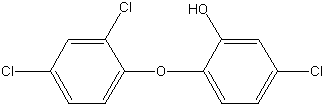
| Formule |
CAS |
| C12H7Cl3O2 |
3380-34-5 |
Background
Triclosan is a diphenyl ether (bis-phenol) derivate. It has a broad-spectrum bacteriostatic activity against a wide range of both gram-negative and gram-positive bacteria. Triclosan has found increasing and recent popular use as a preservative and disinfectant in personal care products, i.e.- toothpaste, deodorant soaps, deodorants, antiperspirants and body washes, detergents, dish washing liquids, cosmetics and anti-microbial creams, lotions and hand soaps. It is also used as an additive in plastics, polymers and textiles to give these materials antibacterial properties. Incorporated into such footwear as men's hosiery and insoles of shoes it is called an "odor-eaters" because it is claimed that this chemical can suppress the odor produced by foot organism.
Triclosan is very easily absorbed, even through the skin and a stady state is reached quickly. Although Triclosan can cause an allergic contact dermatitis, particularly when used in products for the feet, in practice it rarely causes sensitisation or skin irritation.
Synonyms2,4,4'-Trichloro-2'-hydroxydiphenyl ether
5-Chloro-2-(2,4-dichlorophenoxy) phenol
Aquasept
CH-3635
Gamophen
Irgasan
Ch 3635
Irgasan DP 300 (Ciba-Geigy)
Microban
Sapoderm
Ster-Zac
UsesAdditive in plastics, polymers and textiles to give these materials antibacterial properties
Anti-microbial creams
Anti-odor insoles and hose
Bath additives
Body wash
Commercial laundry products
Cosmetics
Deodorant soaps
Deodorants and antiperspirants
Detergents, dish washing liquids
Disposable paper products
Foot powders and sprays
Laundry products
Shampoos
Toothpaste
Cross-ReactionsUnusual ReactionsToxic effects
Back to list of contact allergens
Referenties
| 1. |
Maurer, T., et al., Predictive evaluation
in animals of the contact allergenic potential of medically
important substances. II. Comparison of different methods of
cutaneous sensitization with "weak" allergens. Contact
Dermatitis, 1979. 5(1): p. 1-10. |
| 2. |
Veronesi, S., et al., Contact dermatitis
to triclosan. Contact Dermatitis, 1986. 15(4): p. 257-8. |
| 3. |
Zaugg, T. and T. Hunziker, Germall II and
triclosan [letter]. Contact Dermatitis, 1987. 17(4): p. 262. |
| 4. |
Steinkjer, B. and L.R. Braathen, Contact
dermatitis from triclosan (Irgasan DP 300). Contact Dermatitis,
1988. 18(4): p. 243-4. |
| 5. |
Perrenoud, D., et al., Frequency of
sensitization to 13 common preservatives in Switzerland. Swiss
Contact Dermatitis Research Group. Contact Dermatitis, 1994.
30(5): p. 276-9. |
Author(s):Allergology: background information on allergens.
 ICD10:
L23.9
ICD10:
L23.9