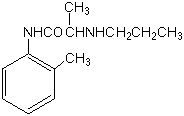
| Formule |
CAS |
| C13H21ClN2O |
1786-81-8 |
Background
Prilocaine hydrochloride belongs to the amide group of local anesthetics and has been used since 1961. Allergic reactions are rare to members of this group of anesthetics.
SynonymsCitanest
EMLA® cream
Prilocaine hydrochloride
Xylonest
N-(2-Methylphenyl)-2-(propylamino)-propanamide
2-(Propylamino)-o-propionotoluidide
N-(a-propylaminopropionyl)-o-toluidine
a-propylamino-2-methylpropionanilide
Propitocaine
UsesLocal anesthetic
EMLA® cream (lidocaine base + prilocaine base)
Cross-ReactionsLidocaine
Bupivacaine
Cinchocaine
Mepivacaine
Unusual Reactions
Back to list of contact allergens
Referenties
| 1. |
Fregert, S., E. Tegner, and I. Thelin,
Contact allergy to lidocaine. Contact Dermatitis, 1979. 5(3): p.
185-8. |
| 2. |
Curley, R.K., A.W. Macfarlane, and C.M.
King, Contact sensitivity to the amide anesthetics lidocaine,
prilocaine, and mepivacaine. Case report and review of the
literature. Archives of Dermatology, 1986. 122(8): p. 924-6. |
| 3. |
Black, R.J., T.A. Dawson, and W.C.
Strang, Contact sensitivity to lignocaine and prilocaine.
Contact Dermatitis, 1990. 23(2): p. 117-8. |
| 4. |
van den Hove, J., et al., Allergic
contact dermatitis from prilocaine, one of the local
anaesthetics in EMLA cream. Contact Dermatitis, 1994. 30(4): p.
239. |
Author(s):
dr. Jan R. Mekkes. Dermatologist, Amsterdam UMC.
 ICD10:
L23.9
ICD10:
L23.9