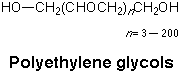
 Background
Polyethylene glycols (PEGs) are used extensively as solvent vehicles in cosmetics, industrial products and technical industries. The molecular weights vary from 200 to 7500. At room temperature, the low molecular weigth (200 - 700) are liquids, whereas the consistency of higher molecular PEGs (1000 - 7500) varies from soft to hard. PEGs are hydrophilic and easily bind many products becaused of theric special helical configuration. PEGs are therfore used as a vehicle for many drugs. PEGs (especially PEG 400) facilitate the skin penetration of many substances and are therfore often used in topical preparations. PEGs are not subject ot bacterial deterioration. Peroxidases may be formed during storage, especially at higher temperatures or in daylight, so storage conditions should preferably be a cool environment protected from direct sunlight.
Cross reactions occurr between the low molecular weight but not the higher molecular weight PEGs and the higher molecular weight PEGs are consisdered to be rare sensitizers.
SynonymsPolyethylene glycol 400
UsesCarbowax
Contraceptives
Topical medications
Shampoos
Detergents
Insect repellents
Cosmetics
Toothpaste
Furacin
Hair dressings
Plastibase
Suppositores
Cross-ReactionsUnusual ReactionsBack to list of contact allergens
Referenties
| 1. |
Fisher, A.A., Contact urticaria due to
polyethylene glycol. Cutis, 1977. 19(4): p. 409-12. |
| 2. |
Fisher, A.A., Immediate and delayed
allergic contact reactions to polyethylene glycol. Contact
Dermatitis, 1978. 4(3): p. 135-8. |
| 3. |
Daly, B.M., Bactroban allergy due to
polyethylene glycol. Contact Dermatitis, 1987. 17(1): p. 48-9. |
| 4. |
Bajaj, A.K., et al., Contact sensitivity
to polyethylene glycols. Contact Dermatitis, 1990. 22(5): p.
291-2. |
| 5. |
Stenveld, H.J., P.N. Langendijk, and D.P.
Bruynzeel, Contact sensitivity to polyethylene glycols. Contact
Dermatitis, 1994. 30(3): p. 184-5. |
Author(s):
dr. Jan R. Mekkes. Dermatologist, Amsterdam UMC.
 ICD10:
L23.9
ICD10:
L23.9