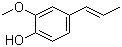
| Formula |
CAS |
| C10H12O2 |
97-54-1 |
Background
Isoeugenol is a fragrance and spice with the odor of cloves. It is found in the oils of clove, ylang-ylang, tuberose, and jonquil. It is manufactured by the isomerization of eugenol. The International Fragrance Research Association recommends that isoeugenol be used at no more than a 1% concentration in fragrance compounds. It is an approved flavoring agent for foods.
Synonyms2-Methoxy-4-(1-propenyl) phenol
2-Methoxy-4-propenylphenol
4-Hydroxy-3-methoxy-1-propenylbenzene
4-Propenyl-2-methoxyphenol
4 -Propenylguaiacol
Benzylisoeugenol
Isoeugenol acetate
Isoeugenol methyl ether
UsesCosmetics (clove and carnation scent)
Dental materials
Food flavor
Over-the-counter medicines
Perfumes
Production of vanillin flavor
Cross-ReactionsEugenol
Unusual Reactions
Back to list of contact allergens
Referenties
| 1. |
Maurer, T., et al., Predictive
evaluation in animals of the contact allergenic potential of
medically important substances. II. Comparison of different
methods of cutaneous sensitization with "weak" allergens.
Contact Dermatitis, 1979. 5(1): p. 1-10. |
| 2. |
de Groot, A.C., et al., Patch tests with
fragrance materials and preservatives. Contact Dermatitis, 1985.
12(2): p. 87-92. |
| 3. |
Roberts, D.W., B.F. Goodwin, and D.
Basketter, Methyl groups as antigenic determinants in skin
sensitisation. Contact Dermatitis, 1988. 18(4): p. 219-25. |
| 4. |
Roesyanto-Mahadi, I.D., et al.,
Sensitization to fragrance materials in Indonesian cosmetics.
Contact Dermatitis, 1990. 22(4): p. 212-7. |
| 5. |
Barratt, M.D. and D.A. Basketter,
Possible origin of the skin sensitization potential of
isoeugenol and related compounds. (I). Preliminary studies of
potential reaction mechanisms. Contact Dermatitis, 1992. 27(2):
p. 98-104. |
| 6. |
de Groot, A.C., et al., Frequency of
false-negative reactions to the fragrance mix. Contact
Dermatitis, 1993. 28(3): p. 139-40. |
| 7. |
Garrigue, J.L., et al., Optimization of
the mouse ear swelling test for in vivo and in vitro studies of
weak contact sensitizers. Contact Dermatitis, 1994. 30(4): p.
231-7. |
Author(s):Allergology: background information on allergens.
 ICD10: L23.9