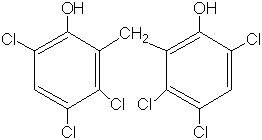
| Formula |
CAS |
| C13H6Cl6O2 |
70-30-4 |
Background
Hexachlorophene is used as a topical antiseptic. Because of potential neurotoxicity in humans, the FDA has regulated its use.
Synonyms2,2´-Methylenebis[3,4,6-trichlorophenol]
2,2´-Dihydroxy-3,3´,5,5´,6,6´-hexachlorodiphenylmethane
bis(3,5,6-trichloro-2-hydroxyphenyl)methane
AT-7
Bilevon
Dermadex
Exofene
G-11
Gamophen
Hexachlorophene
Hexosan
pHisohex
Surgi-Cen
Surofene
UsespHisoHex
Soaps, cleansers, shampoos, and shaving cream.
Cross-ReactionsBithionol
Halogenated salicylanilides
Unusual ReactionsPhotoallergy
Back to list of contact allergens
Referenties
| 1. |
Fisher, A.A., F. Pascher, and N.B.
Kanof, Allergic contact dermatitis due to ingredients of
vehicles. A "vehicle tray" for patch testing. Archives of
Dermatology, 1971. 104(3): p. 286-90. |
| 2. |
Wilkinson, D.S. and E. Cronin, Contact
dermatitis XIX. British Journal of Dermatology, 1972. 87(4): p.
400-2. |
| 3. |
Iden, D.L. and A.L. Schroeter, The
vehicle tray revisited: the use of the vehicle tray in assessing
allergic contact dermatitis by a 24-hour application method.
Contact Dermatitis, 1977. 3(3): p. 122-6. |
| 4. |
Wilkinson, D.S., Hexachlorophene bath
hazard [letter]. Contact Dermatitis, 1978. 4(3): p. 172. |
| 5. |
Kaidbey, K.H. and A.M. Kligman,
Photomaximization test for identifying photoallergic contact
sensitizers. Contact Dermatitis, 1980. 6(3): p. 161-9. |
Author(s):Allergology: background information on allergens.
 ICD10: L23.9