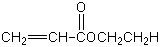
 Background
Ethyl acrylate is a liquid acrylic monomer with a penetrating, acrid odor. It polymerizes to form an odorless, transparent, elastic substance.
Koppula et al suggested that ethyl acrylate be used as screening allergen for acrylate dermatitis with ethylene glycol dimethacrylate, 2-hydroxyethyl acrylate, ethyl a cyanoacrylate, and triethylene glycol diacrylate. These investigators felt that a common carboxy ethyl group was requisite but not essential for alllergenicity. They found that ethyl acrylate was positive in 91% of nail-acrylate-allergic patients and in 72% of total acrylate-allergic patients. They stated that it would make a reasonable single-screening allergen for acrylate sensitivity.
SynonymsEthyl acrylate
UsesAdhesives
Aircraft and automobile industry
Cosmetics (nail mending kits)
Electronic industry - circuit boards
Leather finish resins
Medicine (binding of tissue, sealing of wounds, ileostomy appliances)
Paint vehicles (water emulsion)
Paper and textile coatings
Perfume
Rubber
Cross-ReactionsUnusual Reactions
Back to list of contact allergens
Referenties
| 1. |
Kanerva, L., T. Estlander, and R.
Jolanki, Sensitization to patch test acrylates. Contact
Dermatitis, 1988. 18(1): p. 10-5. |
| 2. |
Kanerva, L., et al., Statistics of
allergic patch test reactions caused by acrylate compounds,
including data on ethyl methacrylate. American Journal of
Contact Dermatitis, 1995. 6(2): p. 75-77. |
| 3. |
Koppula, S., J. Fellman, and F. Storrs,
Screening allergens for acrylate dermatitis associated with
artificial nails. American Journal of Contact Dermatitis, 1995.
6(2): p. 78-85. |
Author(s):Allergology: background information on allergens.
 ICD10: L23.9