 Background
Chrysanthemum cinerariaefolium is a compositae plant that grows on rocky ground in Europe, Australia, Japan, and North America. It is a tufted perennial with silvery-grey silky leaves and a solitary 3 to 4 cm white flower. It is the main source of the pyrethrum insecticides which are still used for organic gardening. The pyrethrins (i.e., permethrin) have insecticide activity are prepared synthetically and are chemically unrelated to pyrethrum.
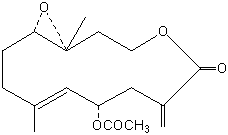
The principle allergen is the sesquiterpene lactone, pyrethrosin.
SynonymsChrysanthemum cinerariaefolium
Compositae
Pyrethrum
Tanacetum cinerariifolium
Pyrethrosin
UsesPlant
Pesticide (organic)
Cross-ReactionsUnusual ReactionsImmunologic contact urticaria
Back to list of contact allergens
Referenties
| 1. |
Mitchell JC, Dupuis G, Towers GH.
Allergic contact dermatitis from pyrethrum (Chrysanthemum spp.).
The roles of pyrethrosin, a sesquiterpene lactone, and of
pyrethrin II. British Journal of Dermatology 1972;86(6):568-573. |
| 2. |
Lovell CR. Plants and the Skin. 1993,
London: Blackwell Scientific Publications. |
Author(s):Allergology: background information on allergens.
 ICD10: L23.9