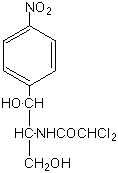
| Formula |
CAS |
| C11H12Cl2N2O5 |
56-75-7 |
Background
Chloramphenicol is a broad spectrum antibiotic produced by Streptomyces venezuelae.
SynonymsChloramphenicol
2,2-Dichloro-N-[2-hydroxy-1-(hydroxymethyl)-2-(4-nitrophenyl)ethyl]acetamide
D-threo-N-dichloroacetyl-1-p-nitrophenyl-2-amino-1,3-propane-diol
D(‹)-threo-2-dichloroacetamido-1-p-nitrophenyl-propanediol
D-threo-N-(1,1´-dihydroxy-1-p-nitrophenylisopropyl)dichloroacetamide
UsesAntibotic and antirickettsial
Eye drops and ointments
Bactericide for vegetables (rot of potatoes and other root vegetables)
Cross-ReactionsAzidamfenicol
Unusual Reactions
Back to list of contact allergens
Referenties
| 1. |
Strick
RA. Lack of cross-reaction between DNCB and chloramphenicol. Contact Dermatitis 1983;9(6):484-487. |
| 2. |
Rebandel P, Rudzki
E. Occupational contact sensitivity in oculists. Contact Dermatitis 1986;15(2):92. |
| 3. |
van Joost T, Dikland W, Stolz E, Prens E. Sensitization to chloramphenicol; a persistent problem. Contact Dermatitis 1986;14(3):176-178. |
| 4. |
Kubo Y, Nonaka S, Yoshida H. Contact sensitivity to chloramphenicol. Contact Dermatitis 1987;17(4):245-247. |
| 5. |
Goh CL. Contact sensitivity to topical antimicrobials. (II). Sensitizing potentials of some topical antimicrobials. Contact Dermatitis 1989;21(3):166-171. |
| 6. |
Vincenzi C. et al. Contact dermatitis from chloramphenicol in a leg ulcer cream. Contact Dermatitis 1991;25(1):64-65. |
| 7. |
Urrutia I. et al. Sensitization to chloramphenicol. Contact Dermatitis 1992;26(1):66-67. |
Author(s):Allergology: background information on allergens.
 ICD10: L23.9